

📢 Disclosure: This post contains affiliate links. We may earn a commission at no extra cost to you. We only recommend products we genuinely believe in.
What is compound interest? Compound interest is the process of earning interest on both your original principal and the interest you have already earned — meaning your money grows faster and faster over time. Understanding what is compound interest is one of the most important financial concepts you can learn, because compound interest is the engine behind every long-term savings account, investment portfolio, and retirement fund. This complete guide on what is compound interest explains how it works, shows you real examples, and reveals exactly why starting early makes such a dramatic difference.
What Is Compound Interest — The Simple Definition
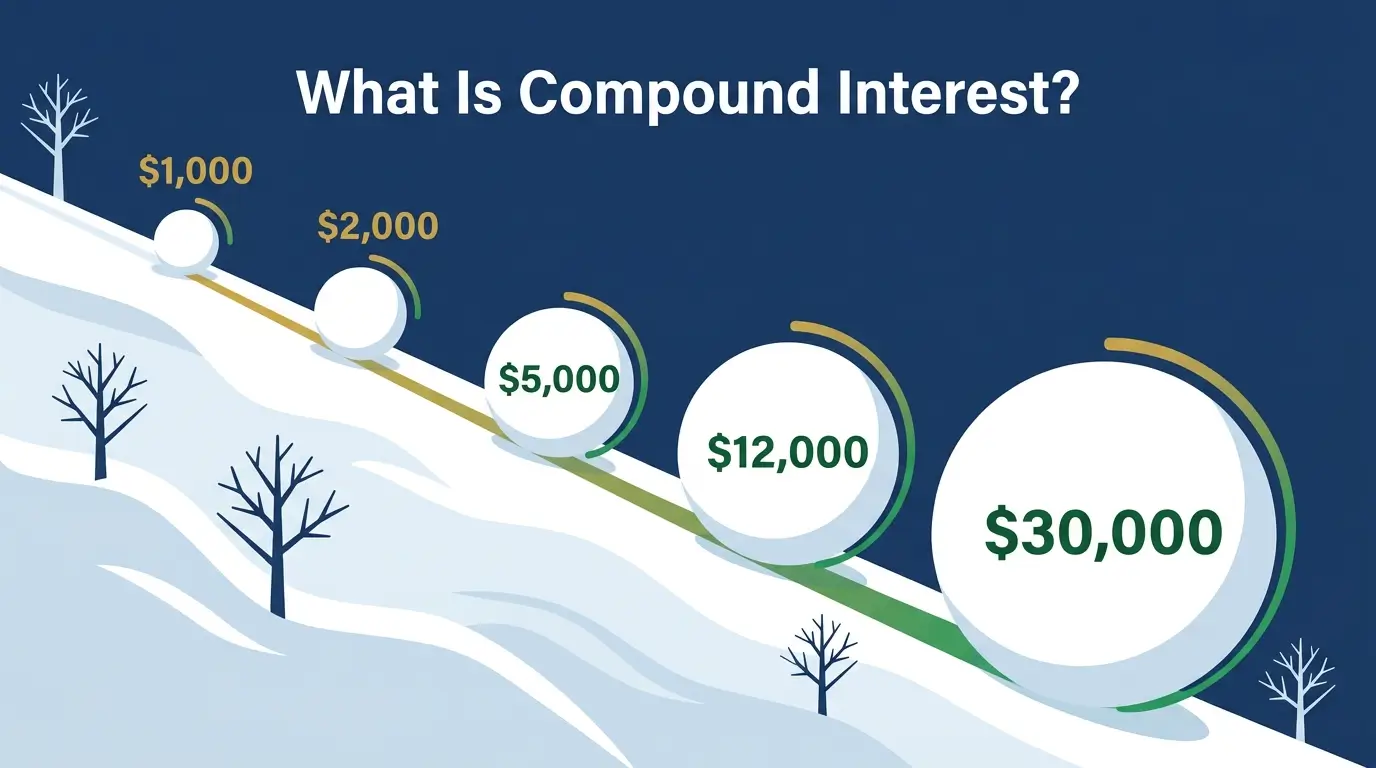
Compound interest is interest calculated on the initial principal and also on the accumulated interest from previous periods. In plain English: you earn interest on your interest. This creates a snowball effect — the longer your money sits and grows, the faster it accumulates.
Compare these two scenarios to see what is compound interest in action:
- You deposit $10,000 at 7% interest. After year 1, you earn $700 in interest — total: $10,700.
- In year 2, you earn 7% on $10,700 (not just $10,000) — that is $749 in interest. Total: $11,449.
- In year 3, you earn 7% on $11,449 — that is $801. Total: $12,250.
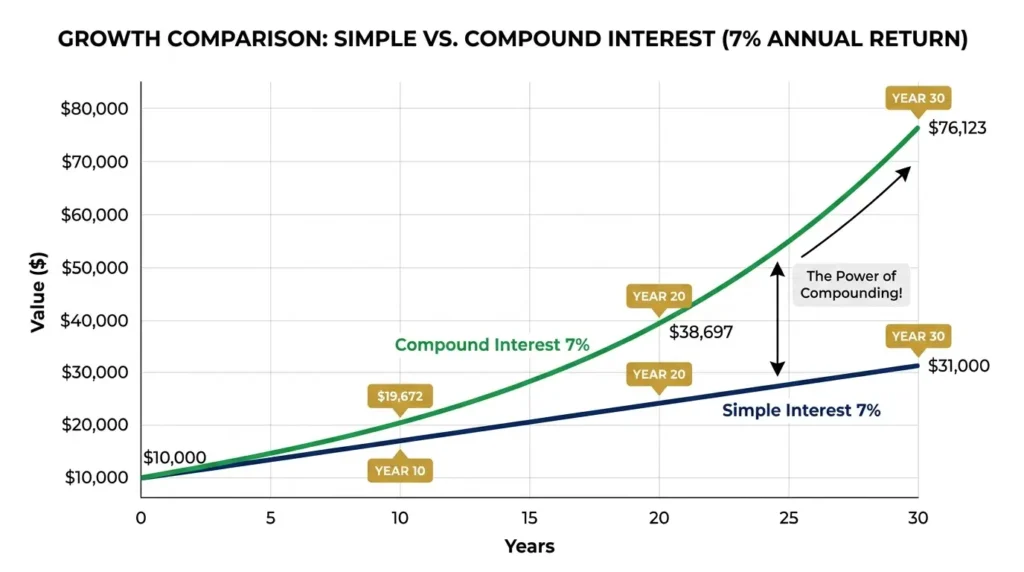
- By year 30, that original $10,000 has grown to over $76,000 — with no additional contributions.
That growth from $10,000 to $76,000 without adding a single extra dollar is what is compound interest working at full power. The interest you earned in year 1 earned its own interest in year 2 — and so on for 30 years.
Compound Interest vs Simple Interest
To fully understand what is compound interest, it helps to compare it to simple interest:
- Simple interest is calculated only on the original principal. $10,000 at 7% simple interest earns exactly $700 every single year — forever. After 30 years: $31,000 total.
- Compound interest is calculated on the principal plus all accumulated interest. $10,000 at 7% compound interest grows to $76,123 after 30 years.
| Year | Simple Interest (7%) | Compound Interest (7%) | Difference |
|---|---|---|---|
| 1 | $10,700 | $10,700 | $0 |
| 5 | $13,500 | $14,026 | $526 |
| 10 | $17,000 | $19,672 | $2,672 |
| 20 | $24,000 | $38,697 | $14,697 |
| 30 | $31,000 | $76,123 | $45,123 |
After 30 years, compound interest produces $45,123 more than simple interest on the exact same $10,000 investment at the exact same 7% rate. This is why compound interest is called the eighth wonder of the world — and why understanding what is compound interest is so important for your financial future.
How Compound Interest Works: The Formula
The formula for compound interest is: A = P(1 + r/n)^(nt)
- A = the final amount (principal + interest)
- P = the principal (starting amount)
- r = annual interest rate (as a decimal)
- n = number of times interest is compounded per year
- t = time in years
Most savings accounts and investments compound interest either daily, monthly, or annually. The more frequently interest compounds, the faster your money grows. A 7% rate compounded daily produces slightly more than a 7% rate compounded annually — though the difference is small compared to the power of time itself.
Real Examples of Compound Interest
Here are concrete examples that show what is compound interest doing to real money at 7% annual return:
| Starting Amount | After 10 Years | After 20 Years | After 30 Years | After 40 Years |
|---|---|---|---|---|
| $1,000 | $1,967 | $3,870 | $7,612 | $14,974 |
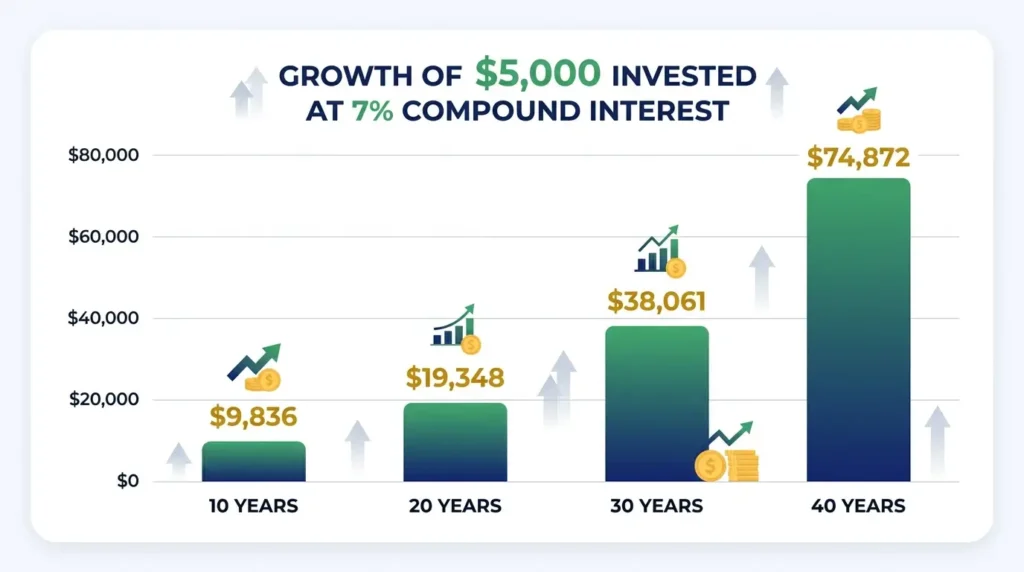
| $5,000 | $9,836 | $19,348 | $38,061 | $74,872 |
| $10,000 | $19,672 | $38,697 | $76,123 | $149,745 |
| $25,000 | $49,179 | $96,742 | $190,306 | $374,361 |
Notice what happens with $5,000 over 40 years — it grows to nearly $75,000 without a single additional contribution. What is compound interest? It is your money making money, which makes more money, for decades. The longer the time horizon, the more dramatic the results become.
The Power of Starting Early
The most important lesson in understanding what is compound interest is this: time is the most powerful variable. Starting early beats investing more money later. Here is a comparison that makes this crystal clear:
| Investor | Starts Investing | Monthly Amount | Stops At | Total Contributed | Portfolio at 65 |
|---|---|---|---|---|---|
| Early Emily | Age 22 | $200/month | Age 32 (10 years) | $24,000 | $348,000 |
| Late Larry | Age 32 | $200/month | Age 65 (33 years) | $79,200 | $272,000 |
Early Emily invests for only 10 years but ends up with $76,000 more than Late Larry who invests for 33 years. She contributed $55,200 less and still came out ahead. That is what is compound interest doing when time is maximized. The conclusion is simple: the best time to start is now — not when you have more money.
The Rule of 72
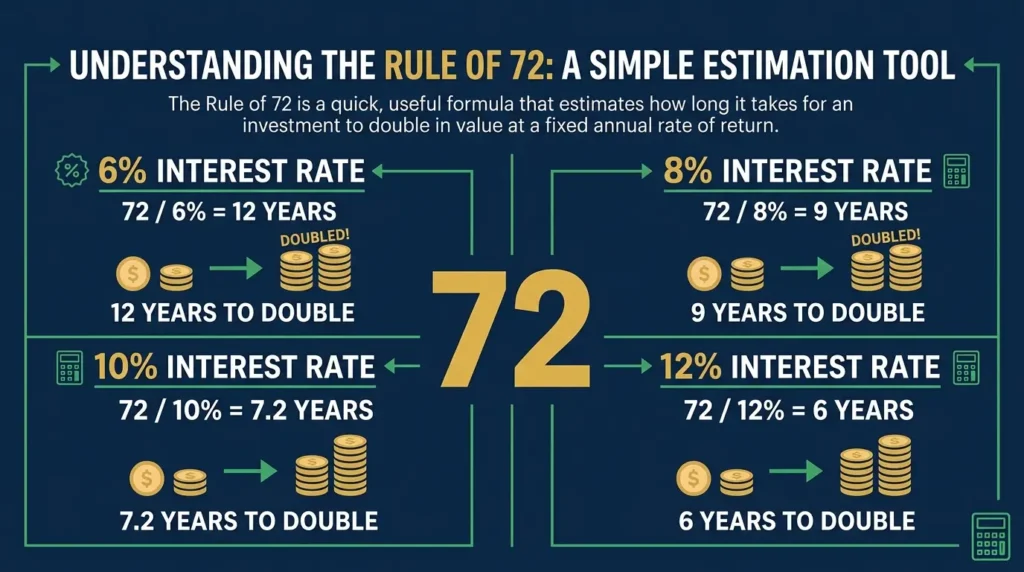
The Rule of 72 is a quick mental math shortcut to estimate how long it takes compound interest to double your money. Divide 72 by your annual interest rate to get the approximate number of years it takes to double:
- 6% return: 72 / 6 = 12 years to double
- 8% return: 72 / 8 = 9 years to double
- 10% return: 72 / 10 = 7.2 years to double
- 12% return: 72 / 12 = 6 years to double
At 7% (the historical average return of the S&P 500 after inflation), your money doubles approximately every 10.3 years. If you invest $10,000 at age 25 and earn 7% compound interest, it becomes $20,000 by 35, $40,000 by 45, $80,000 by 55, and $160,000 by 65 — without adding another dollar.
Where Compound Interest Works For You
Compound interest works in your favor in these accounts and investments:
- High-yield savings accounts — compound interest on your cash savings at 4%–5.25% APY. See our guide on the best high-yield savings accounts 2026.
- Roth IRA — compound interest grows tax-free inside this retirement account. Read our guide on what a Roth IRA is.
- 401(k) — employer-sponsored retirement accounts use compound interest over decades. Learn more in our guide on what a 401(k) is.
- Index funds and ETFs — compound interest on stock market returns, historically averaging 7–10% annually. See our guide on how to start investing with $100.
Where Compound Interest Works Against You
Compound interest is not always your friend. When you carry debt, compound interest works against you at a much faster rate than it works in your favor on savings:
- Credit card debt at 24% APR — a $5,000 balance grows to $9,985 in just 3 years if you make no payments
- Payday loans — compound interest at 300%–400% APR can trap borrowers in an impossible debt spiral
- Personal loans with high rates — above 20% APR, compound interest makes debt very expensive to carry
This is why paying off high-interest debt is mathematically equivalent to earning a guaranteed return equal to the interest rate. Paying off a 24% credit card is a guaranteed 24% return — better than any investment. Always eliminate high-interest debt before prioritizing additional investing.
How to Make Compound Interest Work for You
- Start as early as possible — time is the most powerful ingredient of compound interest
- Invest consistently every month — read our guide on dollar-cost averaging for the ideal strategy
- Keep your savings in high-yield accounts — earn compound interest on your cash
- Reinvest dividends — never take investment earnings as cash; let them compound
- Avoid withdrawing early — every early withdrawal resets your compound interest clock
- Minimize fees — a 1% fund fee reduces your compound returns by tens of thousands of dollars over 30 years
Frequently Asked Questions
What is compound interest in simple terms?
Compound interest is earning interest on your interest. When you deposit $1,000 and earn 10% interest, you have $1,100. The next year, you earn 10% on $1,100 — not just $1,000 — so you earn $110 instead of $100. Over time, this snowball effect causes your money to grow exponentially faster than simple interest.
What is the difference between compound interest and simple interest?
Simple interest is calculated only on the original principal — the same dollar amount each period. Compound interest is calculated on the principal plus all previously earned interest. Over long periods, compound interest produces dramatically more growth. On a $10,000 investment at 7% over 30 years, compound interest produces $76,123 versus $31,000 with simple interest.
How often does compound interest compound?
It depends on the account. High-yield savings accounts typically compound daily or monthly. Investment accounts compound as dividends and returns are reinvested. The more frequently interest compounds, the slightly faster money grows — though the most important factor is always the time invested, not the compounding frequency.
What is the Rule of 72 in compound interest?
The Rule of 72 is a quick formula to estimate how long it takes compound interest to double your money. Divide 72 by your annual interest rate. At 8% annual return, your money doubles in approximately 9 years (72 ÷ 8 = 9). At 6%, it takes 12 years. At 10%, about 7.2 years.
Is compound interest good or bad?
Compound interest is good when it works for you — in savings accounts, Roth IRAs, 401(k)s, and index funds. It is bad when it works against you — in credit card debt, payday loans, and high-interest personal loans. The key is to maximize compound interest on your savings and investments while eliminating any debt where compound interest is working against you.
Final Thoughts: What Is Compound Interest and Why It Changes Everything
What is compound interest? It is the single most powerful force in personal finance — the mechanism that turns small, consistent savings into life-changing wealth over time. The earlier you understand what is compound interest and put it to work, the more time you give it to build momentum. Even small amounts invested consistently for decades can grow into substantial wealth through compound interest alone.
Start today. Open a Roth IRA or high-yield savings account, invest your first dollar, and let compound interest do the heavy lifting for the next 20, 30, or 40 years. Your future self will thank you for understanding what is compound interest — and acting on that knowledge now.