

📢 Disclosure: This post contains affiliate links. We may earn a commission at no extra cost to you. We only recommend products we genuinely believe in.
A high-yield savings account can help your cash earn substantially more interest than a traditional savings account while keeping your money accessible.
As of October 2026, competitive high-yield savings accounts continue to offer APYs well above standard savings rates. However, the highest advertised APY is not necessarily the best account for every saver because rates may be promotional, conditional, tiered or limited to certain balances.
This guide explains how to compare the best high-yield savings accounts in 2026, including APYs, fees, minimum deposits and account requirements.
Rates checked: October 7, 2026. Savings APYs are variable and can change at any time. Always verify the current rate and account terms directly with the financial institution before opening an account.
If you want to understand how rates translate into actual earnings, start with our guide to what APY means for savings.
What Is a High-Yield Savings Account?
A high-yield savings account, or HYSA, is a savings account that generally pays a higher APY than a typical savings account.
Like other savings accounts, HYSAs offered by FDIC-insured banks are eligible for federal deposit insurance within applicable limits and ownership categories.
Many high-yield accounts are offered by online banks, although traditional financial institutions may offer them as well.
The primary attraction is simple: your cash earns interest while remaining relatively accessible.
High-Yield Savings Account Rates in October 2026
Savings rates have changed substantially from the figures previously shown in this article.
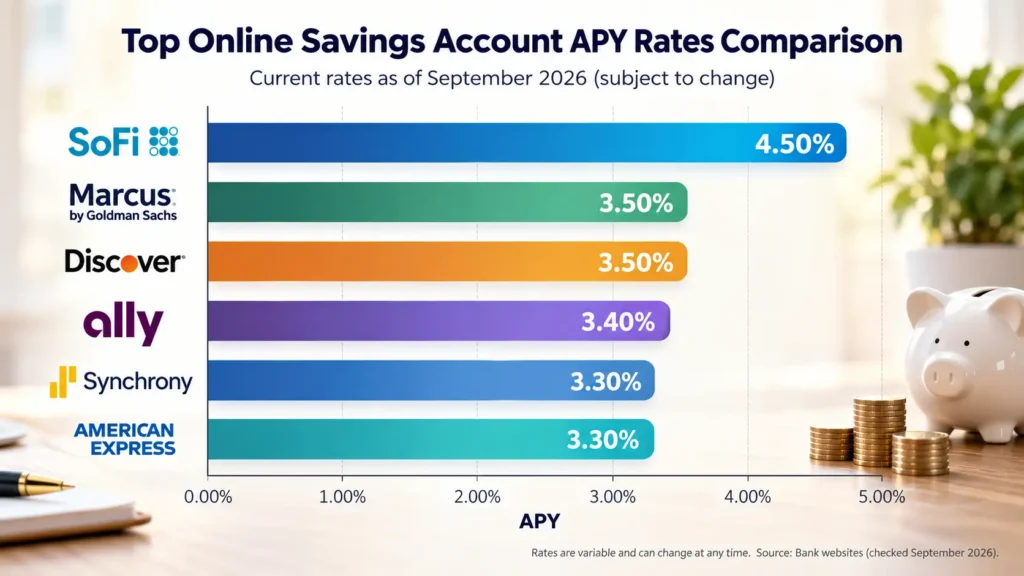
As of October 7, 2026, advertised rates vary widely by product and eligibility. Marcus lists 3.50% APY on its Online Savings Account, while SoFi lists a standard qualifying savings APY of 3.30% and promotional or membership-based rates that can be higher under specific conditions.
The gap between competitive online savings products and typical savings rates remains meaningful, but the exact difference changes as banks update APYs. Compare the current rate, qualification rules and fees rather than relying on a single market-wide headline.
This difference is why comparing rates can matter—but APY shouldn’t be the only factor you consider.
High-Yield Savings Accounts to Compare in 2026
Rather than treating one bank as permanently the “best,” compare the combination of APY, requirements, fees and features that fits your situation.
Marcus by Goldman Sachs Online Savings
Marcus is worth considering for savers who prioritize simplicity.
As of October 7, 2026, its Online Savings Account offers 3.50% APY, with no minimum deposit and no account fees. Marcus states that the APY is variable and can change before or after the account is opened. Marcus
Current APY: 3.50%
Minimum deposit: $0
Fees: No account fees
Rate type: Variable
Marcus also reports that interest compounds daily. Marcus
SoFi Checking and Savings
SoFi requires a little more attention because its APY depends on how you qualify.
SoFi currently lists 3.30% APY on savings for customers who meet its high-yield qualification through eligible direct deposit or qualifying deposits. Customers who do not meet those requirements earn a lower standard APY. SoFi
SoFi Plus introduces another tier: eligible subscribers can earn 4.50% APY on qualifying savings balances up to $20,000, with additional conditions applying. New eligible SoFi Checking and Savings members may also qualify for a limited-time APY boost under separate promotional terms. SoFi
Standard qualifying APY: 3.30%
SoFi Plus qualifying APY: up to 4.50% on eligible balances
Minimum balance: No minimum balance requirement
Monthly account fees: None for SoFi Checking and Savings
The important lesson here is that an advertised maximum APY may not apply to every customer or every dollar deposited.
American Express High Yield Savings
American Express offers a High Yield Savings Account with no minimum balance required to open the account, avoid a fee or obtain the disclosed APY. Its rate is variable and may change after the account is opened. American Express
This can make it worth comparing for savers who value straightforward balance requirements.
Before opening the account, check American Express directly for the current APY because the rate is variable.
Synchrony High Yield Savings
Synchrony is another established option to compare when shopping for a high-yield savings account.
Synchrony states that its HYSA APY is variable and that published APYs are subject to change without notice. Its High Yield Savings account has no minimum balance and its deposit accounts are FDIC-insured within applicable limits. Synchrony
Check the current rate immediately before opening the account.
Don’t Choose an HYSA Based Only on APY
Suppose one account advertises 4.50% APY but requires a subscription, qualifying activity or limits the highest APY to part of your balance.
Another account might offer a lower APY without those requirements.
The account with the largest number isn’t automatically the most appropriate account for your circumstances.
Compare:
- FDIC insurance
- Current APY
- Conditions required to earn it
- Minimum opening deposit
- Minimum ongoing balance
- Monthly fees
- Transfer options
- Withdrawal access
- Mobile and online banking
What to Look for in a High-Yield Savings Account
Competitive APY
APY tells you how much your deposit can earn over a year when compounding is taken into account.
But savings APYs are generally variable.
A bank offering a highly competitive rate today can lower it later.
Fees
Monthly maintenance fees can reduce the benefit of a higher APY.
Look at the entire fee schedule rather than focusing exclusively on the headline rate.
Minimum Deposit and Balance Requirements
Some accounts have no minimum deposit.
Others require a certain deposit or balance to qualify for their advertised APY.
This becomes especially important when an account uses tiered rates.
Conditions for the Highest APY
Check whether the advertised rate requires:
- Direct deposit
- Recurring deposits
- A paid membership
- A linked checking account
- A minimum balance
- A maximum qualifying balance
SoFi is a good example of why this matters: different qualification methods, promotions and membership tiers can produce different APYs. SoFi
FDIC Insurance
For a deposit account at an FDIC-insured bank, the standard FDIC insurance amount is $250,000 per depositor, per insured bank, for each account ownership category.
If you’re depositing substantial savings, understand how the ownership category and total deposits you hold at the same insured bank affect your coverage.
High-Yield Savings Account vs. Money Market Account
These products have substantial overlap.
Both can offer competitive variable interest rates while keeping cash relatively accessible.
A money market account may additionally offer features such as check-writing or debit-card access, depending on the institution.
If you’re unfamiliar with MMAs, read what a money market account is.
And if you’re comparing actual accounts rather than learning how they work, see our best money market accounts of 2026.
Don’t assume that an HYSA always pays more than a money market account. Compare the current APYs and requirements of the specific products you’re considering.
High-Yield Savings Account vs. CD
A HYSA generally provides more liquidity.
Its APY is variable, however, so the bank can change it.
A certificate of deposit typically offers a stated rate for a defined term. In exchange, you generally agree to leave your deposit in the CD until maturity, and withdrawing principal early may result in a penalty.
If you won’t need part of your savings for a specific period, compare both options.
Our guide explaining what a CD account is covers this product in more detail.
How Much Can You Earn in a High-Yield Savings Account?
The amount depends on three main variables:
Your balance + APY + time.
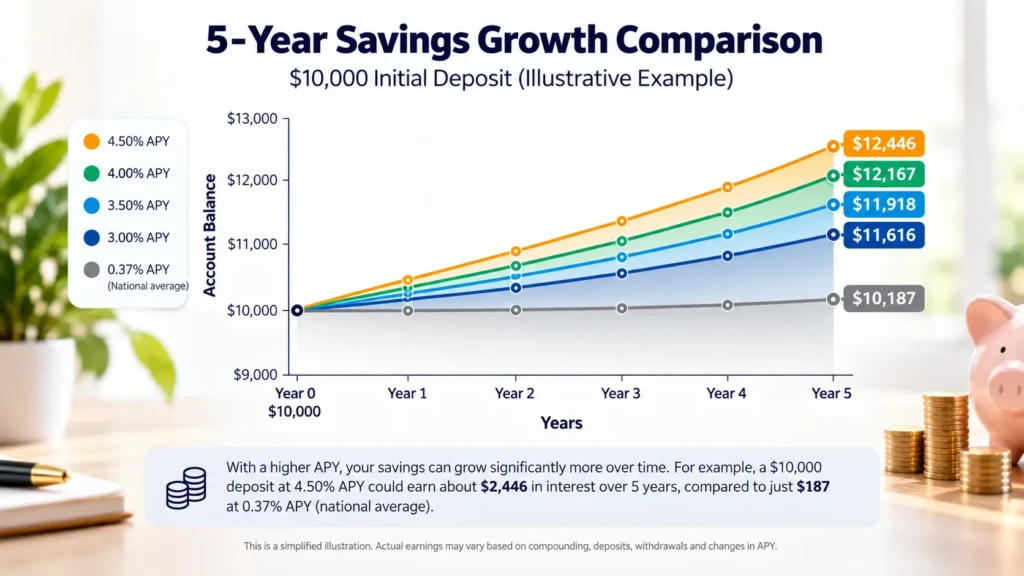
For illustration, if $10,000 remained in an account for approximately one year:
| APY | Approximate interest* |
|---|---|
| 0.37% | $37 |
| 3.00% | $300 |
| 3.50% | $350 |
| 4.00% | $400 |
| 4.50% | $450 |
Simplified illustrations. Actual interest depends on compounding, deposits, withdrawals, rate changes and other account conditions.
The table also illustrates why moving savings from a very low-yield account to a competitive HYSA can make a meaningful difference.
Are High-Yield Savings Accounts Safe?
A HYSA is a deposit account, not a stock or mutual fund.
Eligible deposits at FDIC-insured banks receive federal deposit insurance within applicable coverage limits.
However, “safe” doesn’t mean that nothing can affect your money’s value.
Inflation can reduce purchasing power, account fees can reduce your balance, and variable APYs can fall.
That’s why it’s better to say an HYSA doesn’t expose your deposit to the same market-price fluctuations as stocks rather than describing it as completely “risk-free.”
Is a High-Yield Savings Account Good for an Emergency Fund?
An HYSA can be useful for emergency savings because it combines liquidity with interest earnings.
But accessibility matters.
Before choosing one for your emergency fund, check:
- Transfer speed
- Withdrawal methods
- Whether ATM access is available
- Transfer limits
- Account fees
- Minimum balance requirements
You may also want to keep some immediately accessible cash in your checking account while holding the larger portion of your emergency savings in an interest-bearing account.
Our guide on how to build an emergency fund explains the broader strategy.
How to Open a High-Yield Savings Account
Once you’ve compared accounts:
- Choose the account that fits your needs.
- Apply through the financial institution.
- Provide the identification and other information requested by the bank.
- Link an existing account if required.
- Fund the new savings account.
- Consider setting up recurring transfers.
- Periodically review your APY and account terms.
For more detail, see how to open a bank account online.

When a High-Yield Savings Account May Not Be the Right Choice
An HYSA is primarily a cash-savings tool.
It isn’t designed to replace a diversified long-term investment strategy.
For money you expect to need relatively soon, preserving liquidity may be important.
For money intended for retirement decades from now, the considerations are different because long-term investing involves different potential returns and risks.
If you’re just beginning to explore investing, our guide on how to start investing with $100 explains the basics.
Frequently Asked Questions
What is the best high-yield savings account in 2026?
There isn’t one account that’s best for every saver. Compare current APYs, qualification requirements, fees, minimum balances and access features. Rates are variable and can change frequently.
What are the best high-yield savings account rates right now?
As of October 7, 2026, current examples include Marcus at 3.50% APY and SoFi at 3.30% qualifying APY, while promotional or membership-based rates can be higher under specific conditions. Rates can change at any time, so verify the APY and requirements directly with each financial institution before applying. Fortune
Are high-yield savings accounts safe?
Eligible savings deposits at FDIC-insured banks receive federal deposit insurance within applicable limits. HYSAs don’t have the same market-price exposure as stocks or mutual funds, but inflation, fees and changing interest rates can still matter.
Can you lose money in a high-yield savings account?
A HYSA isn’t a market investment whose price fluctuates like a stock. Eligible deposits are protected within applicable FDIC insurance limits at insured banks. Fees can reduce an account balance, and inflation can reduce purchasing power.
Are high-yield savings account rates fixed?
Usually not. HYSA rates are generally variable, meaning the bank can increase or decrease the APY. Marcus, for example, explicitly states that its savings APY may change before or after an account is opened. Marcus
Is a high-yield savings account better than a money market account?
Neither is universally better. HYSAs focus primarily on savings, while some money market accounts provide additional access features such as checks or debit cards. Compare the actual APY, fees, balance requirements and access options.
Is high-yield savings account interest taxable?
Interest earned on a savings account is generally taxable income in the United States. The tax reporting requirements depend on the amount earned and your circumstances.
How many high-yield savings accounts can you have?
There is no general requirement to limit yourself to one HYSA. Some savers use separate accounts for different goals. If you hold substantial deposits, consider how FDIC coverage rules apply across accounts at the same insured institution.
Final Thoughts
The best high-yield savings account isn’t necessarily the account displaying the largest APY.
A strong account combines a competitive rate with manageable requirements, low fees, appropriate access to your cash and federal deposit insurance when applicable.
As of October 2026, competitive online savings accounts continue to offer meaningfully higher APYs than many traditional savings products, but rates are variable and account terms differ significantly. Recheck the bank’s current APY and qualification rules immediately before opening an account.
Compare the account’s current terms immediately before opening it—and continue checking your APY periodically after your account is open.
Financial Disclaimer: The information on SmartCentHub.com is for educational and informational purposes only. It does not constitute personalized financial, investment, tax or banking advice. Rates and account terms can change. Verify current information directly with the financial institution before opening an account.