

📢 Disclosure: This post contains affiliate links. We may earn a commission at no extra cost to you. We only recommend products we genuinely believe in.
Learning how to start investing with $100 is one of the smartest financial moves a beginner can make. You don’t need a financial advisor, a finance degree, or thousands of dollars sitting in a savings account. In 2026, fractional shares, commission-free brokerages, and low-cost index funds have made $100 genuinely enough to start building real, lasting wealth.
This guide gives you the exact steps — from choosing an account to making your first purchase — so you can go from zero to investor today.
Before You Invest Your First $100
Investing is powerful — but only when the financial foundation beneath it is solid. Before you put $100 into the market, make sure these boxes are checked:
- You have a $1,000 emergency fund — investing money you might need in 3 months is a mistake. If the market drops 20% right when your car breaks down, you’ll be forced to sell at a loss. Read our guide on how to build an emergency fund first.
- You have no high-interest debt — paying off a 24% APR credit card is a guaranteed 24% return. No investment reliably beats that. Pay off high-interest debt before investing.
- You’re capturing your 401(k) match. If your employer matches contributions, that’s a 50–100% instant return on your money. Always capture the full match before investing elsewhere. Learn more in our guide on what is a 401(k).
If all three boxes are checked — you’re ready. Let’s invest your $100.
Best Ways to Invest $100 as a Beginner
The best investments for beginners share three qualities: low cost, broad diversification, and simplicity. Here are the top options:
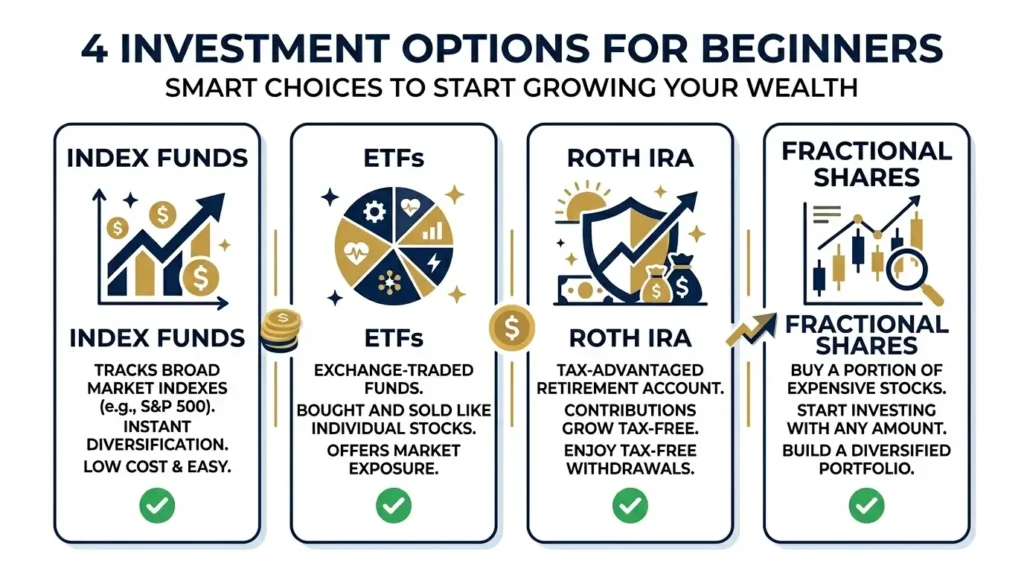
1. Index Funds — Best Overall for Beginners
An index fund is a type of investment that tracks a market index — like the S&P 500, which includes the 500 largest U.S. companies. Instead of picking individual stocks, you own a tiny piece of hundreds of companies at once. This instant diversification reduces risk dramatically.
- Average annual return: ~7–10% historically (S&P 500)
- Minimum investment: As low as $1 with fractional shares
- Fees: Extremely low (0.03%–0.20% expense ratio)
- Best for: Long-term wealth building, retirement savings
- Risk level: Medium — value fluctuates with the market
2. ETFs (Exchange-Traded Funds) — Best for Flexibility
ETFs (exchange-traded funds) are similar to index funds but trade throughout the day like individual stocks. They offer the same diversification benefits with added flexibility. Many beginner-friendly ETFs track the total US stock market or the S&P 500 and can be purchased with $1 via fractional shares. Read our full guide on what is an ETF to understand the difference.
- Average annual return: ~7–10% (broad market ETFs)
- Minimum investment: $1 with fractional shares
- Fees: Very low (0.03%–0.15%)
- Best for: Beginners who want flexibility and low costs
- Risk level: Medium
3. Roth IRA — Best for Tax-Free Growth
A Roth IRA is not an investment itself — it’s a tax-advantaged account you open and then invest inside. Contributions are made with after-tax dollars, but all growth and withdrawals in retirement are completely tax-free. For most beginners under 50, this is the single best place to invest your first $100.
- 2026 contribution limit: $7,500/year (under 50)
- Tax benefit: Tax-free growth and withdrawals in retirement
- Minimum investment: $0 at most online brokerages
- Best for: Long-term retirement savings, beginners with earned income
- Risk level: Depends on what you invest in inside the account
Read our complete guide on what is a Roth IRA for everything you need to know.
4. Fractional Shares — Best for Stock Market Access
Many well-known companies have share prices of $300, $500, or even $3,000+. Fractional shares let you buy a portion of one share for as little as $1. This means you can invest in any company in the market with $100 — without needing to afford a full share.
- Minimum investment: $1
- Best for: Beginners who want exposure to specific companies
- Risk level: Higher than index funds — individual stocks are volatile
- Note: Best used as a small portion of a diversified portfolio, not the whole thing
Investment Options Compared
| Investment Type | Min. Amount | Avg. Return | Risk Level | Best Account | Best For |
|---|---|---|---|---|---|
| Index Funds | $1 | 7–10%/yr | Medium | Roth IRA / Brokerage | Long-term wealth |
| ETFs | $1 | 7–10%/yr | Medium | Roth IRA / Brokerage | Flexible diversification |
| Roth IRA | $0 | Varies | Varies | IS the account | Tax-free retirement |
| Fractional Shares | $1 | Varies | Higher | Brokerage | Specific companies |
| High-Yield Savings | $0 | 4–5% | None | HYSA | Short-term / emergency |
Your First $100 Portfolio — Exactly What to Buy
If you’re not sure where to start, here’s a simple, proven first portfolio that requires zero stock-picking and minimal ongoing attention:
Option A — The One-Fund Portfolio (simplest)
- 100% in VTI (Vanguard Total Stock Market ETF) or FZROX (Fidelity Zero Total Market)
- Instant exposure to every publicly traded US company
- Expense ratio: 0.03% (VTI) or 0.00% (FZROX)
Option B — The Two-Fund Portfolio (slightly more diversified)
- 80% in VTI (US total market)
- 20% in VXUS (international stocks)
- Covers virtually the entire global stock market
Option C — The Target-Date Fund (most hands-off)
- 100% in a Target-Date 2055 or 2060 fund (e.g., Vanguard Target Retirement 2055)
- Automatically adjusts risk as you approach retirement
- Zero ongoing decisions required
All three options are low-cost, fully diversified, and appropriate for a $100 starting investment. Choose the one that matches your preference for simplicity vs. control.
Best Apps to Invest $100 in 2026
Choosing the right platform matters — especially as a beginner. Here are the top options based on ease of use, fees, and features:
| Platform | Best For | Account Min. | Fractional Shares | Standout Feature |
|---|---|---|---|---|
| Fidelity | Overall best for beginners | $0 | Yes ($1 min) | Zero-fee index funds (FZROX, FZILX) |
| Charles Schwab | Research + simplicity | $0 | Yes ($5 min) | Excellent customer service |
| Vanguard | Long-term index investing | $0 | Yes | Home of the index fund |
| Robinhood | Mobile-first beginners | $0 | Yes ($1 min) | Clean, simple interface |
| Public | Social + beginner learning | $0 | Yes ($1 min) | Community features |
For most beginners opening their first Roth IRA or brokerage account, Fidelity is the top choice — no account minimum, zero-fee index funds, fractional shares from $1, and one of the best beginner interfaces available. See our full guide on the best investment apps for beginners for a deeper comparison.
How $100/Month Grows Over Time
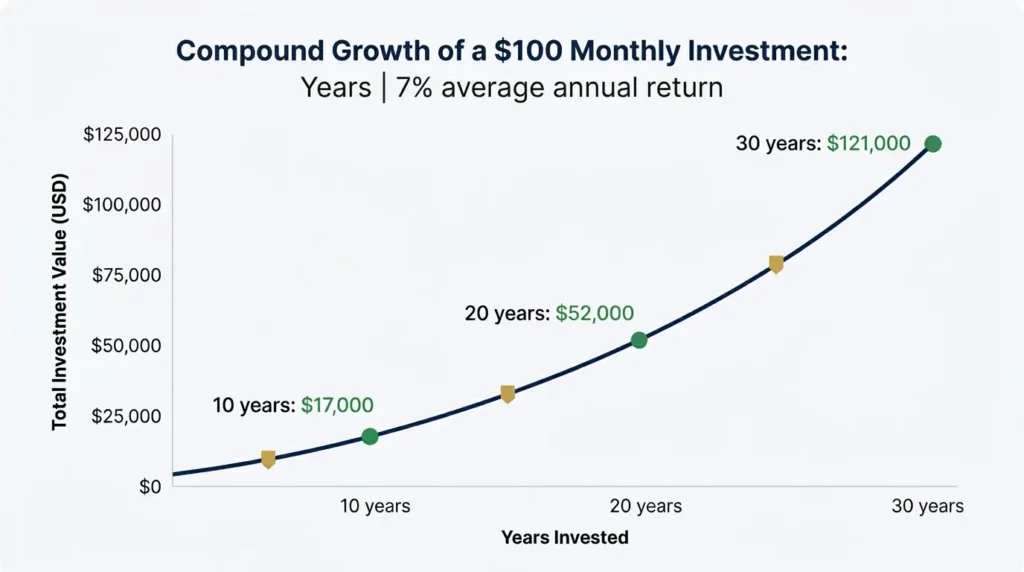
The most powerful force in investing is time — not the amount you start with. Here’s what happens when you invest just $100 per month at a 7% average annual return (historical S&P 500 average after inflation):
| Years Invested | Total Contributed | Portfolio Value | Gains from Compounding |
|---|---|---|---|
| 5 years | $6,000 | $7,159 | $1,159 |
| 10 years | $12,000 | $17,308 | $5,308 |
| 20 years | $24,000 | $52,093 | $28,093 |
| 30 years | $36,000 | $121,997 | $85,997 |
| 40 years | $48,000 | $262,481 | $214,481 |
Starting at 25 and investing $100/month until 65 turns $48,000 of contributions into over $262,000 — with more than $214,000 coming purely from compound growth. This is why starting early matters far more than the amount you start with.
To understand the strategy behind consistent monthly investing, read our guide on dollar-cost averaging.
Step-by-Step: How to Make Your First Investment
Here is exactly how to start investing with $100 today, from zero to your first investment:
- Choose where to invest . For most beginners, open a Roth IRA if you have earned income. If you’ve already maxed your Roth IRA or don’t qualify, open a taxable brokerage account.
- Pick a brokerage. Look for commission-free trading, no account minimums, fractional shares support, and a beginner-friendly app. Popular options include Fidelity, Charles Schwab, and Vanguard.
- Open your account. The process takes 10–15 minutes. You’ll need your Social Security number, bank account details, and basic personal information.
- Fund your account. Transfer your $100 from your bank account. Most brokerages process transfers in 1–3 business days.
- Choose your investment. For most beginners, a total market index fund or S&P 500 ETF is the best starting point. Simple, diversified, and low-cost.
- Buy your investment. Enter the fund name or ticker symbol, enter your dollar amount ($100), and confirm. You’re now an investor.
- Set up automatic monthly contributions. Even $50 or $100/month automated makes a dramatic difference over time. Set it and forget it.
Common Beginner Investing Mistakes to Avoid
- Trying to time the market. No one consistently predicts market movements — not professionals, not algorithms. The best strategy is to invest regularly regardless of what the market is doing. Read our dollar-cost averaging guide to understand why.
- Selling when the market drops. Market downturns are normal and temporary. Selling locks in your losses. Long-term investors who stay the course always recover.
- Picking individual stocks as a beginner. Individual stocks are volatile and require deep research. Start with diversified index funds and add individual stocks later if you choose.
- Waiting until you have “enough” to invest. There is no minimum threshold. $100 today is worth more than $1,000 in 5 years because of compound growth.
- Ignoring fees. A 1% annual fee on a $10,000 portfolio costs you $100/year — and far more over decades through lost compounding. Stick to low-cost index funds with expense ratios below 0.20%.
- Investing your emergency fund. Money you might need in the next 1–2 years belongs in a high-yield savings account, not the stock market.
The Right Order: Where $100 Should Go First
If you’re deciding between several financial priorities, here’s the optimal order for your money:
| Priority | Action | Why |
|---|---|---|
| 1st | $1,000 emergency fund | Prevents going into debt for surprises |
| 2nd | 401(k) up to employer match | 50–100% instant return |
| 3rd | Pay off high-interest debt | Guaranteed return equal to interest rate |
| 4th | Roth IRA ($100/month) | Tax-free compound growth |
| 5th | Full emergency fund (3–6 months) | Complete financial safety net |
| 6th | Taxable brokerage account | No limits, maximum flexibility |
Frequently Asked Questions
Can I really start investing with just $100?
Yes. In 2026, most major brokerages have no minimum account balance and offer fractional shares starting at $1. You can open a Roth IRA or brokerage account, deposit $100, and buy a slice of an S&P 500 index fund the same day. The amount matters less than starting early and investing consistently.
What is the best investment for a beginner with $100?
The best investment for most beginners is a low-cost S&P 500 index fund or total market ETF inside a Roth IRA. This gives you instant diversification across hundreds of companies, extremely low fees (under 0.10%), and tax-free growth for retirement. It requires no investment expertise to maintain.
Should I pay off debt before investing?
It depends on the interest rate. High-interest debt (credit cards at 20%+) should be paid off before investing — no investment reliably beats a 20%+ guaranteed return. Low-interest debt (student loans at 4–6%) can be paid alongside investing. Always capture your 401(k) employer match first, regardless of debt.
How much money can I make investing $100/month?
At a 7% average annual return, $100/month grows to approximately $17,000 in 10 years, $52,000 in 20 years, and $122,000 in 30 years. The longer you invest, the more compound growth does the heavy lifting—most of the final balance comes from growth, not your contributions.
Is it safe to invest $100 in the stock market?
The stock market always carries some risk — your balance will go up and down. However, broad index funds historically recover from every downturn and have returned ~7–10% annually over the long term. The key is investing money you won’t need for at least 5 years and staying invested through market dips.
What’s the difference between a Roth IRA and a brokerage account?
A Roth IRA is a tax-advantaged retirement account—contributions grow tax-free and qualified withdrawals in retirement are also tax-free, but there are annual contribution limits ($7,000 in 2026) and early withdrawal rules. A taxable brokerage account has no contribution limits and no withdrawal restrictions, but you pay taxes on gains. Start with the Roth IRA, then add a brokerage account once you’ve maxed it.
Can I invest $100 and withdraw it anytime?
In a taxable brokerage account, yes — you can withdraw at any time, though you may owe capital gains tax on profits. In a Roth IRA, you can withdraw your contributions (not earnings) at any time penalty-free, but withdrawing earnings before age 59½ typically triggers taxes and a 10% penalty. For money you might need soon, use a high-yield savings account instead.
What if the market crashes right after I invest my $100?
This is the most common fear for new investors — and it’s understandable. But a market crash early in your investing journey is actually less damaging than it sounds. Your $100 would drop in value temporarily, but because you’re investing regularly, you’d also be buying more shares at lower prices each month. Long-term investors who stayed invested through every major crash—2008, 2020, 2022—recovered fully and went on to significant gains.
Is $100 a month enough to retire on?
$100/month is a powerful starting point, but probably not enough on its own for a full retirement — it depends heavily on when you start. Starting at 25, $100/month grows to ~$262,000 by age 65 at 7% annual returns. Most financial planners suggest saving 10–15% of your income for retirement. Use $100/month as a floor, and increase contributions with every raise or income boost.
Do I need a financial advisor to start investing with $100?
No. For a beginner investing in low-cost index funds via a Roth IRA or brokerage account, a financial advisor is not necessary—and the cost of one often outweighs the benefit at this stage. The strategy is simple: open an account, buy a broad index fund, automate contributions, and don’t interfere. A financial advisor becomes more valuable as your portfolio grows and your financial situation becomes more complex.
Final Thoughts: Start with $100, Stay Consistent
The best time to start investing was yesterday. The second best time is today.
You don’t need the perfect amount, the perfect market conditions, or the perfect investment to begin. Open an account, invest your $100 in a simple index fund, set up a monthly automatic contribution, and let time do the rest.
The habits you build now compound just like the money does—and your future self will thank your present self for starting now rather than waiting for the “perfect” moment.
Ready for the next step? Read our guide on dollar-cost averaging to understand the strategy behind consistent investing, or explore the best investment apps for beginners to choose your platform today.