

📢 Disclosure: This post contains affiliate links. We may earn a commission at no extra cost to you. We only recommend products we genuinely believe in.
One of the biggest reasons people avoid investing is the fear of choosing the wrong time to buy. What if you invest all your money right before the market crashes? What if you miss the perfect entry point? Dollar-cost averaging (DCA) is a simple strategy that eliminates these worries entirely — and decades of data show it works remarkably well for everyday investors.
In this guide, you’ll learn exactly what DCA is, how it works with real numbers, how it compares to lump sum investing, and how to set it up today — even if you’re starting with just $50. If you’re new to investing, also read our guide on what is a Roth IRA to understand the best account to pair with your DCA strategy.
What Is Dollar-Cost Averaging?
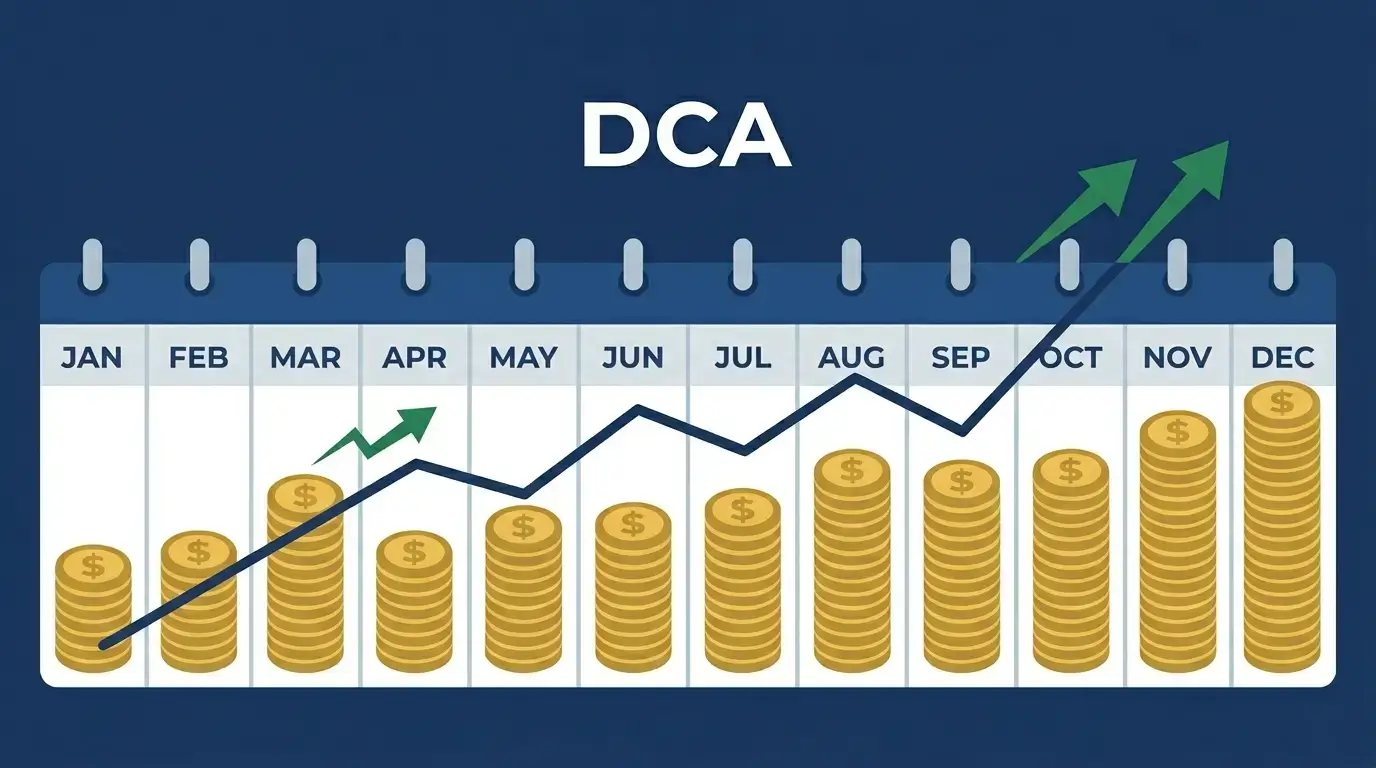
Dollar-cost averaging is an investment strategy where you invest a fixed amount of money at regular intervals — regardless of whether the market is up, down, or sideways.
Instead of trying to invest a lump sum at the “perfect” time, you spread your purchases over time. Some months you’ll buy when prices are high. Some months you’ll buy when prices are low. Over time, your average cost per share ends up lower than if you had panicked and tried to time everything perfectly.
The simplest example of DCA you already know: Every time money is deducted from your paycheck and contributed to your 401(k), that’s dollar-cost averaging in action — automatically, without you having to think about it.
How Does Dollar-Cost Averaging Work?
The mechanics are straightforward:
Don’t touch it — let it grow
Choose an investment (such as an S&P 500 index fund)
Decide on a fixed dollar amount (such as $300/month)
Set up automatic contributions on a regular schedule
Dollar-Cost Averaging Example
Here’s what DCA looks like over 4 months with $500/month invested in an index fund:
| Month | Amount Invested | Share Price | Shares Purchased |
|---|---|---|---|
| January | $500 | $100 | 5.0 shares |
| February | $500 | $80 | 6.25 shares |
| March | $500 | $90 | 5.56 shares |
| April | $500 | $110 | 4.55 shares |
| Total | $2,000 | Avg: $94.18 | 21.36 shares |
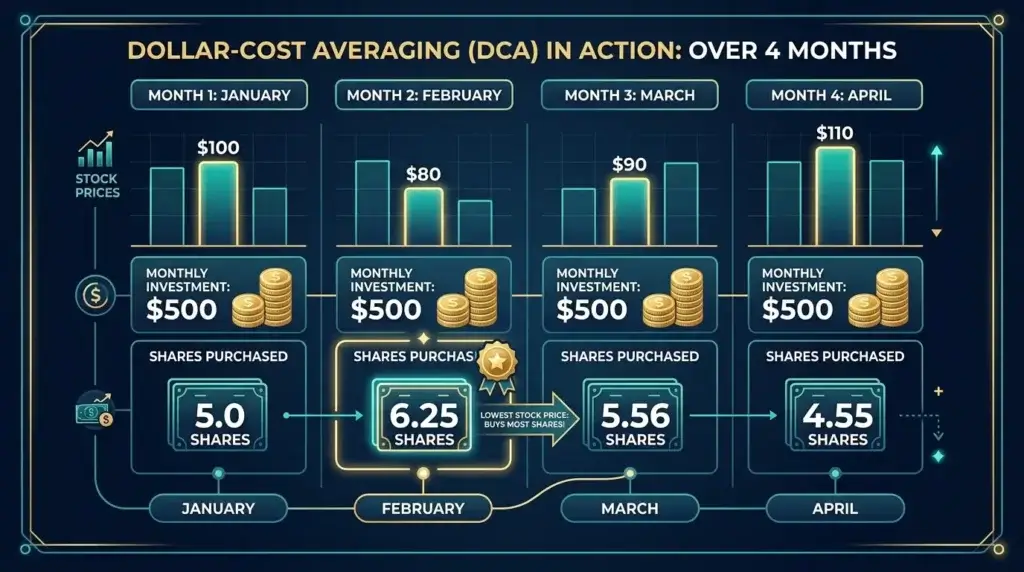
Notice what happened: because you invested the same fixed amount each month, you automatically bought more shares when prices were low (February at $80) and fewer when prices were high (April at $110). Your average cost per share — $94.18 — is lower than the simple average of the four prices ($95).
This is the core benefit of DCA: you don’t need to predict the market. The strategy works with volatility, not against it.
Dollar-Cost Averaging vs Lump Sum Investing
A common question: is it better to invest a large sum all at once (lump sum) or spread it out over time (DCA)? Here is what the research shows:
| Strategy | Best When | Risk Level | Psychological Ease |
|---|---|---|---|
| Lump Sum | Markets are rising long-term | Higher short-term | Difficult — fear of timing |
| Dollar-Cost Averaging | Markets are volatile or falling | Lower short-term | Easy — removes emotion |
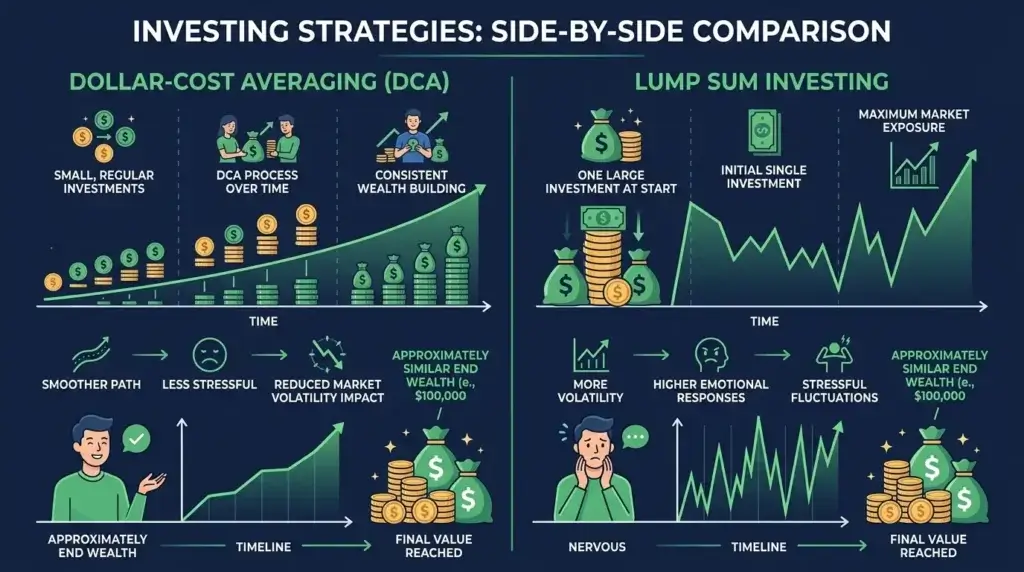
Research from Vanguard shows that lump sum investing outperforms DCA roughly two-thirds of the time in rising markets — simply because more money is invested earlier and has more time to compound. However, DCA significantly outperforms lump sum during downturns and periods of high volatility.
The practical conclusion: If you have a large windfall to invest (an inheritance, a bonus), lump sum is statistically slightly better over the long run. But for the vast majority of people investing from their regular paycheck, DCA is not just acceptable — it’s the ideal strategy. The behavioral benefits (removing emotional decision-making) often make it the superior real-world choice.
The 5 Key Benefits of Dollar-Cost Averaging
1. Eliminates the Need to Time the Market
Professional fund managers with teams of analysts consistently fail to time the market reliably. DCA removes this pressure entirely. You invest on schedule regardless of market conditions — and your results will closely mirror the market’s long-term performance.
2. Reduces the Impact of Market Volatility
When markets fall, DCA means you’re buying more shares for the same fixed amount. Market dips actually become opportunities rather than sources of anxiety. Over time, this lowers your average cost per share compared to investing everything at a market peak.
3. Removes Emotional Decision-Making
The biggest enemy of successful investing is emotion. Investors who try to time the market often panic-sell during downturns (locking in losses) and FOMO-buy during peaks (overpaying). DCA automates your investing decisions and removes emotion from the equation entirely.
4. Works for Any Budget
You don’t need a large sum to start. DCA works with any amount — $25 per week, $100 per month, or $500 per paycheck. The key is consistency, not the size of each contribution. See our guide on how to start investing with $100 for a step-by-step walkthrough.
5. Builds the Habit of Consistent Investing
By automating contributions on a schedule, DCA turns investing into a background habit rather than a recurring decision. Set it up once, and it runs without you — which is exactly the point.
The Limitations of Dollar-Cost Averaging
DCA isn’t perfect. Here’s an honest look at its drawbacks:
It can underperform in consistently rising markets. If the market climbs steadily all year, money invested in January has 12 months of growth while money invested in December has only 1. In a long bull market, holding cash while waiting to deploy each month has an opportunity cost.
Transaction costs can add up (in theory). If you pay a commission per trade, 12 monthly purchases cost 12 times more than a single annual purchase. In practice, this is almost irrelevant today — most major brokerages (Fidelity, Schwab, Vanguard, Robinhood) offer commission-free trading.
It requires consistency. DCA only works if you stick with it — including during downturns when it feels psychologically difficult. The solution is simple: automate your contributions so you never have to make the decision manually.
How to Implement Dollar-Cost Averaging: Step by Step
Step 1: Choose Your Investment Account
The best accounts for DCA are:
- 401(k) — Automatic DCA with every paycheck. This is already happening if you’re enrolled.
- Roth IRA — Ideal for long-term, tax-free growth. Contribute up to $7,000/year in 2026 (or $8,000 if you’re 50+). Read our Roth IRA guide for setup instructions.
- Taxable brokerage account — For investing beyond retirement account limits. Fidelity, Schwab, and Vanguard offer free accounts with no minimums.
Step 2: Choose Your Investment
For most DCA investors, a broad market index fund is the ideal choice:
- S&P 500 index fund — Tracks the 500 largest US companies (e.g., Fidelity ZERO S&P 500 Index Fund, Vanguard VOO)
- Total stock market index fund — Even broader diversification across all US companies
- Target-date fund — Automatically adjusts risk as you approach retirement. Ideal for hands-off investors.
Not sure what an index fund or ETF is? Read our explainer on what is an ETF before choosing.
Avoid individual stocks for DCA — diversified index funds eliminate single-company risk and require zero ongoing research.
Step 3: Set Your Fixed Amount and Schedule
Decide how much you’ll invest and how often. Common schedules:
- Weekly: $50–$100 per week (great if you’re paid weekly)
- Bi-weekly: Aligned with your paycheck schedule
- Monthly: $100–$500 per month (most common)
The amount matters less than the consistency. Starting with $50 per month today is infinitely better than waiting until you can invest $500 per month.
Step 4: Automate Everything
Set up automatic investments so contributions happen without any action from you. Most brokerages and retirement accounts allow you to set recurring investments. Once automated, the only thing you need to do is not interfere — resist the urge to stop contributions when markets fall.
Step 5: Review Annually (Not Monthly)
Check your portfolio once or twice a year to rebalance if needed. Do not check it every day — frequent monitoring leads to emotional decision-making, which is exactly what DCA is designed to prevent.
DCA at Every Life Stage
Dollar-cost averaging looks different depending on where you are in life. Here’s how to adapt it:
In Your 20s — Build the Habit
Your biggest advantage is time. Even small amounts invested consistently in your 20s have decades to compound. Prioritize maxing out your Roth IRA ($7,000/year in 2026) before a taxable account. Aggressive allocation (90–100% stocks) is appropriate — you have time to ride out downturns.
In Your 30s — Scale Up
Your income is likely growing. Increase your DCA contributions with every raise (a good rule: direct 50% of each raise to your investment accounts). Max out your 401(k) ($23,500 in 2026) if possible, then your Roth IRA. See our guide on how to build wealth in your 30s for a full strategy.
In Your 40s — Protect and Grow
Maintain DCA consistency, but begin a gradual shift toward slightly more conservative allocation (perhaps 70–80% stocks, 20–30% bonds). Avoid the temptation to make large lump-sum moves in response to market news.
In Your 50s — Transition Toward Retirement
Continue DCA, but focus on tax-efficient withdrawal planning. If you’re 50+, take advantage of catch-up contributions ($8,000 Roth IRA limit, $31,000 401(k) limit in 2026). Consider shifting to target-date funds if you want to automate the glide path to retirement.
Best ETFs and Index Funds for DCA in 2026
You don’t need to research individual stocks. These are the most widely used, low-cost options for DCA investors:
| Fund | Type | Expense Ratio | What It Tracks |
|---|---|---|---|
| Vanguard VOO | ETF | 0.03% | S&P 500 |
| Fidelity FZROX | Index Fund | 0.00% | Total US Market |
| Vanguard VTI | ETF | 0.03% | Total US Market |
| Vanguard VXUS | ETF | 0.07% | International stocks |
| Vanguard BND | ETF | 0.03% | US Bond Market |
A simple, proven DCA portfolio for most beginners: 80% VTI + 20% VXUS — total global market exposure, ultra-low fees, automatic diversification.
Dollar-Cost Averaging Real-World Results
Here’s what $500/month invested in an S&P 500 index fund looks like over time, assuming a 10% average annual return:
| Years | Total Invested | Portfolio Value (10% avg return) | Total Gain |
|---|---|---|---|
| 5 years | $30,000 | $38,820 | +$8,820 |
| 10 years | $60,000 | $102,422 | +$42,422 |
| 20 years | $120,000 | $381,750 | +$261,750 |
| 30 years | $180,000 | $1,130,243 | +$950,243 |
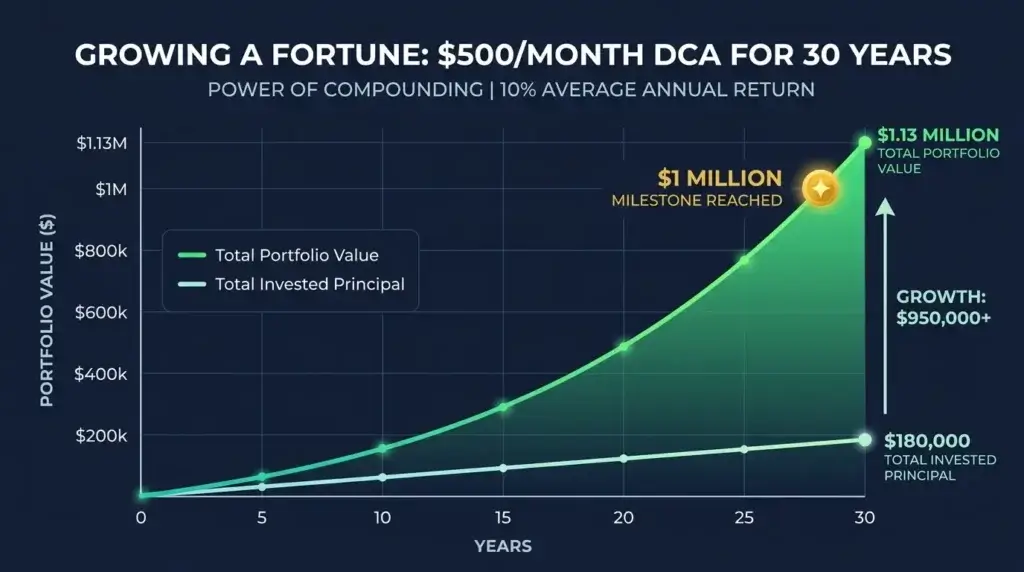
Investing just $500 per month consistently for 30 years turns $180,000 of contributions into over $1.1 million — with no market timing, no stock picking, and no financial expertise required. This is the power of DCA combined with compound interest.
Frequently Asked Questions About Dollar-Cost Averaging
Is dollar-cost averaging good for beginners?
Yes — it is arguably the best strategy for beginners. It requires no market knowledge, no timing decisions, and no emotional discipline beyond setting up the automation. It’s how Warren Buffett recommends most people invest their money.
How often should I invest with DCA?
Monthly is the most common and practical frequency for most investors. Weekly works well if you prefer smaller, more frequent contributions. The most important factor is consistency — pick a frequency you can maintain long-term.
Should I stop DCA investing during a market crash?
No — this is actually the worst time to stop. During a market crash, your fixed contribution buys more shares at lower prices, dramatically lowering your average cost. Investors who stopped DCA during the 2020 COVID crash and the 2022 bear market missed some of the best buying opportunities in recent history.
Can I use DCA with individual stocks?
Technically yes, but it’s not recommended for most beginners. Individual stocks carry company-specific risk that index funds eliminate through diversification. If a company goes bankrupt, your DCA investment goes to zero — that can’t happen with a broad market index fund.
What is the minimum amount to start DCA?
With most modern brokerages (Fidelity, Schwab, Robinhood), you can start with as little as $1 using fractional shares. There is no practical minimum. Start with whatever you can afford consistently — even $25 per month builds meaningful wealth over time.
Is DCA the same as automatic investing?
Essentially yes. When you set up automatic monthly contributions to your Roth IRA or 401(k), you are implementing dollar-cost averaging automatically. The strategy and the automation go hand in hand.
Should I use DCA in a Roth IRA or a regular brokerage account?
Start with a Roth IRA — contributions grow tax-free, and qualified withdrawals in retirement are also tax-free. Once you’ve maxed your Roth IRA ($7,000/year in 2026), continue DCA in a taxable brokerage account. Read our Roth IRA guide and best investment apps for beginners to get started.
What’s the difference between DCA and value averaging?
DCA invests a fixed dollar amount on a fixed schedule, regardless of market performance. Value averaging adjusts the amount invested each period based on portfolio growth — investing more when the market falls and less when it rises. DCA is simpler and more practical for most investors; value averaging requires active calculation each period.
Does DCA work in a bear market?
DCA works especially well in bear markets. When prices fall, each fixed contribution buys more shares — which means you’re building your position at lower average prices. The recovery that follows a bear market often produces outsized returns for consistent DCA investors.
Can I use DCA with ETFs?
Yes — ETFs are one of the best vehicles for DCA. Most brokerages allow automatic recurring purchases of ETFs, and with fractional shares now widely available, you can invest any dollar amount regardless of the ETF’s share price. Read our guide on what is an ETF for more.
The Bottom Line
Dollar-cost averaging is one of the most effective, stress-free investment strategies available — especially for beginners. It doesn’t require you to predict the market, pick the right stock, or invest a large sum all at once. All it requires is consistency.
The simplest DCA setup: Open a Roth IRA → choose a low-cost S&P 500 index fund → set up automatic monthly contributions → don’t interfere. Time and consistency will do the rest.
Ready to take the first step? Read our guide on how to start investing with $100, or explore the best investment apps for beginners to find the right platform for your DCA journey.
Disclaimer: This article is for informational purposes only and does not constitute financial or investment advice. Past performance is not indicative of future results. Always consult a qualified financial advisor before making investment decisions.