

📢 Disclosure: This post contains affiliate links. We may earn a commission at no extra cost to you. We only recommend products we genuinely believe in.
If you are juggling several debts with different rates and due dates, debt consolidation can simplify repayment by replacing multiple obligations with one new loan or credit product. But a lower monthly payment does not automatically mean a lower total cost, and consolidation is not the same as debt settlement or debt forgiveness.
In this complete guide, you’ll learn exactly what debt consolidation is, how it works, the different types available, the pros and cons, and how to decide if it’s the right move for your financial situation. Understanding your options is also connected to your credit score — consolidation can both help and hurt it depending on how it’s done.
What Is Debt Consolidation?
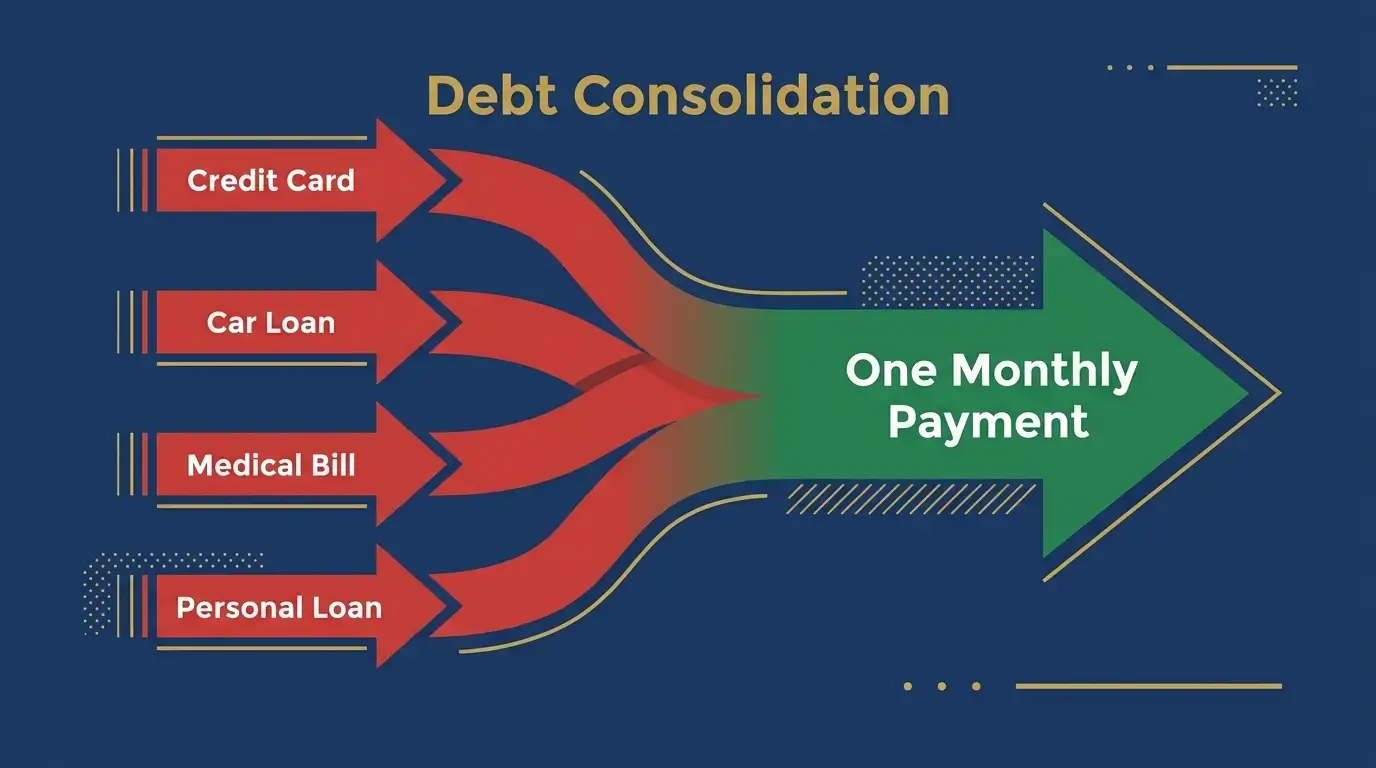
Debt consolidation generally means taking out a new loan or credit product to repay multiple existing debts, leaving you with fewer payments to manage. The new product may have a lower rate, but whether it saves money depends on the APR, fees and repayment term.
The goal is usually to simplify repayment and, in some cases, reduce borrowing costs. The CFPB warns that a lower monthly payment can simply reflect a longer repayment period, which may increase the total amount paid.
Debt consolidation is not debt elimination. You are replacing existing debt with a new obligation and still need a workable repayment plan. Compare the new loan’s APR, fees, term and total repayment amount with your current debts before deciding.
How Does Debt Consolidation Work?
The basic mechanics are straightforward:
- You apply for a new loan or credit product (a consolidation loan, balance transfer card, or home equity loan).
- You use the funds from the new loan to pay off all your existing debts.
- You now have a single debt — the consolidation loan — with one monthly payment, one interest rate, and one due date.
- You make consistent monthly payments until the consolidated debt is fully paid off.
The key test is total cost, not just the headline rate or monthly payment. A lower APR can still cost more overall if the loan has significant fees or stretches repayment over a much longer period.
Types of Debt Consolidation
1. Personal Debt Consolidation Loan
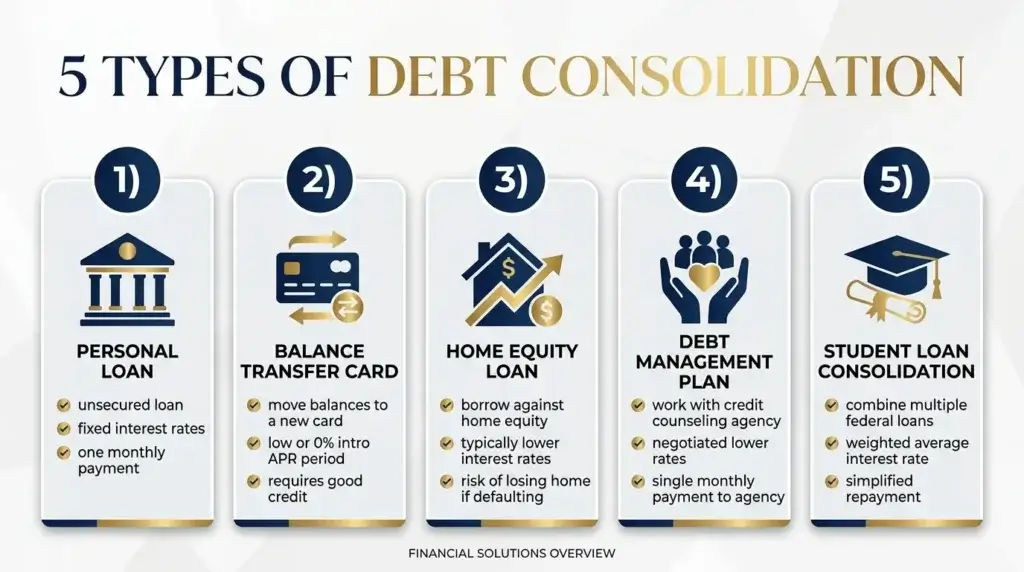
A personal loan from a bank, credit union or online lender can be used to repay multiple unsecured debts. Rates, fees, loan amounts and eligibility vary widely by lender and applicant, so compare offers using APR and total repayment cost.
- May fit: Borrowers who qualify for a loan whose APR, fees and term improve on their current debt costs
- Loan amounts: Vary by lender and applicant
- Terms: Vary by lender; longer terms can lower the monthly payment while increasing total interest
- Secured or unsecured: Usually unsecured (no collateral required)
2. Balance Transfer Credit Card
A balance transfer credit card can consolidate revolving balances onto one card. Some offers use a temporary 0% or low promotional APR, but the rate, duration, transfer fee and post-promotional APR vary by issuer.
- May fit: Borrowers who qualify for an offer where the fee and promotional terms reduce total borrowing costs
- Promotional period: Varies by issuer and offer
- Balance transfer fee: Often a percentage of the transferred amount or a minimum fixed fee, depending on the offer
- After promotional period: The card’s disclosed non-promotional APR generally applies to any remaining balance
3. Home Equity Loan or HELOC
If you own a home, a home equity loan or HELOC can sometimes be used to repay other debts. Because your home secures the borrowing, failure to repay can put the property at risk. Rates and fees vary and should be compared carefully with unsecured alternatives.
- May fit: Homeowners who understand the collateral risk and whose total borrowing costs are meaningfully improved
- Interest rates: May be lower than unsecured debt, but not always; terms vary by lender and market conditions
- Major risk: Your home is collateral — failure to repay could result in foreclosure
4. Debt Management Plan (DMP)
A structured repayment plan arranged through a nonprofit credit counseling agency. The agency negotiates with your creditors to reduce interest rates and consolidates your payments into one monthly amount that you pay to the agency.
- Best for: People with significant credit card debt who don’t qualify for a good consolidation loan
- Typical duration: 3 to 5 years
- Fees: Nonprofit status does not mean free; ask for all setup and monthly fees in writing
- Credit impact: Depends on how creditors report the accounts and how the plan is structured
5. Student Loan Consolidation
Federal student loans can be consolidated through the U.S. Department of Education’s Direct Consolidation Loan program. This combines multiple federal loans into one, but the interest rate is the weighted average of your existing loans — so it doesn’t necessarily save money on interest.
Debt Consolidation: Pros and Cons
| ✅ Pros | ❌ Cons |
|---|---|
| One monthly payment instead of many | May extend your repayment period |
| Potentially lower interest rate | Upfront fees (origination, balance transfer) |
| Fixed monthly payment (predictable) | Risk of accumulating new debt on paid-off cards |
| Can lower your monthly payment | Home equity options risk your home |
| May reduce financial stress | Requires good credit for best rates |
| Can improve credit score long-term | Short-term credit score dip from hard inquiry |
Does Debt Consolidation Hurt Your Credit Score?
The short-term and long-term effects on your credit score depend on how you consolidate:
Short-Term Impact (Usually Negative)
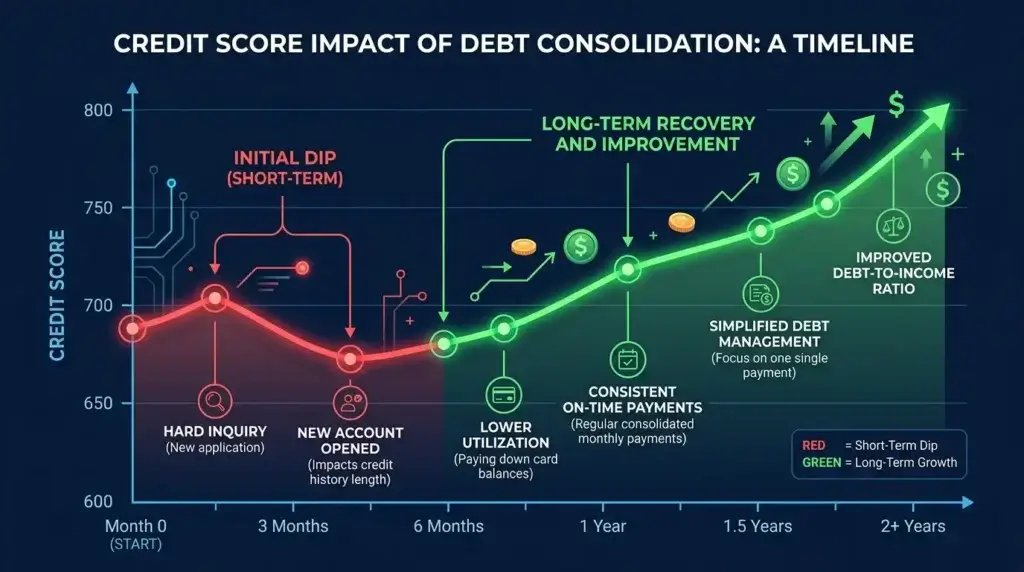
- Hard inquiry: Applying for a new loan or credit card may create a hard inquiry, which can affect your score. The size of the impact varies by credit file and scoring model.
- New account: Opening a new account lowers the average age of your credit accounts, which can slightly reduce your score.
- Credit utilization spike: If you open a new credit card and transfer balances, your utilization on that card will be high initially.
Long-Term Impact Depends on What Happens Next
- Utilization: Paying down revolving balances can improve utilization, but opening or closing accounts can also change the ratio.
- On-time payments: Making consistent on-time payments on your consolidation loan builds a positive payment history.
- Debt level: Lower balances and consistent on-time payments can strengthen parts of your credit profile, but no score increase is guaranteed.
Key warning: Consolidation can fail if paid-off revolving accounts are used to accumulate new balances. That can leave you with both the consolidation loan and new credit-card debt, increasing total obligations.
Is Debt Consolidation Worth It? How to Decide
Debt consolidation makes financial sense when:
- ✅ You can qualify for a significantly lower interest rate than your current debts
- ✅ You have multiple high-interest debts (especially credit cards at 20%+)
- ✅ You have a stable income to make consistent monthly payments
- ✅ You’re committed to not accumulating new debt on paid-off accounts
- ✅ The consolidation reduces your total interest paid, not just your monthly payment
Debt consolidation is NOT worth it when:
- ❌ The new interest rate is equal to or higher than your current rates
- ❌ You would extend repayment so long that you pay more total interest
- ❌ You plan to use the freed-up credit on paid-off cards to spend more
- ❌ The fees are too high to make the consolidation beneficial
- ❌ Your debt amount is small enough to pay off quickly with the debt snowball or avalanche method
Debt Consolidation vs Debt Settlement: What’s the Difference?
These two terms are often confused, but they are very different strategies:
| Feature | Debt Consolidation | Debt Settlement |
|---|---|---|
| What happens | Combine debts into one new loan | Negotiate to pay less than you owe |
| Credit impact | Varies by product, inquiry, balances and repayment | Can be significant if payments are missed or debts are settled for less than owed |
| You pay | Typically repay the new consolidation obligation under its terms | May negotiate to settle for less than the amount claimed, with fees and possible tax consequences |
| Risk considerations | Fees, longer terms, teaser rates, collateral risk | Missed payments, collection activity, fees, credit damage and scam risk |
| Best for | Good credit, manageable debt | Severe hardship, near bankruptcy |
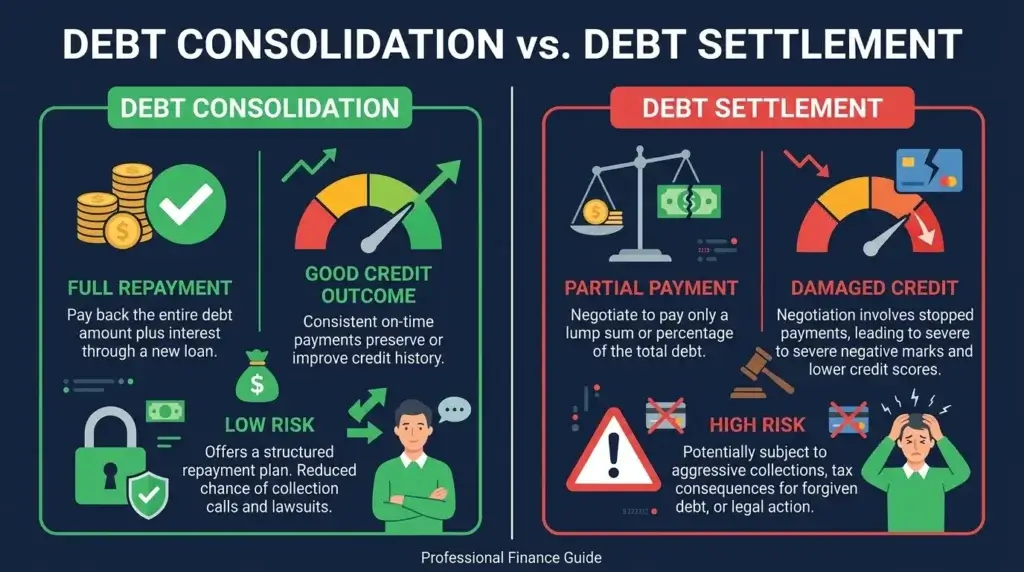
Debt settlement is different from consolidation and can involve serious risks. Some companies encourage consumers to stop paying creditors while money accumulates in a separate account, which can lead to late fees, collection activity and credit damage. The FTC also warns that debt-relief companies that demand upfront payment or guarantee fast settlement are major scam red flags.
How to Consolidate Debt: Step by Step
Step 1: List All Your Debts
Write down every debt you have: the lender, balance, interest rate, and monthly minimum payment. This gives you a clear picture of what you’re working with and helps you calculate whether consolidation makes financial sense.
Step 2: Check Your Credit Score
Your credit profile can affect approval, rate and loan terms, but there is no universal score cutoff for a worthwhile consolidation loan. Check your credit reports and scores, then compare prequalification offers where available before submitting full applications.
Step 3: Calculate the Math
Use a debt consolidation calculator to compare:
- Total interest paid on current debts at current rates
- Total interest paid on the consolidated loan at the new rate
- Any fees associated with consolidation
If the consolidation lowers your total expected cost and the new payment fits your budget, it may be worth considering. Also compare the repayment term, fees, collateral risk and what happens if a promotional rate expires.
Step 4: Shop and Compare Lenders
Compare offers from multiple lenders and check whether prequalification is available. Some lenders use a soft inquiry for prequalification, but practices vary. Compare APR, fees, term, monthly payment and total repayment amount rather than choosing on the advertised rate alone.
Step 5: Apply and Execute
Once you’ve found the best offer, apply formally. If approved, use the funds to pay off your existing debts immediately. Then set up automatic payments on your new consolidation loan to ensure you never miss a payment.
Step 6: Stop Using the Paid-Off Accounts
After consolidating, the most important practical step is avoiding new balances you cannot repay. Whether to keep or close paid-off cards depends on fees, spending risk, account age and your broader credit profile; there is no universal rule that every card should remain open.
Frequently Asked Questions About Debt Consolidation
Will debt consolidation stop collection calls?
If your debts are current (not in collections), consolidation won’t affect collection activity since there is none. If your debts are already in collections, consolidation may not apply — you’d need to negotiate directly with collectors or consider a debt management plan.
Can I consolidate debt with bad credit?
It’s difficult but not impossible. Options for bad credit include: secured personal loans, credit unions (which often have more flexible lending criteria), debt management plans through nonprofit agencies, or asking a creditworthy co-signer to help you qualify for better rates.
How long does debt consolidation take?
The setup time varies by product and provider. A personal loan may fund relatively quickly after approval, while a debt management plan is a longer repayment arrangement. A balance transfer depends on issuer processing time and the promotional terms. Keep making required payments until you confirm that old balances have actually been paid.
Is debt consolidation the same as bankruptcy?
No. Debt consolidation generally means replacing multiple debts with a new repayment obligation, while bankruptcy is a legal process governed by federal law. The credit impact of either option depends on the details of your situation, and bankruptcy consequences vary by chapter and credit-reporting rules.
Should I close my credit cards after consolidating?
There is no universal rule. Closing a card can affect available credit and account history, while keeping it open may create a spending risk or annual fee. Review each account individually based on fees, age, limits and your ability to avoid new debt.
The Bottom Line
Debt consolidation can be a powerful tool for simplifying your finances and reducing the interest you pay — but only if the numbers actually work in your favor. Before consolidating, do the math carefully, understand the fees involved, and have a concrete plan to avoid accumulating new debt.
A consolidation product works best when it is paired with a realistic repayment plan and a budget that prevents new balances from replacing the old ones. Compare the 50/30/20 rule with other budgeting methods and use the structure that fits your cash flow.
Want to compare alternatives? Read our guide on how to get out of debt, our comparison of debt snowball vs debt avalanche, and our explainer on what a balance transfer is. If you’re also rebuilding credit, see how to improve your credit score.
Disclaimer: This article is for informational purposes only and does not constitute financial or legal advice. Debt consolidation options vary based on individual circumstances and creditworthiness. Always consult a qualified financial advisor or nonprofit credit counselor before making debt consolidation decisions.