


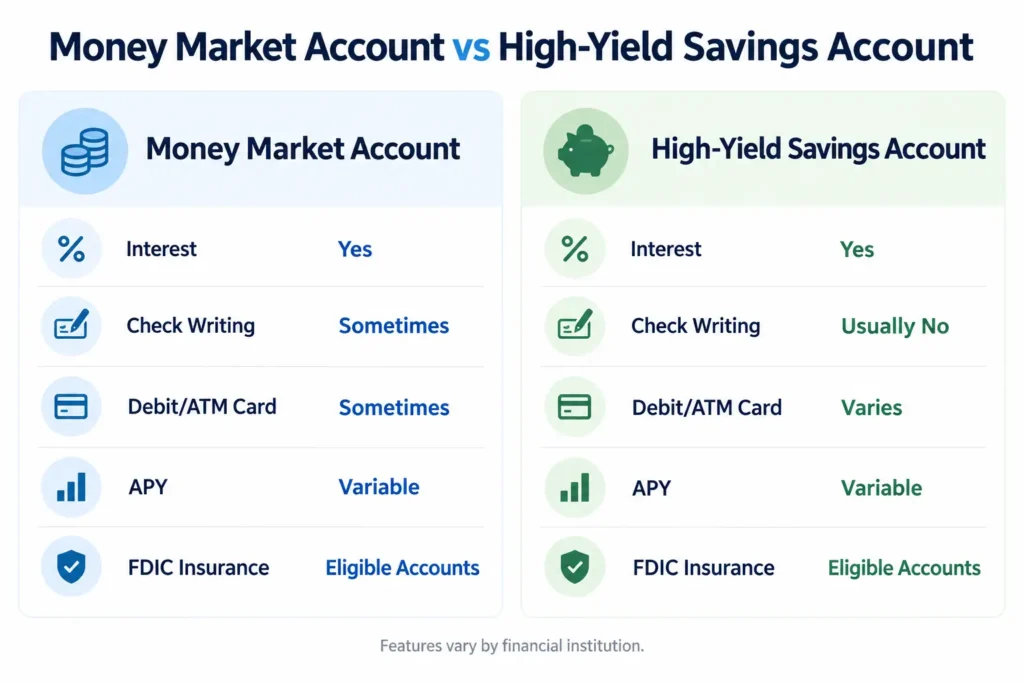
Choosing between a money market account vs. high-yield savings account can be confusing because the two accounts have a lot in common. Both can earn interest, keep your savings relatively accessible and offer federal deposit insurance when held at an eligible insured institution.
The main differences usually come down to how you access your money, account requirements, fees and the APY offered by the specific bank or credit union.
A money market account may offer checks or a debit card, while a high-yield savings account generally focuses on earning a competitive rate without those additional transaction features.
Here’s how the two compare and what to consider before choosing one.
Money Market Account vs. High-Yield Savings Account at a Glance
| Feature | Money Market Account | High-Yield Savings Account |
|---|---|---|
| Earns interest | Yes | Yes |
| APY | Variable | Variable |
| FDIC insurance at eligible banks | Yes | Yes |
| Check-writing | Sometimes | Usually no |
| Debit/ATM card | Sometimes | Varies |
| Minimum balance | May be required | Often low or none |
| Monthly fees | Varies | Varies |
| Access to money | Generally flexible | Generally flexible |
| Best use | Savings with additional access features | Savings focused on competitive yield |
Neither account type automatically pays a higher rate. The better APY depends on the individual financial institution and can change over time.
If you’re unfamiliar with money market accounts, start with our guide explaining what a money market account is.
What Is a Money Market Account?
A money market account, or MMA, is an interest-bearing deposit account offered by banks and credit unions.
It combines features commonly associated with savings accounts with some access features that may resemble checking accounts.
Depending on the institution, an MMA may provide:
- Interest on your balance
- Electronic transfers
- ATM access
- A debit card
- Check-writing privileges
Account features vary significantly between institutions.
Money market deposit accounts should not be confused with money market mutual funds, which are investment products and are not FDIC-insured.
If you’re ready to compare individual accounts, see our guide to the best money market accounts of 2026.
What Is a High-Yield Savings Account?
A high-yield savings account, commonly called an HYSA, is a savings account designed to pay a relatively competitive APY.
Many HYSAs are offered by online banks, although they are also available from other financial institutions.
They generally provide electronic transfers and online or mobile account management, but they don’t necessarily provide check-writing or debit-card access.
The primary objective is straightforward: earn interest on cash you want to keep accessible rather than invest in the market.
For current account comparisons, see our best high-yield savings accounts of 2026.
Which Pays More Interest: Money Market or High-Yield Savings?
There is no universal winner.
Both money market accounts and high-yield savings accounts can offer competitive APYs, and their rates are typically variable.
That means an account offering the higher rate today may not necessarily remain ahead.
Instead of choosing based only on the account category, compare the actual:
- APY
- Minimum balance required to earn that APY
- Promotional conditions
- Balance tiers
- Monthly fees
- Other qualification requirements
For example, a 4% APY with no monthly fee could potentially be more useful to a particular saver than a slightly higher advertised APY that requires conditions they cannot consistently meet.
If you’re unsure how banks calculate savings returns, our guide to what APY means in savings explains it.
The Biggest Difference: Access to Your Money
This is one area where money market accounts can stand out.
Money Market Account Access
Depending on the bank, an MMA may provide:
Checks: Some accounts allow you to write checks directly against the account.
Debit card: Certain MMAs include debit or ATM cards.
Electronic transfers: You can generally move money electronically between linked accounts.
This can make an MMA appealing when you want savings to earn interest while maintaining additional ways to access the money.
High-Yield Savings Account Access
An HYSA generally emphasizes saving rather than transactions.
Access commonly occurs through:
- Electronic transfers
- Online banking
- Mobile banking
- Transfers to a linked checking account
Some institutions may offer additional withdrawal options, but features vary.
The key is to check the actual account terms rather than assuming all MMAs or all HYSAs work the same way.

Money Market Account vs. High-Yield Savings: Minimum Balances
Minimum balance requirements are another potential difference.
Some money market accounts require a relatively large balance to:
- Open the account
- Avoid a monthly fee
- Earn the advertised APY
High-yield savings accounts—particularly online accounts—may have lower minimum requirements, although this isn’t universal.
Before opening either account, check both the minimum opening deposit and the ongoing balance requirement.
A high advertised APY isn’t particularly useful if you don’t meet the conditions required to earn it.
Money Market Account vs. High-Yield Savings: Fees
Fees vary by institution rather than simply by account type.
Potential charges can include:
- Monthly maintenance fees
- Excess transaction fees imposed by the institution
- ATM fees
- Wire transfer fees
- Fees for falling below a required balance
When comparing two accounts with similar APYs, fees can become particularly important.
Even a small recurring fee reduces the interest your savings actually earn.
Are Both Accounts FDIC Insured?
They can be.
Eligible money market deposit accounts and high-yield savings accounts held at FDIC-insured banks receive FDIC insurance subject to applicable coverage rules.
The standard insurance amount is $250,000 per depositor, per insured bank, for each account ownership category.
At federally insured credit unions, qualifying accounts receive similar protection through the NCUA.
However, a money market mutual fund is different. It is an investment product rather than a bank deposit and isn’t covered by FDIC deposit insurance.
Money Market vs. High-Yield Savings for an Emergency Fund
Both accounts can potentially work for an emergency fund.
The important considerations aren’t limited to APY.
For emergency savings, consider:
Accessibility. How quickly can you get your money?
Transfer time. How long does it take to transfer funds to checking?
ATM access. Is it available if you need cash?
Fees. Could maintaining or accessing the account cost money?
Minimum balance. Will you consistently meet it?
APY. How competitive is the rate?
An HYSA can make sense when your priority is earning interest while keeping savings separate from everyday spending.
An MMA can make sense when you value additional access features such as checks or an ATM/debit card.
You can also read our guide on how to build an emergency fund before deciding where to keep it.
Money Market Account vs. HYSA for a House Down Payment
If you’re saving toward a near-term house purchase, protecting your principal and maintaining access to the money may be important considerations.
Both an HYSA and MMA can potentially serve this purpose.
Instead of choosing by account name, compare:
- APY
- FDIC or NCUA coverage
- Fees
- Minimum balances
- Withdrawal options
- Transfer speed
For the broader savings strategy, see how to save for a house down payment.
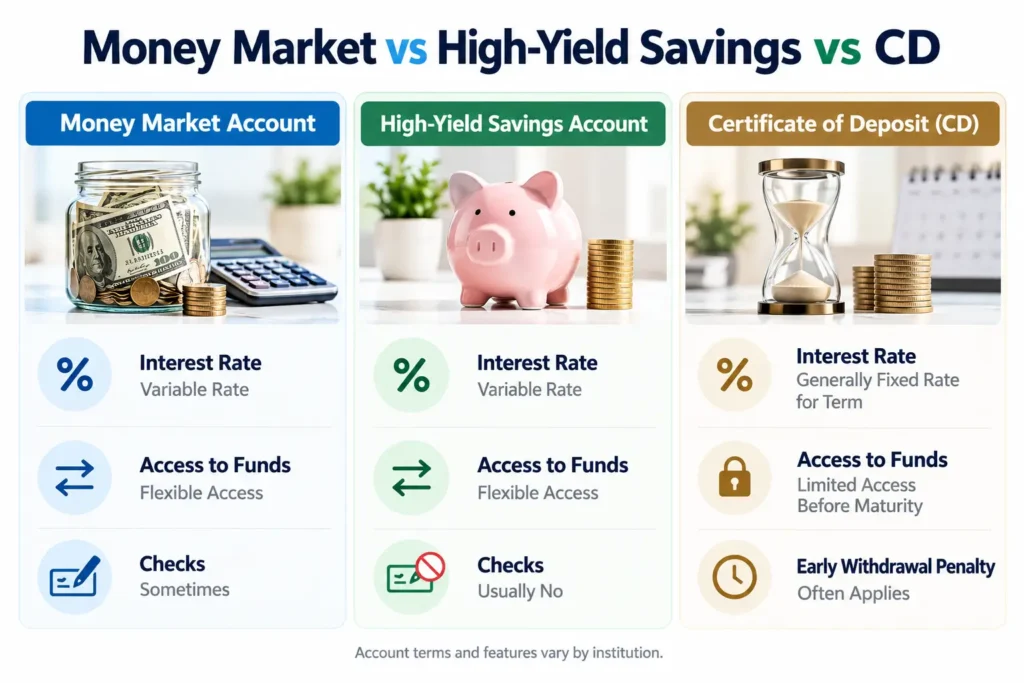
Money Market Account vs. CD
There’s another option worth understanding: a certificate of deposit.
A CD works differently because you generally agree to leave your money deposited for a specified term in exchange for a stated interest rate.
| Feature | Money Market | High-Yield Savings | CD |
|---|---|---|---|
| Rate | Usually variable | Usually variable | Generally fixed for term |
| Access | Flexible | Flexible | Restricted until maturity |
| Early withdrawal penalty | Generally no | Generally no | Often yes |
| Checks | Sometimes | Usually no | No |
| Suitable for liquid savings | Potentially | Potentially | Less liquid |
If you’re certain you won’t need the money during a particular period, a CD may be worth comparing.
Learn more in what is a CD account?.
Pros and Cons of a Money Market Account
Potential Advantages
A money market account may provide:
- Competitive interest
- Check-writing privileges
- ATM or debit-card access
- Federal deposit insurance when eligible
- Relatively easy access to savings
Potential Disadvantages
Depending on the institution, you may encounter:
- Higher minimum balance requirements
- Monthly fees
- Transaction restrictions
- A lower APY than competing savings products
- Variable interest rates
Pros and Cons of a High-Yield Savings Account
Potential Advantages
An HYSA may offer:
- Competitive APY
- Low or no minimum deposit
- Low or no monthly maintenance fee
- Federal deposit insurance when eligible
- Simple online account management
Potential Disadvantages
Possible drawbacks include:
- Variable APY
- Limited check-writing options
- No debit card at some institutions
- Transfer delays
- Conditions attached to certain advertised rates
How to Choose Between a Money Market Account and High-Yield Savings
Instead of asking which account type is universally better, ask which features matter for the money you’re saving.
If easy transaction access matters, investigate MMAs that provide checks or debit-card access.
If you’re primarily interested in earning a competitive APY while keeping money separate from everyday spending, compare available HYSAs.
If you’re holding money that you know you won’t need for a defined period, also compare CDs.
Most importantly, compare actual accounts—not just account categories.
Rates, fees and requirements can change.
Frequently Asked Questions
Is a money market account better than a high-yield savings account?
Neither is universally better. Money market accounts may provide additional access features such as checks or debit cards, while high-yield savings accounts may provide competitive rates with simpler requirements. Compare the specific accounts available to you.
Which earns more: a money market account or high-yield savings account?
Either can offer the higher APY. Rates depend on the financial institution, balance requirements and account conditions, and variable rates can change over time.
Is a money market account the same as a high-yield savings account?
No. They’re separate types of deposit accounts, although their features can overlap substantially. An MMA may offer additional transaction features that aren’t commonly available with an HYSA.
Are money market accounts and high-yield savings accounts FDIC insured?
Eligible deposit accounts at FDIC-insured banks receive FDIC insurance within applicable coverage limits. At federally insured credit unions, eligible accounts receive NCUA coverage.
Can you lose money in a money market or high-yield savings account?
These are deposit accounts rather than market investments. Eligible deposits receive federal insurance within applicable limits at insured institutions. However, fees can reduce your account balance, and inflation can reduce purchasing power.
Which is better for an emergency fund?
Either may work. An HYSA may suit someone prioritizing competitive interest and separation from everyday spending, while an MMA may suit someone who values additional access features. Compare transfer speed, withdrawal options, fees and APY.
Do money market accounts have withdrawal limits?
Financial institutions may impose their own transaction limits or fees. The former federal Regulation D six-transfer-per-month limit was removed in 2020, but individual banks can still maintain their own policies.
Should I have both a money market account and a high-yield savings account?
You can use more than one savings account if doing so serves different purposes, but it isn’t necessary simply because the products are different. Consider whether maintaining multiple accounts actually improves your savings organization, access or earnings.
Final Thoughts
The difference between a money market account vs. high-yield savings account is smaller than it may initially appear.
Both can provide interest, liquidity and federal deposit insurance when held as eligible deposits at insured institutions.
The biggest practical distinction is often access. Some money market accounts provide checks, ATM cards or debit cards, while high-yield savings accounts tend to focus more narrowly on saving.
But account features vary.
Before opening either one, compare the current APY, fees, minimum balance, access options and insurance coverage.
If you decide an MMA fits your needs, compare the best money market accounts of 2026. If an HYSA looks more appropriate, compare the best high-yield savings accounts of 2026.
Financial Disclaimer: The information on SmartCentHub.com is for educational and informational purposes only and does not constitute personalized financial, investment, tax or banking advice. Interest rates and account terms can change. Verify current information directly with the financial institution before opening an account.