

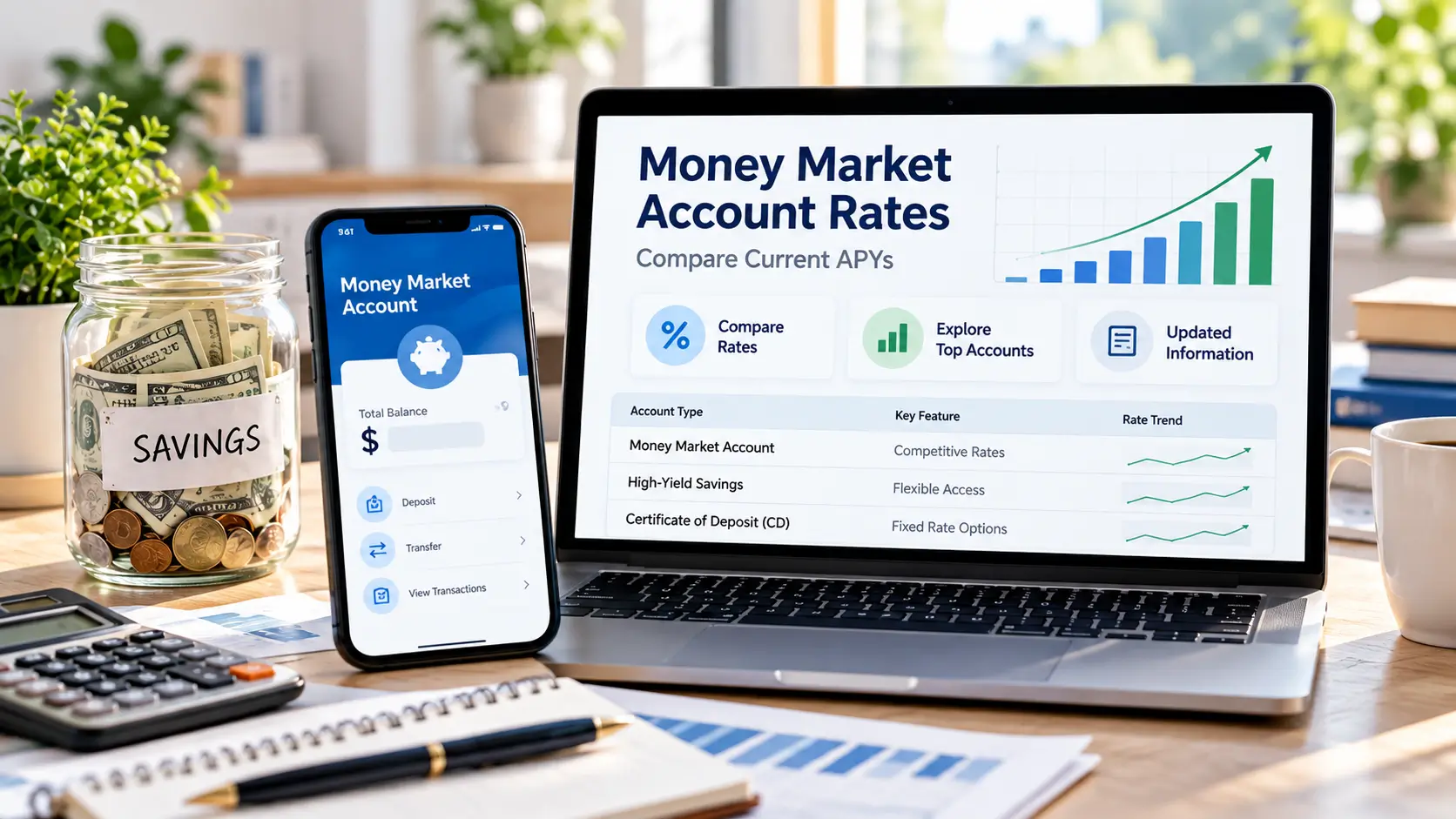
Money market account rates can vary dramatically from one financial institution to another. While the national average remains relatively low, competitive money market accounts can offer APYs several times higher.
As of late September 2026, Bankrate reports an average money market account yield of approximately 0.46% APY, while some of the competitive accounts it tracks offer rates around 4% APY. Bankrate
That difference makes comparing current rates important—but APY isn’t the only factor to consider. Minimum deposits, balance requirements, fees and access features can all affect the value of an account.
Rates checked: September 29, 2026. Money market APYs are variable and can change at any time. Verify current rates and account terms directly with the financial institution before opening an account.
If you’re new to this type of account, first read what a money market account is.
Current Money Market Account Rates
Here are examples of competitive money market account rates reported by Bankrate in late September 2026. Bankrate
| Financial Institution | APY | Minimum Opening Deposit |
|---|---|---|
| CFG Bank | 4.05% | $1,000 |
| Bank5 Connect | 4.00% | $100 |
| Zynlo Bank | 3.90% | $0 |
| Quontic Bank | 3.90% | $100 |
| Sallie Mae Bank | 3.60% | $0 |
| BTG Pactual Bank | 3.50% | $500 |
| Vio Bank | 3.40% | $100 |
| UFB Direct | 3.26% | $0 |
| FNBO Direct | 3.25% | $0 |
| Ally Bank | 3.10% | $0 |
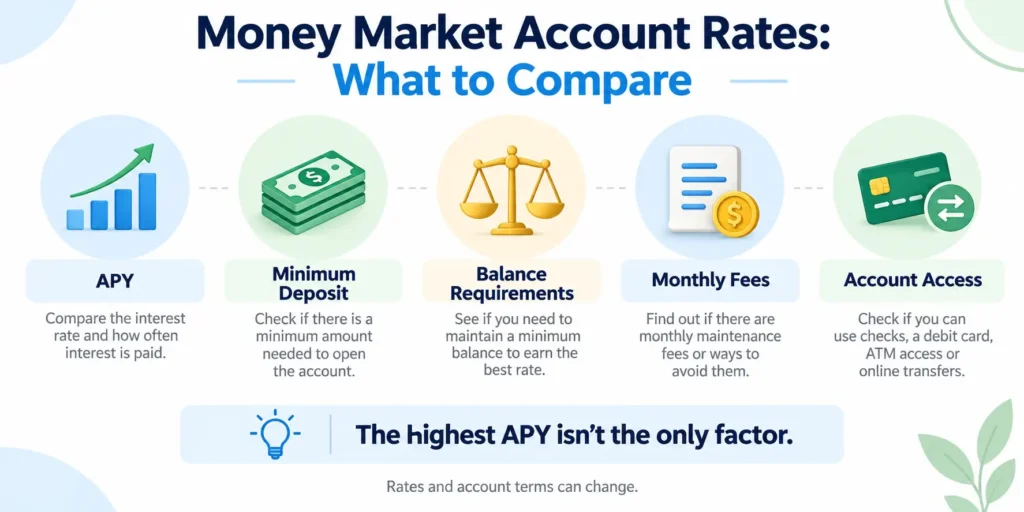
These figures are a snapshot, not permanent rates. APYs can change, and minimum balances required to earn an advertised APY may differ from the minimum amount required to open an account.
For a broader account-by-account comparison that includes features beyond rates, see our best money market accounts of 2026.
What Is the Average Money Market Account Rate?
The national average can provide a useful benchmark.
Bankrate reported an average money market account yield of approximately 0.46% APY for the week of September 28, 2026. Bankrate
However, that average doesn’t represent the most competitive accounts available.
Some online and specialized banks offer substantially higher rates, which is why comparing accounts can matter.
What Is a Good Money Market Account Rate?
Rather than defining a single APY as “good,” compare an account with both the national average and other accounts currently available to you.
As of late September 2026, several competitive MMAs tracked by Bankrate were offering approximately 3% to just above 4% APY, compared with its reported national average of 0.46%. Bankrate
But don’t automatically choose the largest APY.
Check whether that rate requires:
- A minimum opening deposit
- A minimum ongoing balance
- A particular balance tier
- Monthly activity
- Other qualification requirements
Also check monthly fees. A fee can reduce the benefit of earning a higher rate.
Why Do Money Market Account Rates Change?
Money market account rates are generally variable.
Banks can raise or lower them in response to changes in broader interest-rate conditions, funding needs and competitive pressures.
This means the APY available when you open an account isn’t necessarily the APY you’ll receive indefinitely.
That’s one major difference between a money market account and many certificates of deposit.
With a CD, the stated interest rate is generally fixed for its term. Learn more in our guide explaining what a CD account is.
How APY Affects Your Money Market Earnings
APY represents the annual percentage yield and incorporates the effect of compounding.
The difference between a low and competitive APY becomes more noticeable as your balance increases.
Here’s a simplified illustration assuming the rate remains unchanged for an entire year:
| Balance | 0.46% APY | 3.00% APY | 4.00% APY |
|---|---|---|---|
| $1,000 | ~$5 | ~$30 | ~$40 |
| $5,000 | ~$23 | ~$150 | ~$200 |
| $10,000 | ~$46 | ~$300 | ~$400 |
| $25,000 | ~$115 | ~$750 | ~$1,000 |
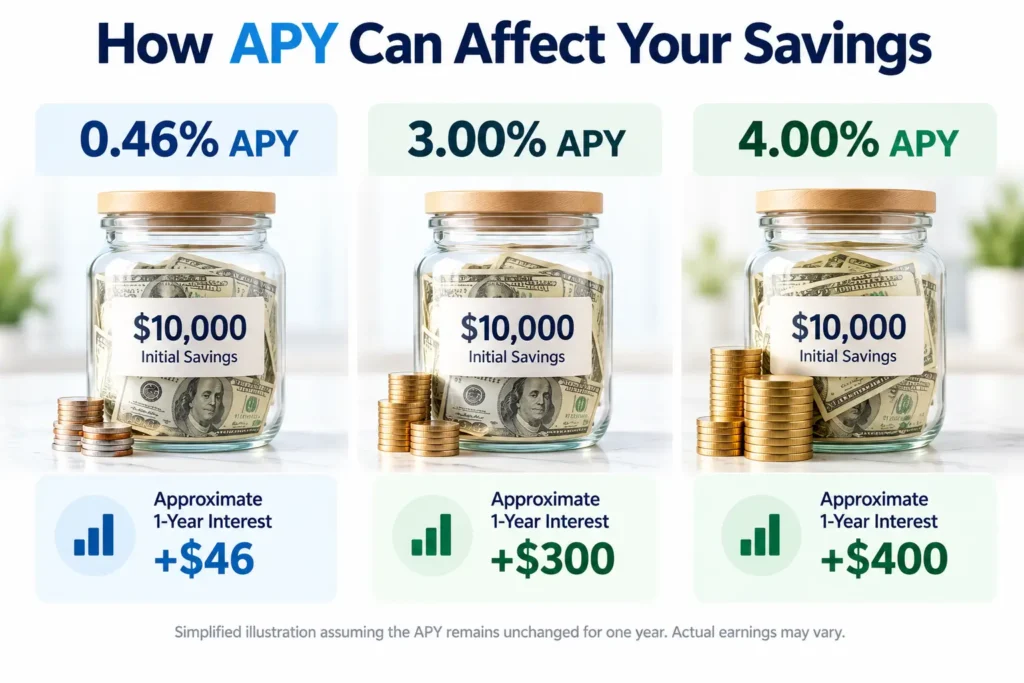
These figures are simplified illustrations. Actual earnings depend on compounding, rate changes, deposits, withdrawals, fees and account terms.
For a deeper explanation, read what APY means for savings.
Do Higher Balances Earn Higher Money Market Rates?
Sometimes.
Some money market accounts use tiered APYs, meaning the interest rate depends on your account balance.
A bank might offer one rate below a certain balance and another rate above it.
But a larger balance doesn’t automatically guarantee a better rate.
When comparing accounts, look at the APY that applies specifically to your expected balance, rather than simply looking at the highest rate advertised.
Money Market Account Rates vs. High-Yield Savings Rates
Money market accounts and high-yield savings accounts can both offer competitive variable APYs.
Neither category consistently pays more than the other.
A money market account may provide additional access features such as checks or a debit card, while an HYSA may have a simpler savings-focused structure.
If you’re deciding between them, read our complete money market account vs high yield savings account comparison.
You can also compare current options in our best high-yield savings accounts of 2026.
Money Market Account Rates vs. CD Rates
Money market accounts and CDs handle rates differently.
A money market account generally has a variable APY. Your bank can change the rate after you open the account.
A traditional CD generally provides a fixed rate for a specified term, although CD structures vary.
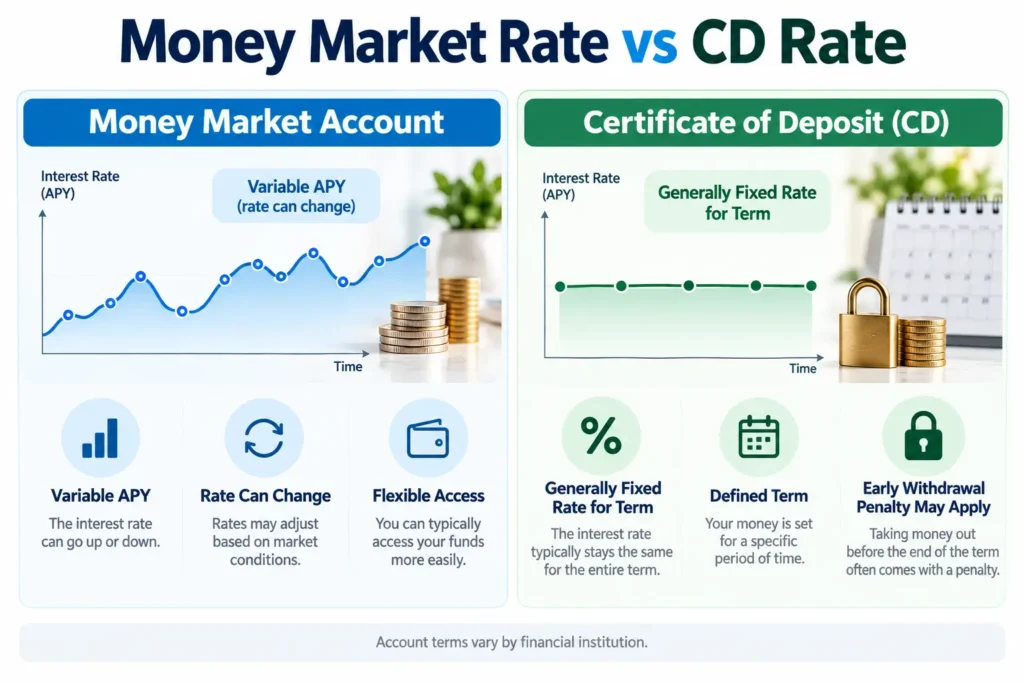
The trade-off is liquidity.
Money market accounts generally allow easier access to your money, while CDs may impose an early withdrawal penalty if you take principal out before maturity.
Therefore, comparing APY alone doesn’t tell the whole story.
Does the Federal Reserve Affect Money Market Account Rates?
Federal Reserve decisions can influence the broader interest-rate environment in which banks operate.
Deposit rates don’t necessarily move by exactly the same amount or at exactly the same time as changes in the Fed’s target rate.
Each institution decides what APY to offer depositors.
That’s why two banks can offer very different money market rates at the same time.
Minimum Balances and Money Market Rates
Pay close attention to the distinction between:
Minimum opening deposit: the amount required to open the account.
Minimum balance for APY: the balance required to earn a particular advertised yield.
Minimum balance to avoid fees: the amount you may need to maintain to avoid a monthly charge.
These aren’t necessarily the same number.
For example, Bankrate lists CFG Bank at 4.05% APY with a $1,000 minimum deposit, while Quontic is listed at 3.90% APY with a $100 opening deposit. Bankrate
This illustrates why choosing an account based solely on the highest APY can be misleading.
Are High Money Market Rates Safe?
The size of the APY doesn’t determine whether a bank deposit is federally insured.
For a money market deposit account held at an FDIC-insured bank, eligible deposits receive FDIC insurance subject to applicable coverage rules.
The standard FDIC insurance amount is $250,000 per depositor, per insured bank, for each account ownership category.
At federally insured credit unions, qualifying accounts receive NCUA coverage subject to its applicable rules.
Don’t confuse a money market deposit account with a money market mutual fund. The latter is an investment product and isn’t FDIC-insured.
How to Compare Money Market Account Rates
When comparing accounts, look beyond the headline APY.
Consider the current APY, the balance needed to earn it, minimum opening deposit, monthly fees, check-writing availability, ATM or debit-card access, transfer policies and federal deposit insurance eligibility.
If you’re building an emergency reserve, accessibility may matter almost as much as the rate. Our guide on how to build an emergency fund explains what else to consider.
Frequently Asked Questions
What are money market account rates today?
Rates vary significantly by institution. As of late September 2026, Bankrate reports a national average MMA yield of approximately 0.46% APY, while several competitive accounts it tracks offer roughly 3% to just above 4% APY. Bankrate
What is the highest money market account rate right now?
The answer depends on which institutions and products are included in the comparison. Bankrate’s September 28 list reaches 4.05% APY, while Forbes reported money market rates reaching 5.00% on September 29. This difference is one reason to verify the account type, eligibility conditions and current rate directly before applying. Bankrate
What is the average money market account rate?
Bankrate reported an average money market account yield of approximately 0.46% APY for the week of September 28, 2026. Bankrate
Can money market account rates change?
Yes. Money market account APYs are generally variable, so financial institutions can raise or lower them.
Is a 4% money market rate good?
In late September 2026, an APY around 4% is substantially above Bankrate’s reported national MMA average of 0.46%. However, also compare balance requirements, fees and access features before evaluating an account. Bankrate
Which pays more, a money market account or a high-yield savings account?
Either can offer the higher APY. Compare individual products rather than assuming one account category always pays more.
Are money market account rates fixed?
Generally no. MMA rates are usually variable. A traditional CD, by comparison, generally provides a stated rate for a defined term.
Does a higher balance earn a higher money market rate?
Sometimes. Some institutions use tiered APYs, but policies vary. Check which APY applies to your expected balance.
Final Thoughts
Money market account rates vary considerably, so the national average tells only part of the story.
As of late September 2026, Bankrate reports an average yield around 0.46% APY, while its selected competitive MMAs reach 4.05% APY. Other rate trackers may report different maximums depending on the products and institutions included. Bankrate
Instead of focusing exclusively on the highest advertised number, compare the APY that applies to your balance alongside fees, minimum requirements and access features.
For account-level comparisons, continue with our best money market accounts of 2026.
Financial Disclaimer: The information on SmartCentHub.com is for educational and informational purposes only and does not constitute personalized financial, investment, tax or banking advice. Rates and account terms can change at any time. Verify current information directly with the financial institution before opening an account.