

A money market account is an interest-bearing deposit account offered by banks and credit unions. It combines some features of a savings account with convenient ways to access your money, which may include checks, a debit card, ATM access, or electronic transfers depending on the institution.
If you’ve come across terms such as money market savings account or money market deposit account, they generally refer to this type of deposit account—not to a money market mutual fund.
Money market accounts can be useful for emergency savings, short-term goals, or cash you want to keep accessible while earning interest.
Here’s how they work, what to consider before opening one, and how they compare with other common bank accounts.
What Is a Money Market Account ? Simple Definition
A money market account, often abbreviated MMA, is a deposit account that earns interest while allowing you to withdraw or transfer your money according to the bank’s terms.
Money market deposit accounts at FDIC-insured banks are eligible for federal deposit insurance, subject to applicable coverage limits and ownership rules.
At federally insured credit unions, qualifying deposits receive similar protection through the NCUA.
A money market account shouldn’t be confused with a money market mutual fund. Despite their similar names, one is a deposit account and the other is an investment product.
How Does a Money Market Account Work?
A money market account works similarly to other interest-bearing bank accounts.
You deposit money into the account, and the financial institution pays interest based on the account’s APY and your eligible balance.
Interest may compound daily or according to another schedule and is typically credited periodically. The exact method varies by institution.
Depending on the account, you may be able to access your money through:
- Electronic transfers
- ATM withdrawals
- Debit cards
- Checks
- Transfers to another bank account
Not every money market account provides all of these options, so check the account terms before opening one.
If APY terminology is unfamiliar, our guide explaining what APY means for savings shows how annual percentage yield helps you compare interest-bearing accounts.
Money Market Account vs. Savings Account vs. Checking Account
Understanding a money market account becomes easier when you compare its purpose with checking and savings accounts.
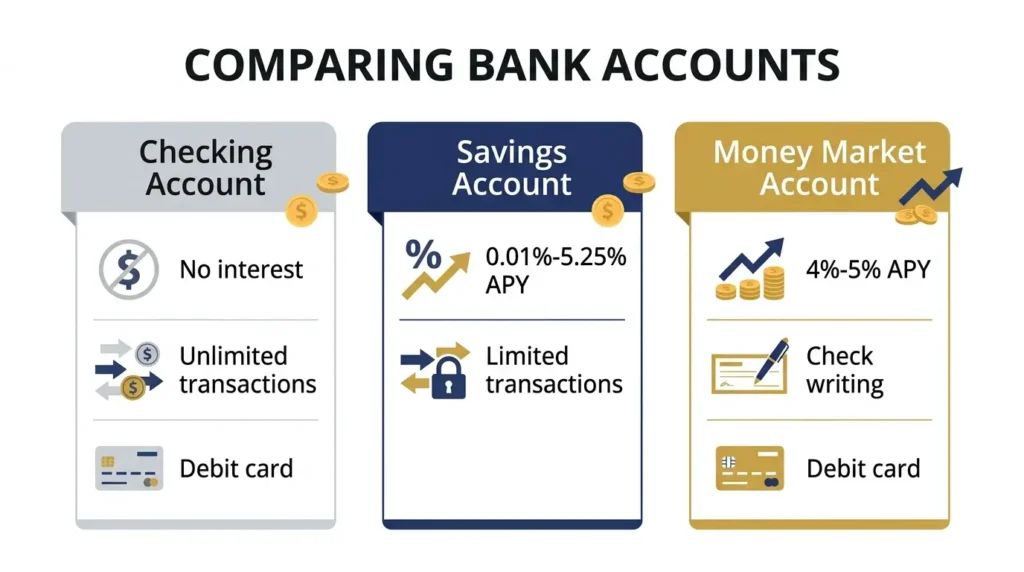
| Feature | Checking Account | Savings Account | Money Market Account |
|---|---|---|---|
| Earns interest | Sometimes | Usually | Usually |
| Debit card | Usually | Sometimes | Sometimes |
| Check writing | Usually | Rare | Sometimes |
| ATM access | Usually | Often | Depends on account |
| APY | Usually lower | Varies widely | Varies widely |
| Best suited for | Everyday spending | Saving | Saving with added access features |
A checking account is primarily designed for frequent spending and transactions.
A savings account is designed primarily for holding money and earning interest.
A money market account sits somewhere between the two: its primary purpose is saving, but some accounts provide additional ways to access your money.
For a closer look at the first two account types, see our guide to checking vs. savings accounts.
Money Market Account vs High-Yield Savings Account
Money market accounts and high-yield savings accounts have considerable overlap.
Both can earn competitive interest, both generally have variable APYs, and eligible deposit accounts can receive federal deposit insurance.
The main differences often involve access and account requirements.
| Feature | Money Market Account | High-Yield Savings Account |
|---|---|---|
| Earns interest | Yes | Yes |
| APY | Variable | Variable |
| Check writing | Available on some accounts | Usually unavailable |
| Debit/ATM access | Available on some accounts | Depends on bank |
| Minimum balance | May apply | May apply |
| Monthly fees | Depends on account | Depends on account |
| Deposit insurance | Available at eligible institutions | Available at eligible institutions |
Don’t assume one type automatically pays a higher rate than the other. Banks change their APYs regularly.
You can compare current savings options in our guide to the best high-yield savings accounts of 2026.
What Are Current Money Market Account Rates?
Money market account rates vary substantially among financial institutions and can change over time.
Instead of relying on a fixed APY range, compare:
- Current APY
- Minimum deposit
- Balance required to earn the advertised APY
- Monthly maintenance fees
- Withdrawal options
- Check or debit-card availability
A high advertised APY isn’t necessarily the best deal if maintaining that rate requires a large balance or the account charges fees you cannot easily avoid.
For updated account comparisons, see our guide to the best money market accounts of 2026.
Are Money Market Accounts FDIC Insured?
A money market deposit account held at an FDIC-insured bank is eligible for FDIC deposit insurance.
The standard FDIC insurance amount is $250,000 per depositor, per insured bank, for each account ownership category.
That distinction matters because a money market mutual fund is not FDIC-insured.
Before depositing a large amount of cash, confirm that the bank is FDIC-insured and understand how the applicable ownership category affects your coverage.
Money Market Account vs. Money Market Fund
These two products have similar names but are fundamentally different.
A money market account is a deposit account offered by a bank or credit union.
A money market fund is a mutual fund that invests in short-term, high-quality debt instruments and is generally offered through investment companies or brokerage firms. Unlike a bank money market deposit account, it is an investment product and is not FDIC-insured.
| Money Market Account | Money Market Fund | |
|---|---|---|
| Product type | Deposit account | Investment |
| Offered by | Banks/credit unions | Brokerages/investment companies |
| Earns a return | Interest/APY | Investment income |
| FDIC insurance | Eligible at FDIC-insured banks | No |
| Investment risk | No market-investment risk on the deposit itself, though fees and inflation can affect value | Yes; principal is not guaranteed by FDIC insurance |
This distinction is particularly important when searching for somewhere to keep emergency savings or other cash you don’t want exposed to investment-market risk.
Benefits of a Money Market Account
Money market accounts can provide several advantages.
Interest on your savings: Your balance can earn interest rather than sitting in a non-interest-bearing account.
Access to your money: Depending on the institution, you may receive checks, ATM access or a debit card.
Deposit insurance: Eligible accounts at federally insured institutions receive deposit protection within applicable limits.
Useful for short-term savings: You can keep money available without committing it to a fixed CD term.
However, these advantages vary by account. Always review the bank’s current terms.
When Does a Money Market Account Make Sense?
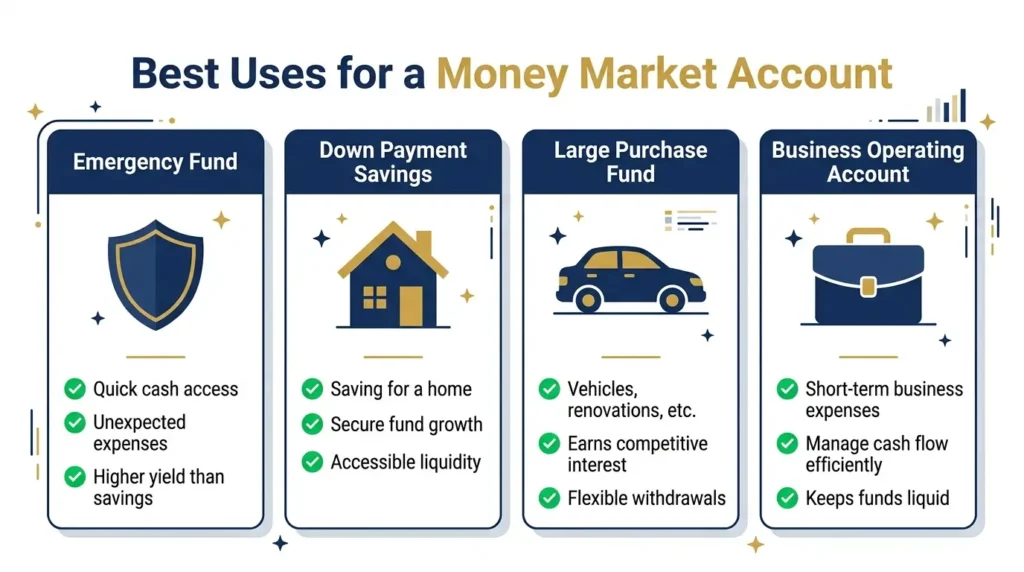
A money market account may be worth considering in several situations.
Emergency savings
Keeping emergency savings in an interest-bearing account can allow the money to earn interest while remaining accessible.
The most important considerations are liquidity, fees, minimum balances and how quickly you can access the funds.
If you’re still building your cash reserve, see our guide on how to build an emergency fund.
Saving for a short-term goal
A money market account may also work for money you’re accumulating for expenses such as:
- A home down payment
- Home improvements
- A car
- Travel
- Tuition
- A major upcoming purchase
For a home specifically, our guide to saving for a house down payment explains how to build that fund.
Cash you don’t want to lock into a CD
Money market accounts generally offer more liquidity than certificates of deposit.
With a CD, you typically agree to leave the deposit for a defined term, and early withdrawals may trigger a penalty.
Learn more about how CDs work in our guide to what a CD account is.
What Are the Disadvantages of Money Market Accounts?
Money market accounts aren’t automatically the best choice for every saver.
Minimum balance requirements
Some institutions require a minimum opening deposit or minimum ongoing balance.
The balance may also affect whether you earn the advertised APY or pay a monthly maintenance fee.
Monthly fees
Some accounts charge maintenance fees, although these may sometimes be waived by meeting specified requirements.
Variable APYs
Money market account APYs are generally variable.
That means the rate can increase or decrease after you open the account.
Transaction policies
Banks may impose their own withdrawal or transfer rules.
The Federal Reserve removed the former federal six-per-month withdrawal limit under Regulation D in 2020, but individual financial institutions may still impose their own transaction limits or fees.
Check the bank’s current policy rather than assuming every money market account follows the same withdrawal rules.
Money Market Account vs. CD
The main distinction is liquidity.
Money market accounts generally allow you to access your funds while the account remains open.
A CD typically requires you to leave your deposit in the account for a specific term, such as several months or years. Withdrawing before maturity may result in an early-withdrawal penalty.
On the other hand, some CDs provide a fixed rate for their term, whereas money market account APYs are generally variable.
If access to your money matters, an MMA may be more flexible. If you won’t need the funds for a defined period, comparing the account with a CD can make sense.
Read what a CD account is before deciding between the two.
How to Choose a Money Market Account
Don’t look only at the advertised APY.
Compare these factors:
- APY — How much interest can the account currently earn?
- Minimum opening deposit — How much do you need to open it?
- Minimum balance — Is a certain balance necessary to earn the stated APY?
- Monthly fee — Is there one, and can it be waived?
- Access — Does the account provide checks, a debit card or ATM withdrawals?
- Transfer policies — Are there account-specific limits?
- Deposit insurance — Is the institution federally insured?
- Online banking — Does the bank provide the features you need?
If your main objective is finding competitive accounts rather than understanding how MMAs work, compare our best money market accounts of 2026.
How to Open a Money Market Account
Opening a money market account is similar to opening many other bank accounts.
First, compare institutions and review the APY, fees, balance requirements and access options.
Once you’ve selected an account, you’ll generally need to provide identifying information requested by the financial institution. The exact requirements depend on the bank and your circumstances.
You can then fund the account using one of the deposit methods supported by the institution.
Before completing the application, review the account agreement carefully—particularly its fee schedule, minimum-balance rules and withdrawal policies.
Our guide on how to open a bank account online explains the general process in more detail.

Frequently Asked Questions
What is a money market account and how does it work?
A money market account is an interest-bearing deposit account offered by a bank or credit union. You deposit money, earn interest according to the account’s APY and can access your funds according to the institution’s rules. Some accounts also provide checks, debit cards or ATM access.
Is a money market account a checking or savings account?
A money market account is a deposit account primarily designed for saving rather than everyday spending. However, some MMAs provide features commonly associated with checking accounts, such as checks or debit-card access.
Is a money market account better than a savings account?
It depends on the account and how you plan to use your money. A money market account may provide additional access features, while a high-yield savings account may offer a competitive APY with different balance requirements. Compare actual rates, fees and features rather than assuming one account type is always better.
Is a money market account safe?
Money market deposit accounts at FDIC-insured banks are eligible for federal deposit insurance within applicable limits. At federally insured credit unions, qualifying accounts receive NCUA coverage. This protection doesn’t apply to money market mutual funds.
Are money market accounts FDIC insured?
Money market deposit accounts at FDIC-insured banks are eligible for coverage. The standard FDIC insurance amount is $250,000 per depositor, per insured bank, for each account ownership category.
Can you lose money in a money market account?
Money deposited within applicable insurance limits at an FDIC-insured bank is protected against loss if the bank fails. However, fees can reduce your balance, and inflation can reduce your money’s purchasing power. Money market mutual funds are different investment products and aren’t FDIC-insured.
What is the difference between a money market account and a money market fund?
A money market account is a deposit account offered by a bank or credit union. A money market fund is an investment product that holds short-term securities. Money market funds aren’t FDIC-insured and can carry investment risk.
Do money market accounts have withdrawal limits?
Banks can establish their own withdrawal and transfer policies. The former federal Regulation D six-per-month limit was removed in 2020, but individual institutions may still impose limits or fees. Check the specific account’s terms.
What is a good money market account rate?
There isn’t one APY that remains “good” indefinitely because rates change. Compare an account’s current APY with competing money market accounts and high-yield savings accounts, while also considering fees and minimum-balance requirements.
Final Thoughts
A money market account can provide a useful combination of interest earnings, liquidity and access to cash.
It can be particularly useful for emergency savings and short-term financial goals when you want your money to earn interest without committing it to a fixed-term product.
But don’t choose an account based only on its label. Compare the APY, fees, minimum balance, withdrawal policies and access features with high-yield savings accounts and CDs.
If you’ve decided that an MMA fits your needs, the next step is to compare the best money market accounts of 2026 and their current rates, fees and minimum deposit requirements.
Financial Disclaimer: The information on SmartCentHub.com is for educational and informational purposes only and does not constitute personalized financial or banking advice. Rates, fees and account features can change. Verify current terms directly with the financial institution before opening an account.