

📢 Disclosure: This post contains affiliate links. We may earn a commission at no extra cost to you. We only recommend products we genuinely believe in.
Learning how to start investing with $100 can be a practical way to begin building investing experience without committing a large amount of money. In 2026, many brokerages offer no-minimum accounts, commission-free trades on eligible securities, and fractional shares, which can make a $100 starting balance workable for beginners.
This guide explains the main decisions involved — including account type, diversification, fees, risk, and how to place a first investment — so you can decide whether investing $100 fits your financial situation.
Before You Invest Your First $100
Investing is powerful — but only when the financial foundation beneath it is solid. Before you put $100 into the market, make sure these boxes are checked:
- You have some emergency savings — the right amount depends on your expenses, job stability, insurance and other circumstances. Avoid investing money you may need for near-term emergencies. Read our guide on how to build an emergency fund first.
- You have a plan for high-interest debt — paying down expensive revolving debt can be a higher-priority use of cash than taking market risk. Compare the interest rate you are paying with the uncertain return you might earn from investing.
- You understand any employer retirement match available to you. Some 401(k) plans offer matching contributions, but the formula, vesting rules and eligibility vary by employer. Review your plan before deciding how to allocate your first $100.
If those basics are reasonably covered, you can compare the investing options below and decide whether investing this $100 fits your goals and time horizon.
Best Ways to Invest $100 as a Beginner
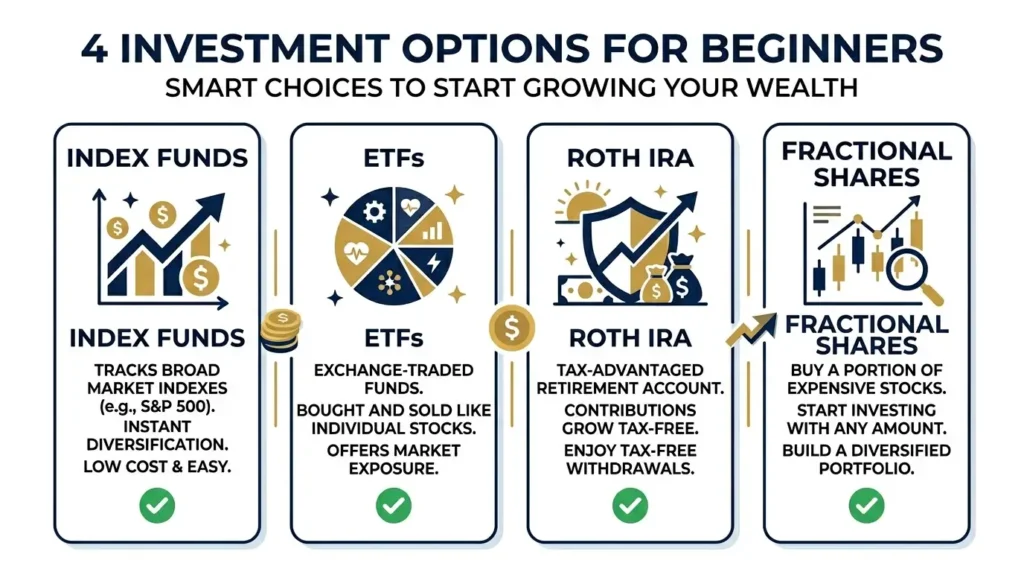
The best investments for beginners share three qualities: low cost, broad diversification, and simplicity. Here are the top options:
1. Broad Index Funds — A Simple Diversified Starting Point
An index fund is a mutual fund or ETF that seeks to track a market index. Broad index funds can make diversification easier because one fund may hold hundreds or thousands of securities, although diversification does not eliminate market risk. For a deeper explanation, read our guide to how to invest in index funds.
- Return: Varies with the index and market conditions; historical returns do not guarantee future results
- Minimum investment: As low as $1 with fractional shares
- Fees: Extremely low (0.03%–0.20% expense ratio)
- Best for: Long-term wealth building, retirement savings
- Risk level: Medium — value fluctuates with the market
2. ETFs — A Flexible Fund Structure
An ETF is a fund structure that trades on an exchange during market hours. Some ETFs are index funds and some are actively managed, so “ETF” and “index fund” are not opposites. Many broad-market ETFs are available through fractional-share programs at participating brokerages. Read our full guide on what an ETF is to understand the distinction.
- Average annual return: ~7–10% (broad market ETFs)
- Minimum investment: $1 with fractional shares
- Fees: Very low (0.03%–0.15%)
- Best for: Beginners who want flexibility and low costs
- Risk level: Medium
3. Roth IRA — A Tax-Advantaged Account for Eligible Savers
A Roth IRA is not an investment itself — it is a tax-advantaged retirement account in which you can hold investments. Contributions are made with after-tax dollars, and qualified withdrawals can be tax-free. Eligibility and contribution limits apply, so compare a Roth IRA with a taxable brokerage account based on your goals and access needs.
- 2026 IRA contribution limit: $7,500, or $8,600 if age 50 or older, subject to compensation and Roth IRA eligibility rules
- Tax benefit: Tax-free growth and withdrawals in retirement
- Minimum investment: $0 at most online brokerages
- Best for: Long-term retirement savings, beginners with earned income
- Risk level: Depends on what you invest in inside the account
Read our complete guide on what a Roth IRA is for the account rules and tradeoffs.
4. Fractional Shares — Best for Stock Market Access
Many well-known companies have share prices of $300, $500, or even $3,000+. Fractional shares let you buy a portion of one share for as little as $1. This means you can invest in any company in the market with $100 — without needing to afford a full share.
- Minimum investment: $1
- Best for: Beginners who want exposure to specific companies
- Risk level: Higher than index funds — individual stocks are volatile
- Note: Best used as a small portion of a diversified portfolio, not the whole thing
Investment Options Compared
| Investment Type | Min. Amount | Avg. Return | Risk Level | Best Account | Best For |
|---|---|---|---|---|---|
| Index Funds | $1 | 7–10%/yr | Medium | Roth IRA / Brokerage | Long-term wealth |
| ETFs | $1 | 7–10%/yr | Medium | Roth IRA / Brokerage | Flexible diversification |
| Roth IRA | $0 | Varies | Varies | IS the account | Tax-free retirement |
| Fractional Shares | $1 | Varies | Higher | Brokerage | Specific companies |
| High-Yield Savings | $0 | 4–5% | None | HYSA | Short-term / emergency |
How to Think About a First $100 Portfolio
If you are not sure where to start, use the examples below to understand how different fund choices change diversification. These are educational illustrations, not personalized portfolio recommendations.
Example A — One broad U.S. market fund
- 100% in VTI (Vanguard Total Stock Market ETF) or FZROX (Fidelity Zero Total Market)
- Instant exposure to every publicly traded US company
- Expense ratio: 0.03% (VTI) or 0.00% (FZROX)
Example B — U.S. plus international stocks
- 80% in VTI (US total market)
- 20% in VXUS (international stocks)
- Covers virtually the entire global stock market
Example C — A target-date fund
- 100% in a Target-Date 2055 or 2060 fund (e.g., Vanguard Target Retirement 2055)
- Automatically adjusts risk as you approach retirement
- Zero ongoing decisions required
Each approach has different tradeoffs. A broad U.S. fund does not provide the same geographic diversification as a global allocation, and a target-date fund may include stocks and bonds based on its glide path. Review the fund prospectus, fees, holdings and risk before investing.
Best Apps to Invest $100 in 2026
Choosing the right platform matters — especially as a beginner. Here are the top options based on ease of use, fees, and features:
| Platform | Best For | Account Min. | Fractional Shares | Standout Feature |
|---|---|---|---|---|
| Fidelity | Overall best for beginners | $0 | Yes ($1 min) | Zero-fee index funds (FZROX, FZILX) |
| Charles Schwab | Research + simplicity | $0 | Yes ($5 min) | Excellent customer service |
| Vanguard | Long-term index investing | $0 | Yes | Home of the index fund |
| Robinhood | Mobile-first beginners | $0 | Yes ($1 min) | Clean, simple interface |
| Public | Social + beginner learning | $0 | Yes ($1 min) | Community features |
Brokerages differ in account features, fractional-share rules, fund availability, customer service and research tools. Compare those details rather than assuming one platform is best for everyone. See our full guide on the best investment apps for beginners for a deeper comparison.
How $100/Month Grows Over Time
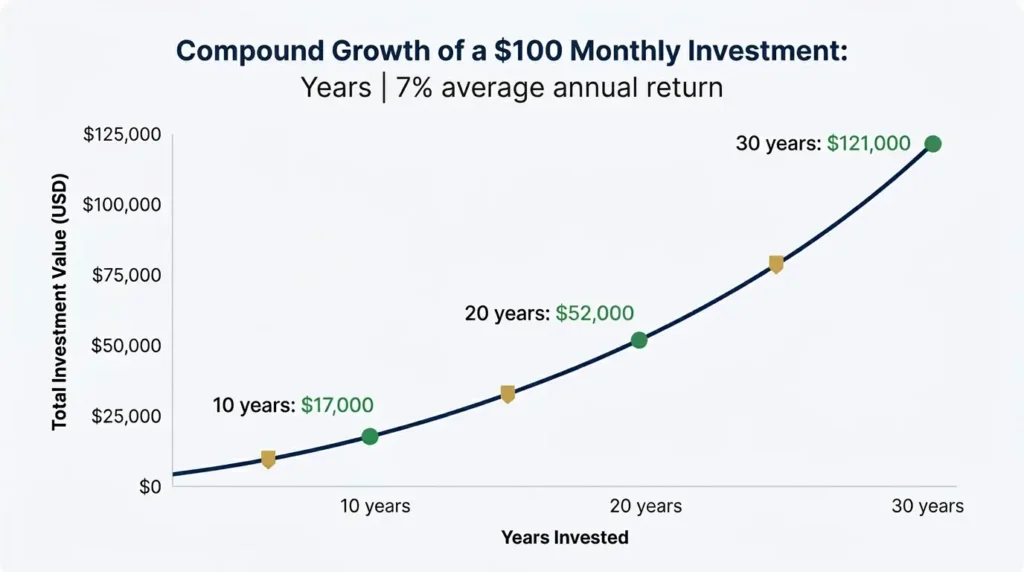
The most powerful force in investing is time — not the amount you start with. Here’s what happens when you invest just $100 per month at a 7% average annual return (historical S&P 500 average after inflation):
| Years Invested | Total Contributed | Portfolio Value | Gains from Compounding |
|---|---|---|---|
| 5 years | $6,000 | $7,159 | $1,159 |
| 10 years | $12,000 | $17,308 | $5,308 |
| 20 years | $24,000 | $52,093 | $28,093 |
| 30 years | $36,000 | $121,997 | $85,997 |
| 40 years | $48,000 | $262,481 | $214,481 |
Starting at 25 and investing $100/month until 65 turns $48,000 of contributions into over $262,000 — with more than $214,000 coming purely from compound growth. This is why starting early matters far more than the amount you start with.
To understand the strategy behind consistent monthly investing, read our guide on dollar-cost averaging.
Step-by-Step: How to Make Your First Investment
Here is exactly how to start investing with $100 today, from zero to your first investment:
- Choose where to invest . For most beginners, open a Roth IRA if you have earned income. If you’ve already maxed your Roth IRA or don’t qualify, open a taxable brokerage account.
- Pick a brokerage. Look for commission-free trading, no account minimums, fractional shares support, and a beginner-friendly app. Popular options include Fidelity, Charles Schwab, and Vanguard.
- Open your account. The process takes 10–15 minutes. You’ll need your Social Security number, bank account details, and basic personal information.
- Fund your account. Transfer your $100 from your bank account. Most brokerages process transfers in 1–3 business days.
- Choose your investment. For most beginners, a total market index fund or S&P 500 ETF is the best starting point. Simple, diversified, and low-cost.
- Buy your investment. Enter the fund name or ticker symbol, enter your dollar amount ($100), and confirm. You’re now an investor.
- Set up automatic monthly contributions. Even $50 or $100/month automated makes a dramatic difference over time. Set it and forget it.
Common Beginner Investing Mistakes to Avoid
- Trying to time the market. Predicting short-term market movements consistently is extremely difficult. A recurring investing plan can reduce the pressure to guess the “right” day to invest. Read our dollar-cost averaging guide to understand the tradeoffs.
- Reacting impulsively to market drops. Stock markets can decline sharply and recovery times vary. Selling after a decline can crystallize losses, but staying invested also does not guarantee a particular recovery timeline. Match your investments to your time horizon and risk tolerance.
- Picking individual stocks as a beginner. Individual stocks are volatile and require deep research. Start with diversified index funds and add individual stocks later if you choose.
- Waiting for a perfect starting amount. Many brokerages allow small starting balances, so you may not need thousands of dollars to begin. Starting earlier can give investments more time to compound, but future returns are uncertain.
- Ignoring fees. Fees reduce investment returns over time. Compare expense ratios and account charges among funds that provide similar exposure rather than using one fixed fee threshold for every investment.
- Investing money you may need soon. Short-term cash needs generally call for more liquidity and less market risk. Compare options such as a high-yield savings account for near-term goals.
The Right Order: Where $100 Should Go First
If you’re deciding between several financial priorities, here’s the optimal order for your money:
| Priority | Action | Why |
|---|---|---|
| 1st | $1,000 emergency fund | Prevents going into debt for surprises |
| 2nd | 401(k) up to employer match | 50–100% instant return |
| 3rd | Pay off high-interest debt | Guaranteed return equal to interest rate |
| 4th | Roth IRA ($100/month) | Tax-free compound growth |
| 5th | Full emergency fund (3–6 months) | Complete financial safety net |
| 6th | Taxable brokerage account | No limits, maximum flexibility |
Frequently Asked Questions
Can I really start investing with just $100?
Yes. In 2026, most major brokerages have no minimum account balance and offer fractional shares starting at $1. You can open a Roth IRA or brokerage account, deposit $100, and buy a slice of an S&P 500 index fund the same day. The amount matters less than starting early and investing consistently.
What is the best investment for a beginner with $100?
The best investment for most beginners is a low-cost S&P 500 index fund or total market ETF inside a Roth IRA. This gives you instant diversification across hundreds of companies, extremely low fees (under 0.10%), and tax-free growth for retirement. It requires no investment expertise to maintain.
Should I pay off debt before investing?
It depends on the interest rate. High-interest debt (credit cards at 20%+) should be paid off before investing — no investment reliably beats a 20%+ guaranteed return. Low-interest debt (student loans at 4–6%) can be paid alongside investing. Always capture your 401(k) employer match first, regardless of debt.
How much money can I make investing $100/month?
At a 7% average annual return, $100/month grows to approximately $17,000 in 10 years, $52,000 in 20 years, and $122,000 in 30 years. The longer you invest, the more compound growth does the heavy lifting—most of the final balance comes from growth, not your contributions.
Is it safe to invest $100 in the stock market?
The stock market carries risk and your balance can fall, sometimes for extended periods. Broad index funds can reduce company-specific risk through diversification, but they still have market risk and no recovery timeline is guaranteed. Invest only money that fits your time horizon and risk tolerance.
What’s the difference between a Roth IRA and a brokerage account?
A Roth IRA is a tax-advantaged retirement account in which qualified withdrawals can be tax-free, but annual contribution limits and income eligibility rules apply. For 2026, the combined traditional and Roth IRA contribution limit is $7,500, or $8,600 if age 50 or older, subject to compensation rules. A taxable brokerage account has different tax treatment and no IRA contribution limit. Which account fits best depends on your goals and access needs.
Can I invest $100 and withdraw it anytime?
In a taxable brokerage account, yes — you can withdraw at any time, though you may owe capital gains tax on profits. In a Roth IRA, you can withdraw your contributions (not earnings) at any time penalty-free, but withdrawing earnings before age 59½ typically triggers taxes and a 10% penalty. For money you might need soon, use a high-yield savings account instead.
What if the market crashes right after I invest my $100?
This is the most common fear for new investors — and it’s understandable. But a market crash early in your investing journey is actually less damaging than it sounds. Your $100 would drop in value temporarily, but because you’re investing regularly, you’d also be buying more shares at lower prices each month. Long-term investors who stayed invested through every major crash—2008, 2020, 2022—recovered fully and went on to significant gains.
Is $100 a month enough to retire on?
$100/month is a powerful starting point, but probably not enough on its own for a full retirement — it depends heavily on when you start. Starting at 25, $100/month grows to ~$262,000 by age 65 at 7% annual returns. Most financial planners suggest saving 10–15% of your income for retirement. Use $100/month as a floor, and increase contributions with every raise or income boost.
Do I need a financial advisor to start investing with $100?
No. For a beginner investing in low-cost index funds via a Roth IRA or brokerage account, a financial advisor is not necessary—and the cost of one often outweighs the benefit at this stage. The strategy is simple: open an account, buy a broad index fund, automate contributions, and don’t interfere. A financial advisor becomes more valuable as your portfolio grows and your financial situation becomes more complex.
Final Thoughts: Start with $100, Stay Consistent
The best time to start investing was yesterday. The second best time is today.
You don’t need the perfect amount, the perfect market conditions, or the perfect investment to begin. Open an account, invest your $100 in a simple index fund, set up a monthly automatic contribution, and let time do the rest.
The habits you build now compound just like the money does—and your future self will thank your present self for starting now rather than waiting for the “perfect” moment.
For the next step, read our guide on dollar-cost averaging to understand recurring investing, or compare the best investment apps for beginners.