

📢 Disclosure: This post contains affiliate links. We may earn a commission at no extra cost to you. We only recommend products we genuinely believe in.
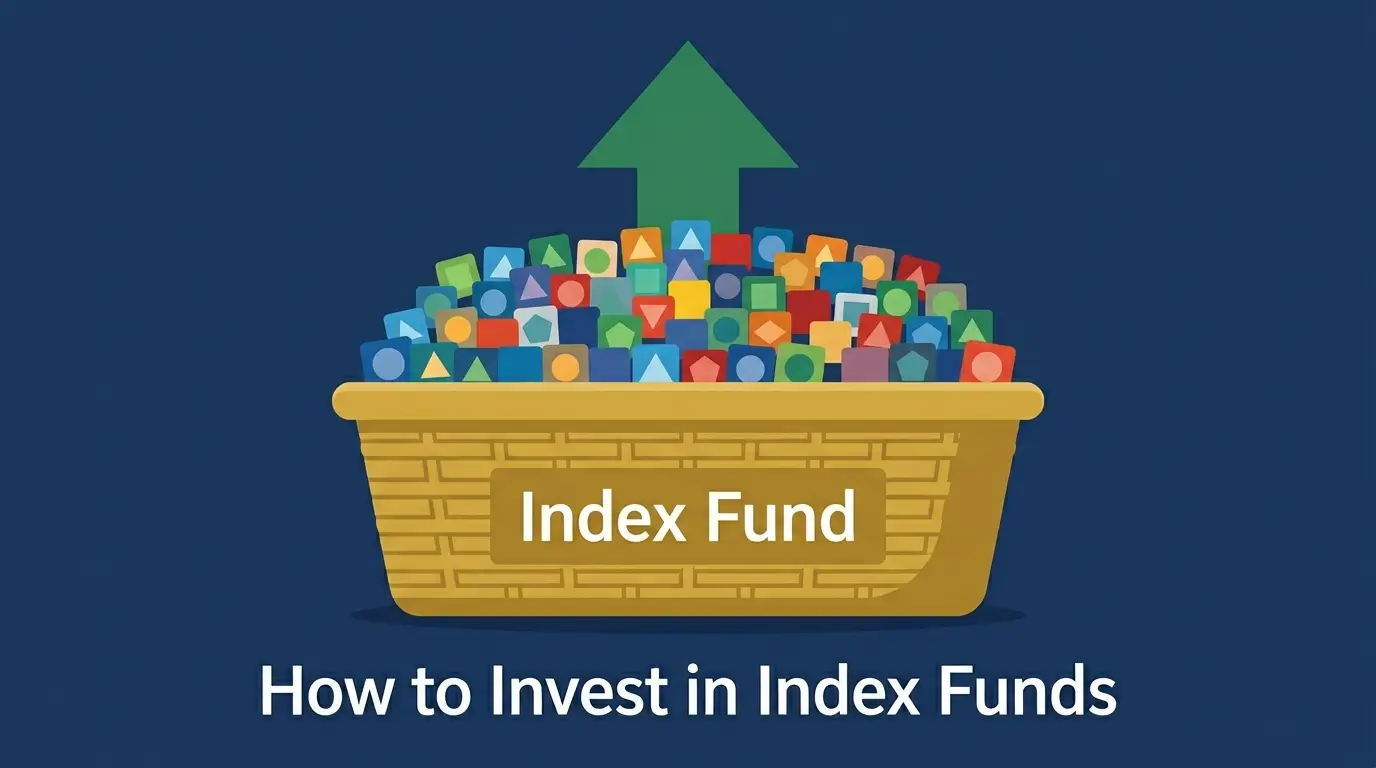
How to invest in index funds is the single most recommended starting point for every beginner investor — and for good reason. Learning how to invest in index funds gives you instant diversification across hundreds of companies, extremely low fees, and historically consistent long-term returns, all with minimal effort and zero need to pick individual stocks. This complete guide on how to invest in index funds walks you through what index funds are, which ones to choose in 2026, how to evaluate them, and the exact step-by-step process to make your first purchase today.
What Is an Index Fund and Why Should You Invest in One?
An index fund is a type of investment fund designed to track the performance of a specific market index — most commonly the S&P 500. Instead of a fund manager actively picking stocks, an index fund simply buys all the stocks in the index in proportion to their size. This passive approach is why index funds have dramatically lower fees than actively managed funds.
When you invest in index funds, you own a tiny slice of every company in that index. One share of an S&P 500 index fund gives you exposure to Apple, Microsoft, Amazon, Google, and 496 other companies simultaneously — instant diversification for the price of a single investment. For a deeper explanation of how index funds relate to ETFs, read our guide on what is an ETF.
Why Most Experts Recommend Investing in Index Funds
The case for investing in index funds is overwhelming:
- Over 15-year periods, more than 90% of actively managed funds underperform their benchmark index — after fees
- S&P 500 index funds have historically returned approximately 10% annually before inflation and 7% after inflation
- Expense ratios as low as 0.00%–0.03% mean almost none of your return is eaten by fees
- Zero stock-picking required — you never need to research individual companies
- Tax-efficient — index funds generate fewer taxable events than actively managed funds
- Fully accessible — most brokerages allow fractional index fund purchases starting at $1
Why Expense Ratios Matter When You Invest in Index Funds
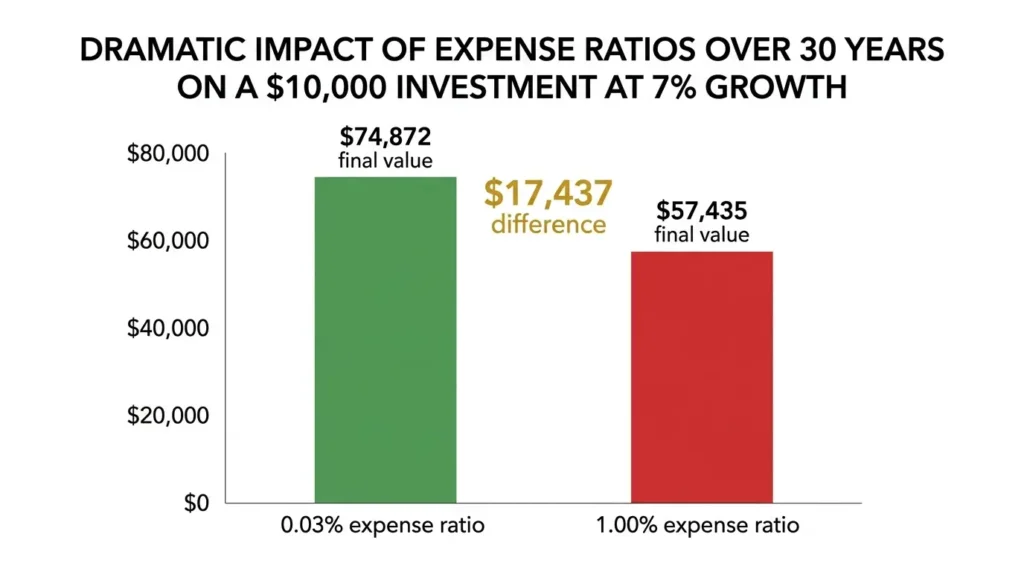
The expense ratio is the annual fee charged by the fund — deducted automatically from your returns. When you invest in index funds, this is the single most important number after the index being tracked. Here is the dramatic long-term impact of expense ratios on a $10,000 investment at 7% annual return over 30 years:
| Expense Ratio | Annual Cost on $10,000 | 30-Year Final Value | Cost vs 0.03% Fund |
|---|---|---|---|
| 0.00% (Fidelity Zero) | $0 | $76,123 | Baseline best |
| 0.03% (Vanguard VOO) | $3 | $74,872 | -$1,251 |
| 0.50% (typical active ETF) | $50 | $65,000 | -$9,872 |
| 1.00% (typical mutual fund) | $100 | $57,435 | -$17,437 |
A 1% expense ratio costs $17,437 over 30 years on just one $10,000 investment — compared to a 0.03% fund tracking the exact same index. Always choose index funds with expense ratios below 0.10% when you invest in index funds.
Best Index Funds to Invest in for Beginners
When learning how to invest in index funds, choosing the right fund is straightforward. For most beginners, one of these five funds is the right starting point:
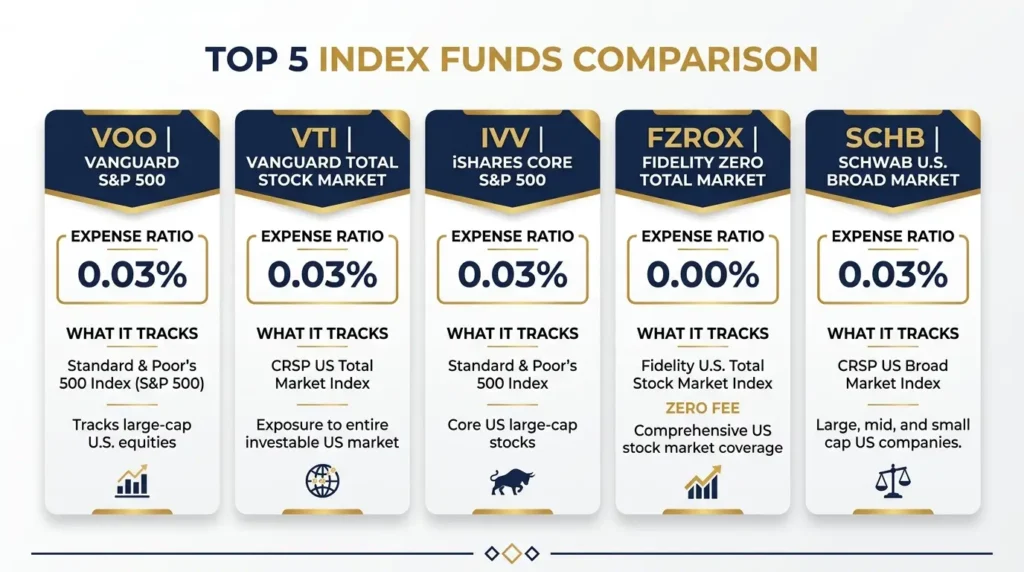
VOO — Vanguard S&P 500 ETF
- Tracks: S&P 500 (500 largest US companies)
- Expense ratio: 0.03%
- Available at: Most brokerages
- Best for: Core long-term S&P 500 exposure
VTI — Vanguard Total Stock Market ETF
- Tracks: Entire US stock market (4,000+ companies)
- Expense ratio: 0.03%
- Available at: Most brokerages
- Best for: Broadest US market diversification including small caps
IVV — iShares Core S&P 500 ETF
- Tracks: S&P 500
- Expense ratio: 0.03%
- Available at: Most brokerages
- Best for: S&P 500 exposure, excellent liquidity
FZROX — Fidelity Zero Total Market Index Fund
- Tracks: Total US stock market
- Expense ratio: 0.00% — literally free
- Available at: Fidelity accounts only
- Best for: Fidelity account holders who want zero fees
SCHB — Schwab US Broad Market ETF
- Tracks: Total US stock market
- Expense ratio: 0.03%
- Available at: Most brokerages
- Best for: Schwab account holders
How to Invest in Index Funds Step by Step
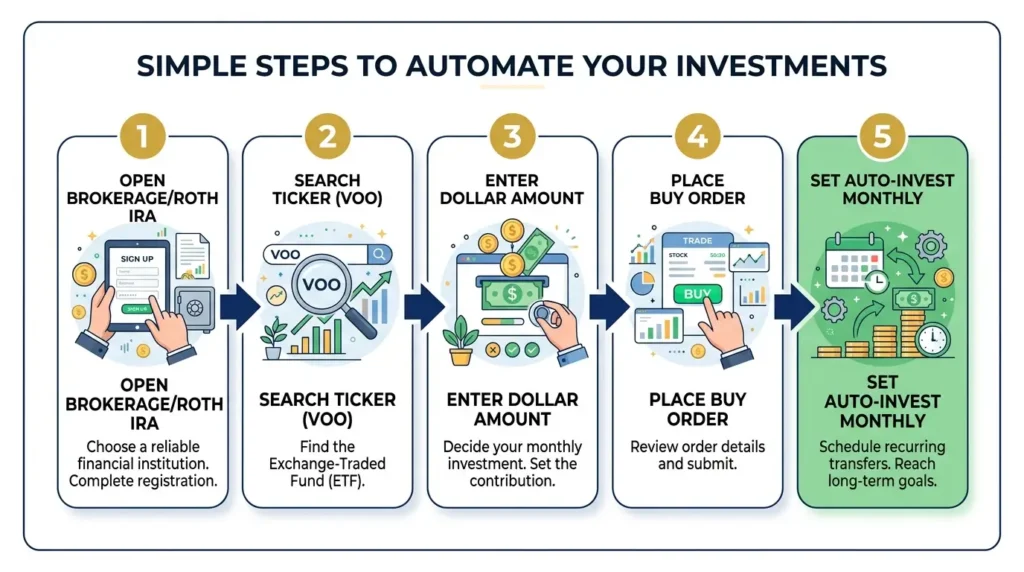
Here is the exact process to invest in index funds for the first time:
- Choose where to invest — open a Roth IRA for tax-free retirement growth, a 401(k) through your employer, or a taxable brokerage account. Read our guide on what a Roth IRA is to understand which account type is right for you.
- Open your account — Fidelity, Vanguard, and Charles Schwab all offer commission-free index fund investing with $0 minimums. The process takes 15 minutes online. See our guide on the best investment apps for beginners to choose the best platform.
- Fund your account — link your bank account and transfer your initial investment amount. Even $50 is enough to start.
- Search for your index fund — type the ticker symbol (VOO, VTI, IVV) in the search bar
- Buy the index fund — enter the dollar amount you want to invest. Most platforms now offer fractional shares, so you can invest any amount regardless of the full share price.
- Set up automatic monthly investments — schedule a recurring purchase of a fixed dollar amount on your payday. This is dollar-cost averaging — the most effective strategy for long-term index fund investing. Read our complete guide on dollar-cost averaging explained.
Index Fund vs Actively Managed Fund: The Numbers
| Feature | Index Fund | Actively Managed Fund |
|---|---|---|
| Expense ratio | 0.00%–0.10% | 0.50%–1.50%+ |
| Stock selection | Automatic (tracks index) | Fund manager picks stocks |
| 15-year outperformance rate | Beats 90%+ of active funds | Less than 10% beat their index |
| Taxes (taxable accounts) | Very tax-efficient | Higher capital gains distributions |
| Required research | None — choose and hold | Constant monitoring needed |
| Minimum investment | $1 with fractional shares | Often $1,000+ |
Common Mistakes When You First Invest in Index Funds
- Buying multiple S&P 500 index funds — owning VOO and IVV is not diversification, they track the identical index. Pick one.
- Selling during market downturns — the S&P 500 has recovered from every single correction in history. Selling locks in losses permanently.
- Waiting for the “right time” to invest — time in the market beats timing the market. Start immediately with any amount.
- Ignoring the account type — the same index fund in a Roth IRA grows tax-free; in a taxable account, dividends and gains are taxed annually. Account choice matters as much as fund choice.
- Stopping automatic contributions — the power of index fund investing comes from consistent monthly additions, not the initial lump sum.
To understand how your index fund investments compound over decades, read our guide on what is compound interest. And to start investing today with whatever amount you have available, read our guide on how to start investing with $100.
Frequently Asked Questions
How do I invest in index funds as a beginner?
To invest in index funds as a beginner: open a Roth IRA or brokerage account at Fidelity, Vanguard, or Schwab. Fund it with any amount — even $50. Search for an S&P 500 index fund like VOO, VTI, or IVV. Enter the amount you want to invest and place a buy order. Then set up automatic monthly contributions. That is the entire process — no research, no stock-picking required.
How much money do I need to invest in index funds?
With fractional shares available at most major brokerages in 2026, you can invest in index funds with as little as $1. You do not need to afford a full share of VOO (approximately $500+) — you can buy $10, $50, or $100 worth of any index fund and own a proportional slice. The amount matters far less than starting early and investing consistently.
What is the best index fund to invest in for 2026?
The best index funds to invest in for 2026 are low-cost S&P 500 or total market funds: VOO (Vanguard S&P 500, 0.03%), VTI (Vanguard Total Market, 0.03%), IVV (iShares S&P 500, 0.03%), and FZROX (Fidelity Zero Total Market, 0.00%). For most beginners, any one of these is an excellent starting point — they all track broadly diversified indexes at minimal cost.
Are index funds safe to invest in?
Index funds carry market risk — their value rises and falls with the market. However, broad market index funds (S&P 500, total market) are among the safest long-term investments for building wealth because they are diversified across hundreds of companies. The S&P 500 has recovered from every recession and correction in history. The key is investing money you will not need for at least 5–10 years.
Should I invest in index funds or ETFs?
For most beginners, the distinction is minor — both can track the same index at the same low cost. ETFs trade throughout the day like stocks; traditional index funds (mutual funds) are priced once per day. Most popular index funds like VOO and VTI are themselves ETFs. The fund’s expense ratio and the index it tracks matter far more than whether it is structured as an ETF or a mutual fund.
Final Thoughts: Invest in Index Funds and Let Time Do the Work
Learning how to invest in index funds is the most impactful 30 minutes you will spend on your financial education. The strategy is simple: pick one low-cost broad market index fund, open a Roth IRA, invest whatever you can each month automatically, and never stop. No stock analysis. No market timing. No financial advisor. Just consistent, low-cost index fund investing — the approach that has made more ordinary people wealthy over the long term than any other strategy.
Open your account today and invest in index funds this week. The best time to start was years ago. The second best time is now. Every month you wait is a month of compound growth permanently missed.