

📢 Disclosure: This post contains affiliate links. We may earn a commission at no extra cost to you. We only recommend products we genuinely believe in.
How to begin investing in index funds is the single most important financial question a beginner investor can ask — because it is the starting point for building real, long-term wealth with the least complexity and the lowest cost. Learning how to begin investing in index funds does not require financial expertise, a large amount of money, or hours of research. You need a brokerage account, $50–$100 to start, and the right fund. This complete beginner’s guide on how to begin investing in index funds walks you through every step — from opening your first account to setting up automatic monthly investments — so you can start today.
Why Index Funds Are the Best Starting Point for Every Beginner
Before explaining how to begin investing in index funds, it helps to understand why index funds are universally recommended as the starting point for beginners. An index fund is a single investment that automatically holds a collection of hundreds or thousands of stocks — tracking a market index like the S&P 500. When you begin investing in index funds, you instantly own a small piece of Apple, Microsoft, Amazon, Google, and hundreds of other companies for the price of a single share.
- Zero stock-picking required — the fund manages itself automatically
- Expense ratios as low as 0.00%–0.03% — almost none of your return is eaten by fees
- Instant diversification across 500–4,000 companies in one purchase
- Historically 7%–10% average annual returns — outperforming 90%+ of actively managed funds over 15-year periods
- Accessible with as little as $1 through fractional shares at most major brokerages
For the complete deep dive into what index funds are and how they work, read our guide on how to invest in index funds — our most comprehensive resource on the topic.
What You Need Before You Begin Investing in Index Funds
To begin investing in index funds, you need three things — and only three things:
- A brokerage account or Roth IRA — where your investment will be held
- Money to invest — as little as $1 with fractional shares, ideally $50–$100 to start meaningfully
- A ticker symbol — the 3–5 letter code for the index fund you want to buy (e.g., VOO, VTI, IVV)
That is genuinely all it takes. No financial advisor. No complicated research. No waiting for the market to be “right.” When you begin investing in index funds, the most important decision is simply choosing the right account type — because tax treatment matters as much as which fund you buy. Read our guide on what a Roth IRA is to understand why it is the recommended starting account for most beginners.
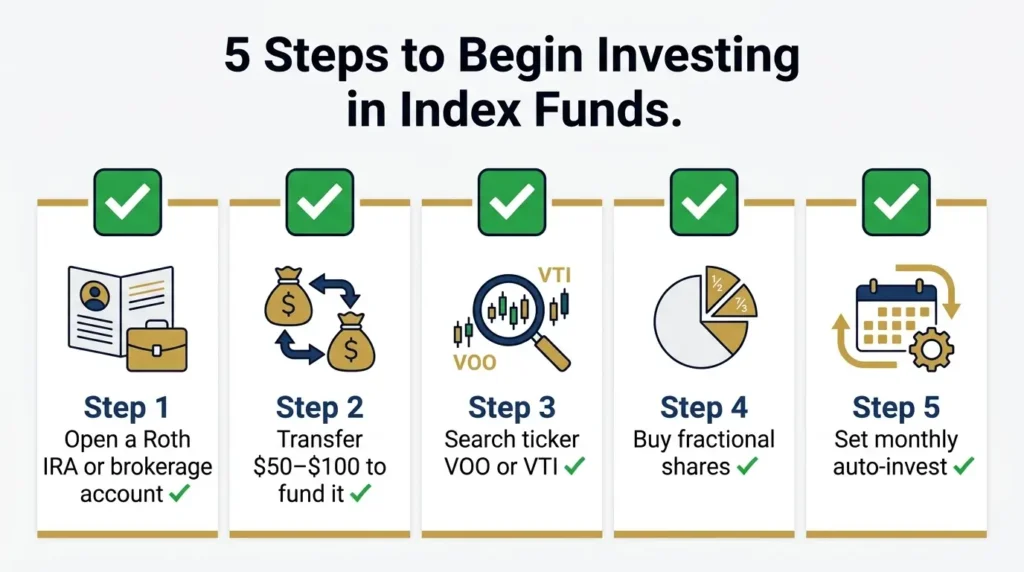
Your First 5 Steps to Begin Investing in Index Funds
Step 1 — Choose Where to Open Your Account
The account type you choose determines how your index fund gains are taxed. For most beginners, start with a Roth IRA — your money grows completely tax-free and withdrawals in retirement are tax-free. If you have already maxed your Roth IRA ($7,500 in 2026), open a taxable brokerage account next.
The best platforms to begin investing in index funds in 2026 are Fidelity, Vanguard, and Charles Schwab — all offer commission-free index fund purchases, fractional shares, and $0 minimums. Read our guide on the best investment apps for beginners to compare your options.
Step 2 — Open the Account Online
Opening a brokerage account or Roth IRA online takes 10–15 minutes. You will need your Social Security number, a government-issued ID, and your bank account information for the initial transfer. Most accounts are approved instantly or within one business day.
Step 3 — Transfer Money to Fund Your Account
Link your checking account and transfer your starting amount. For a Roth IRA, you can contribute up to $7,500/year in 2026. For a taxable brokerage, there is no limit. Even $50–$100 is enough to begin investing in index funds and establish the habit — you can always add more later.
Step 4 — Search for Your Index Fund and Buy
In the search bar of your brokerage, type one of these ticker symbols to begin investing in index funds immediately:
- VOO — Vanguard S&P 500 ETF (0.03% expense ratio)
- VTI — Vanguard Total Stock Market ETF (0.03%)
- IVV — iShares Core S&P 500 ETF (0.03%)
- FZROX — Fidelity Zero Total Market (0.00% — Fidelity only)
Enter the dollar amount you want to invest — not the number of shares. Select “Market Order” to buy at the current price. Click buy. You are now an investor.
Step 5 — Set Up Automatic Monthly Investments
The most powerful thing you can do after your first purchase is to automate a recurring monthly investment. Set up an automatic transfer from your bank account on your payday — even $50 or $100/month — directly into your index fund. This is called dollar-cost averaging, and it eliminates the temptation to time the market. Read our guide on dollar-cost averaging explained to understand why this strategy consistently outperforms manual investing.
What Happens When You Begin Investing in Index Funds Early
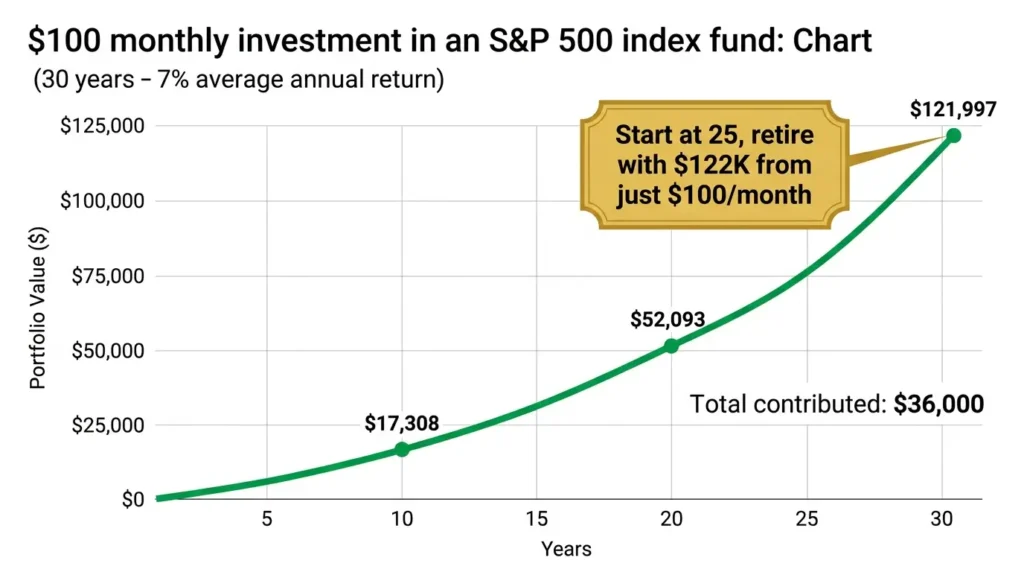
The single biggest advantage when you begin investing in index funds is time — because compound interest turns small monthly investments into life-changing sums over decades. Here is what $100/month invested in a S&P 500 index fund at a 7% average annual return produces:
| Starting Age | Monthly Investment | Total Contributed | Value at Age 65 | Growth Multiple |
|---|---|---|---|---|
| 25 | $100/month | $48,000 | $262,481 | 5.5x |
| 30 | $100/month | $42,000 | $182,946 | 4.4x |
| 35 | $100/month | $36,000 | $121,997 | 3.4x |
| 40 | $100/month | $30,000 | $78,227 | 2.6x |
Starting at 25 versus 35 — with the same $100/month — produces $140,000 more at retirement. The 10-year difference costs only $12,000 in additional contributions but delivers over $140,000 in additional wealth. This is why “begin investing today” is the most important personal finance advice anyone can give. To understand exactly how this growth compounds, read our guide on what is compound interest.
The Best Index Funds to Begin Investing in for Beginners
| Fund | Ticker | Expense Ratio | What It Tracks | Where to Buy |
|---|---|---|---|---|
| Vanguard S&P 500 ETF | VOO | 0.03% | 500 largest US companies | Any brokerage |
| Vanguard Total Market ETF | VTI | 0.03% | Entire US stock market | Any brokerage |
| iShares Core S&P 500 ETF | IVV | 0.03% | 500 largest US companies | Any brokerage |
| Fidelity Zero Total Market | FZROX | 0.00% | Total US market | Fidelity only |
For most beginners, VOO or VTI is the right starting choice — broad diversification, rock-bottom fees, and available at every major brokerage. Pick one and stick with it. You do not need multiple index funds when you begin investing — one broad market fund is all most investors ever need.
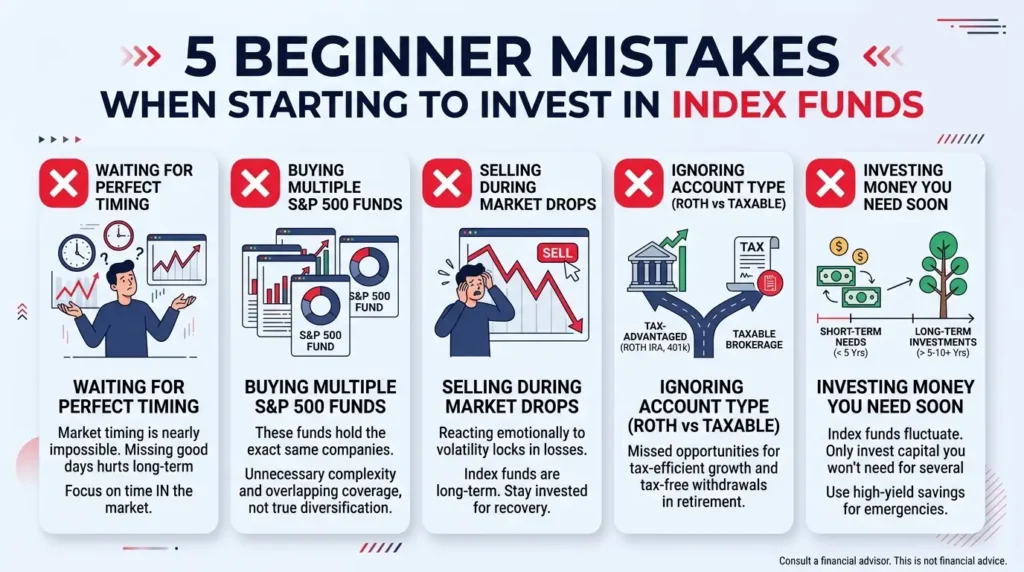
Mistakes to Avoid When You Begin Investing in Index Funds
- Waiting for the “perfect time” — there is no perfect time. The best time to begin investing in index funds is always today. Time in the market beats timing the market every time over 10+ year periods.
- Buying multiple S&P 500 funds — owning VOO, IVV, and SPY is not diversification. They all track the same index. Pick one and add all your contributions to it.
- Selling during market downturns — the S&P 500 has recovered from 100% of its corrections in history. Selling during a drop locks in a permanent loss on what would have been a temporary decline.
- Investing money you need within 1–3 years — index funds are long-term investments. Only invest money you will not need for at least 5 years. Keep short-term savings in a high-yield savings account.
- Skipping the account type decision — the same VOO in a Roth IRA grows tax-free. In a taxable account, dividends are taxed annually. Account type matters as much as fund selection.
Frequently Asked Questions
How do I begin investing in index funds with no experience?
To begin investing in index funds with no experience: open a Roth IRA at Fidelity, Vanguard, or Schwab (takes 15 minutes online), transfer $50–$100 to fund the account, search for the ticker VOO or VTI, enter the dollar amount you want to invest, and click buy. Then set up an automatic monthly contribution of any amount. That is the entire process — no experience required.
How much money do I need to begin investing in index funds?
You can begin investing in index funds with as little as $1 using fractional shares available at Fidelity, Schwab, and most major brokerages in 2026. A practical starting amount is $50–$100 — enough to establish a real position and build the investing habit. The amount matters far less than starting immediately and contributing consistently every month.
What is the best index fund to begin investing in?
The best index funds to begin investing in are VOO (Vanguard S&P 500 ETF, 0.03% fee), VTI (Vanguard Total Stock Market ETF, 0.03%), and FZROX (Fidelity Zero Total Market, 0.00%). All three provide broad diversification at minimal cost and are available at major brokerages. For most beginners, VOO or VTI is the ideal starting fund.
Is it safe to begin investing in index funds?
Broad market index funds carry market risk — values rise and fall with the market. However, they are considered among the safest long-term investment vehicles because they are diversified across hundreds of companies. The S&P 500 has recovered from every single market downturn in history. The key rule: only invest money you will not need for at least 5 years.
Should I open a Roth IRA or brokerage account to begin investing in index funds?
For most beginners, open a Roth IRA first. Your index fund investments grow completely tax-free inside a Roth IRA — you never pay taxes on the gains when you withdraw in retirement. The 2026 annual contribution limit is $7,500. Once your Roth IRA is maxed, open a taxable brokerage account for additional investing beyond the limit.
Final Thoughts: The Best Time to Begin Investing in Index Funds Is Today
Every day you wait to begin investing in index funds is a day of compound growth permanently missed. The strategy is not complicated, the costs are nearly zero, and the historical track record is stronger than virtually any alternative. Open your account today, buy your first index fund this week, and set up an automatic monthly contribution before you close this page.
The only regret investors consistently report about index fund investing is that they did not begin sooner. Start with whatever amount you have — $50, $100, $500 — and let time and compound interest do the work. For the complete, advanced guide to index fund investing strategy, read our full guide on how to invest in index funds.
1 thought on “How to Begin Investing in Index Funds: Beginner’s Complete Guide (2026)”