

📢 Disclosure: This post contains affiliate links. We may earn a commission at no extra cost to you. We only recommend products we genuinely believe in.
How to buy index funds is a simple, step-by-step process that takes less than 20 minutes from start to finish — yet most beginners spend weeks researching before making their first purchase. Learning exactly how to buy index funds removes the last barrier between you and one of the most powerful wealth-building strategies available to everyday Americans. This complete guide on how to buy index funds covers every decision you need to make: where to open an account, which fund to choose, how to place your first order, and how to set up automatic monthly investing so you never have to think about it again.
What You Need to Buy Index Funds
Before explaining how to buy index funds, here is a complete list of what you need — and what you do not need. You need: a brokerage account or Roth IRA, a bank account to fund it, and the ticker symbol of the fund you want to buy. You do not need: a financial advisor, a large amount of money (fractional shares start at $1), or any prior investing experience. The process to buy index funds in 2026 is fully digital and available on any smartphone or computer.
For a deeper understanding of what index funds are and why they are the recommended starting investment for most Americans, read our complete guide on how to invest in index funds. Once you understand the fundamentals, this guide will show you exactly how to execute the purchase.
Where to Buy Index Funds in 2026
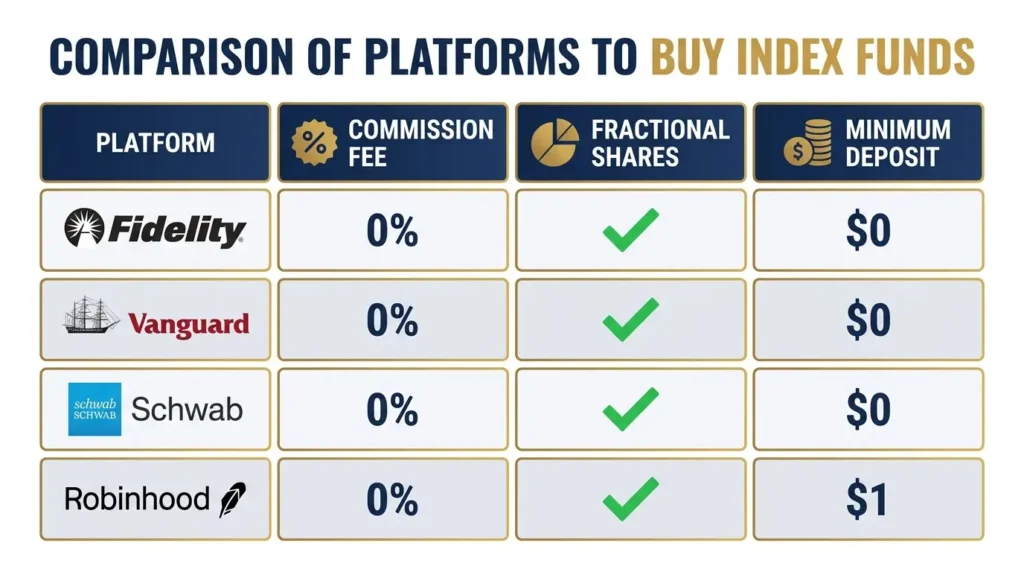
You buy index funds through a brokerage account — an investment platform that holds your funds and processes your purchase orders. In 2026, the best platforms to buy index funds are all commission-free, offer fractional shares, and require no minimum investment:
| Platform | Commission | Fractional Shares | Minimum | Best For |
|---|---|---|---|---|
| Fidelity | $0 | Yes ($1 min) | $0 | Best overall — zero-cost index funds (FZROX) |
| Vanguard | $0 | Yes ($1 min) | $0 | VOO, VTI at the source |
| Charles Schwab | $0 | Yes ($5 min) | $0 | SCHB and broad market ETFs |
| Robinhood | $0 | Yes ($1 min) | $0 | Mobile-first beginners |
For most beginners, Fidelity is the best platform to buy index funds — it offers the only zero-expense-ratio total market fund (FZROX at 0.00%), excellent mobile and desktop interfaces, and a top-rated Roth IRA. To compare the full range of investing platforms, read our guide on the best investment apps for beginners.
Step 1 — Open the Right Account Type Before You Buy Index Funds
Before you buy index funds, you need to decide which type of account to buy them in — because this determines how your gains are taxed for decades. For most beginners:
- Roth IRA — best for most beginners under 50. Your index fund grows completely tax-free and withdrawals in retirement are tax-free. 2026 contribution limit: $7,500/year. Read our guide on what a Roth IRA is.
- 401(k) — if your employer offers one with matching contributions, always buy index funds here first to capture the match before opening anything else
- Taxable brokerage account — once your Roth IRA is maxed, open a taxable brokerage to buy index funds with no annual contribution limit
The same VOO index fund bought inside a Roth IRA grows tax-free. The same VOO bought in a taxable account generates taxable dividends annually. Account type is as important as fund selection when you buy index funds.
Step 2 — Choose Which Index Fund to Buy
For beginners buying their first index fund, the decision is simple. These are the four best index funds to buy in 2026:
- VOO (Vanguard S&P 500 ETF) — tracks the 500 largest US companies, 0.03% fee, available everywhere. The most popular index fund in the world.
- VTI (Vanguard Total Stock Market ETF) — tracks the entire US market including small and mid-cap companies, 0.03% fee. Slightly broader than VOO.
- IVV (iShares Core S&P 500) — identical to VOO in what it tracks, 0.03% fee, excellent for non-Vanguard accounts.
- FZROX (Fidelity Zero Total Market) — 0.00% fee, only available at Fidelity. The only completely free broad market index fund.
Pick one. Do not buy multiple S&P 500 funds — VOO and IVV track the same index, so owning both is redundant, not diversified. One fund is all you need to buy index funds effectively for decades. For a detailed comparison of every top index fund, read our guide on how to begin investing in index funds.
Step 3 — Fund Your Account
Link your checking account to your brokerage and transfer your initial investment. Most platforms process transfers in 1–3 business days. You can buy index funds immediately at many platforms even before the transfer settles — they advance the funds for the purchase.
How much should you transfer to buy your first index fund? There is no minimum with fractional shares — $50 to $200 is a common starting amount that feels meaningful without overcommitting. The most important number is not the initial deposit — it is the monthly recurring amount you will add consistently over time.
Step 4 — Search for the Fund and Place Your Order
Once your account is funded, here is exactly how to buy index funds:
- Click “Trade” or “Buy” in your brokerage app
- In the search bar, type the ticker symbol — for example, VOO
- Select the fund from the results
- Choose “Dollars” (not shares) — type the dollar amount you want to invest
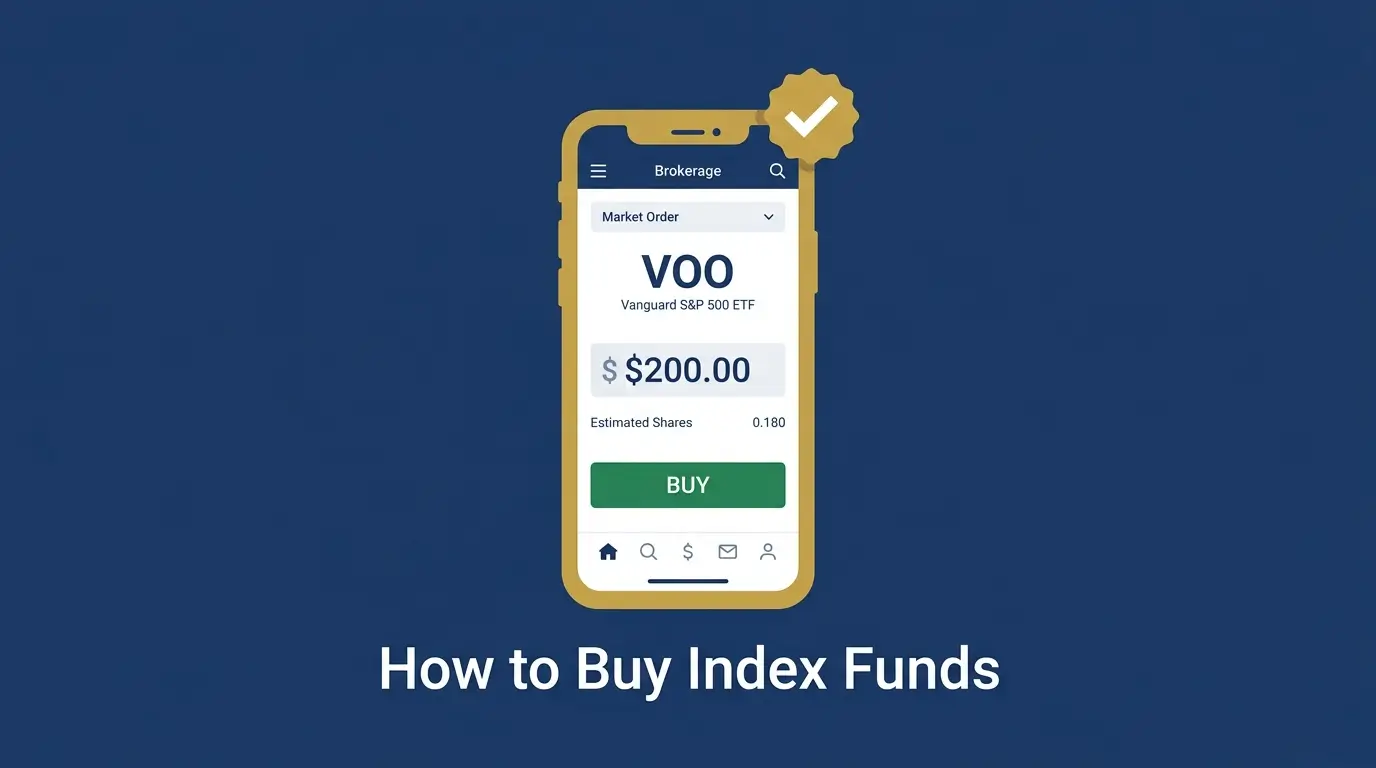
- Select “Market Order” — this buys at the current market price immediately
- Review the order summary — confirm ticker, dollar amount, and order type
- Click “Submit” or “Buy” — your purchase is complete
The entire process takes under 2 minutes once your account is funded. Your index fund shares will appear in your portfolio within seconds during market hours (9:30 AM – 4:00 PM Eastern, Monday–Friday).
Market Order vs Limit Order When Buying Index Funds
When you buy index funds, you choose between two order types:
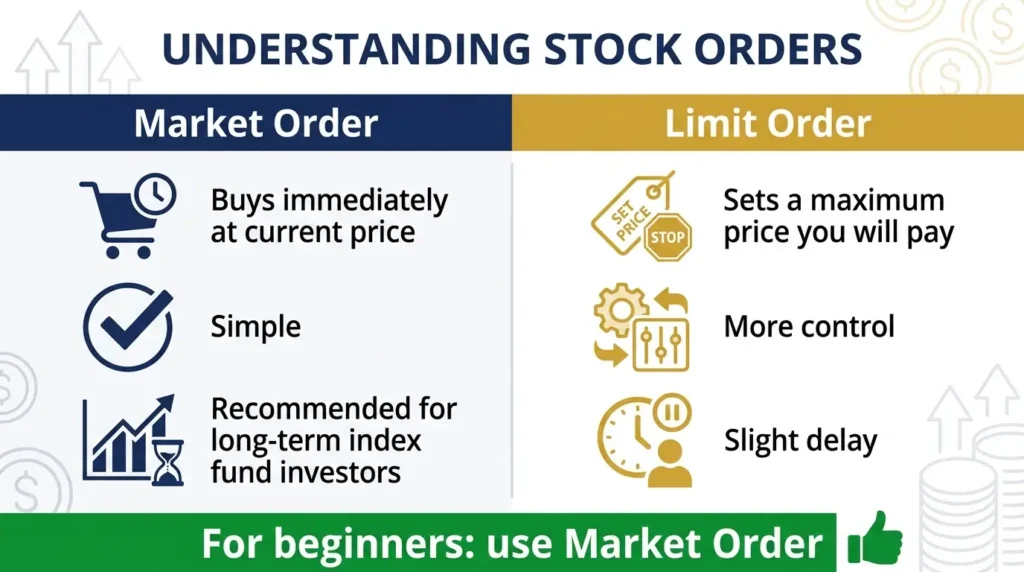
- Market Order — buys immediately at the current market price. Simple, fast, and recommended for long-term index fund investors who do not care about paying a few cents more or less per share.
- Limit Order — sets the maximum price you are willing to pay per share. Your order only executes if the price drops to your limit. Useful in volatile markets but adds unnecessary complexity for most index fund buyers.
For 99% of beginners buying index funds for long-term investing, a market order is the right choice. The difference between a market order at $502 and a limit order at $500 is trivial over a 20-year holding period. Do not let order type complexity delay your purchase.
The Most Important Step After Buying Your First Index Fund
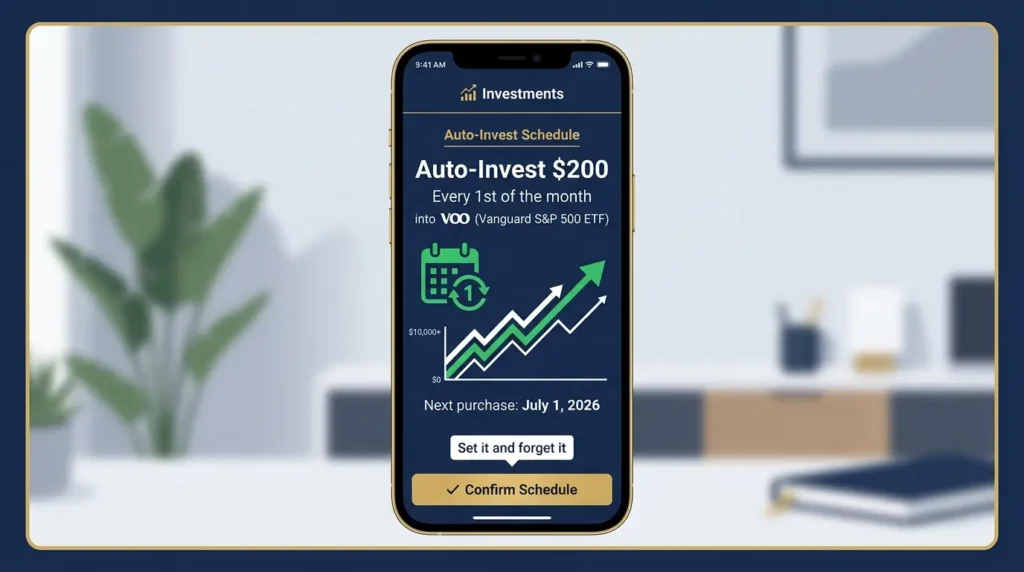
After you buy index funds for the first time, the most powerful next action is setting up automatic monthly purchases. This strategy — called dollar-cost averaging — means you buy a fixed dollar amount of your index fund on the same day every month, regardless of whether the market is up or down.
Most brokerages offer automatic investment scheduling. Set it to your payday so the investment happens before you can spend the money. Even $100/month invested in VOO over 30 years at the historical 7% average annual return grows to over $121,000 — from just $36,000 in total contributions. Read our complete guide on dollar-cost averaging to understand why this approach consistently outperforms trying to time the market.
How Often Should You Buy Index Funds?
| Strategy | Frequency | Best For | Advantage |
|---|---|---|---|
| Automatic monthly | Once/month on payday | Most investors | Removes emotion, consistent |
| Bi-weekly paycheck | Every 2 weeks | Bi-weekly paid workers | More frequent averaging |
| Lump sum | Whenever cash is available | Investors with windfalls | Gets money working faster |
| Daily micro-invest | Daily small amounts | High discipline investors | Maximum averaging effect |
Research consistently shows that lump sum investing slightly outperforms dollar-cost averaging when extra cash is available — because more time in the market produces better results on average. But for most people, automatic monthly purchases are the superior practical approach because they remove the need for discipline and eliminate market-timing temptation entirely.
Frequently Asked Questions
How do I buy index funds for the first time?
To buy index funds for the first time: open a Roth IRA or brokerage account at Fidelity, Vanguard, or Schwab (15 minutes online). Link your bank account and transfer money. Search for VOO, VTI, or IVV in the platform’s search bar. Enter the dollar amount you want to invest. Select “Market Order” and click buy. The entire process from account opening to first purchase takes under 30 minutes.
Can I buy index funds directly without a brokerage?
No — you must use a brokerage or Roth IRA to buy index funds. However, you can buy directly through the fund company’s own brokerage: Vanguard’s platform for VOO and VTI, Fidelity’s platform for FZROX, or iShares at a brokerage for IVV. All of these are free to use and require no minimum balance to open.
What is the minimum amount to buy index funds?
With fractional shares available at most major brokerages in 2026, you can buy index funds with as little as $1. Fidelity and Robinhood allow fractional purchases starting at $1. Schwab starts at $5. Full shares of VOO cost approximately $500+, but fractional shares mean you do not need that amount — you can buy $50 or $100 worth regardless of the per-share price.
Is it better to buy index funds monthly or all at once?
Research shows lump sum investing slightly outperforms monthly investing about 67% of the time because money invested immediately has more time to grow. However, for most people, monthly automatic purchases are the better practical choice — they remove emotion and market-timing temptation. If you have a lump sum available, invest it immediately. For ongoing income, invest monthly on payday through automatic contributions.
Do I pay taxes when I buy index funds?
No — you do not pay taxes when you buy index funds. You may pay taxes when you sell them (capital gains tax) or when the fund distributes dividends (taxable in a brokerage account). In a Roth IRA, all growth and qualified withdrawals are completely tax-free. In a 401(k), taxes are deferred until retirement. To minimize taxes, buy index funds inside tax-advantaged accounts first.
Final Thoughts: Buy Index Funds Today — Not Tomorrow
Now that you know exactly how to buy index funds, the only thing left is to do it. Open your account today. Transfer your first $100. Buy VOO or VTI. Set up a monthly automatic contribution. That is the entire process — and it takes less than 30 minutes to complete from scratch.
Every month you delay buying index funds is a month of compound growth permanently missed. The investors who build generational wealth through index funds are not smarter or richer than you — they simply started earlier and stayed consistent. Start today. For the complete deep-dive strategy on index fund investing beyond just the purchase, read our full guide on how to invest in index funds.