
📢 Disclosure: This post contains affiliate links. We may earn a commission at no extra cost to you. We only recommend products we genuinely believe in.
Debt snowball vs debt avalanche — which method is better for paying off debt? The debt snowball vs debt avalanche debate is one of the most common questions in personal finance, and the answer depends on your psychology as much as the math. Both the debt snowball and the debt avalanche are proven strategies that work — but they work differently for different people. This complete guide on debt snowball vs debt avalanche explains exactly how each method works, compares them with real numbers, and helps you choose the right one for your situation in 2026.
What Is the Debt Snowball Method?
The debt snowball method, popularized by Dave Ramsey, focuses on paying off your smallest debt balance first — regardless of interest rate. Here is the exact process:
- List all your debts from smallest balance to largest balance
- Pay the minimum payment on every debt every month
- Throw every extra dollar at the debt with the smallest balance
- When that debt is paid off, roll its entire payment to the next smallest debt
- Repeat until all debts are eliminated
The power of the debt snowball is psychological. Every time you pay off a debt — even a small one — you get a real, tangible win. That sense of momentum and progress keeps you motivated through a long debt payoff journey. The snowball gets bigger and faster as each debt is eliminated and its payment rolls to the next one.
What Is the Debt Avalanche Method?
The debt avalanche method focuses on paying off your highest interest rate debt first — regardless of balance size. Here is the exact process:
- List all your debts from highest interest rate to lowest interest rate
- Pay the minimum payment on every debt every month
- Throw every extra dollar at the debt with the highest interest rate
- When that debt is paid off, roll its entire payment to the next highest-rate debt
- Repeat until all debts are eliminated
The power of the debt avalanche is mathematical efficiency. By eliminating the highest-rate debt first, you stop the most expensive interest from compounding as quickly as possible. The debt avalanche saves more money in total interest compared to the debt snowball on the same set of debts.
Debt Snowball vs Debt Avalanche: Real Example Compared
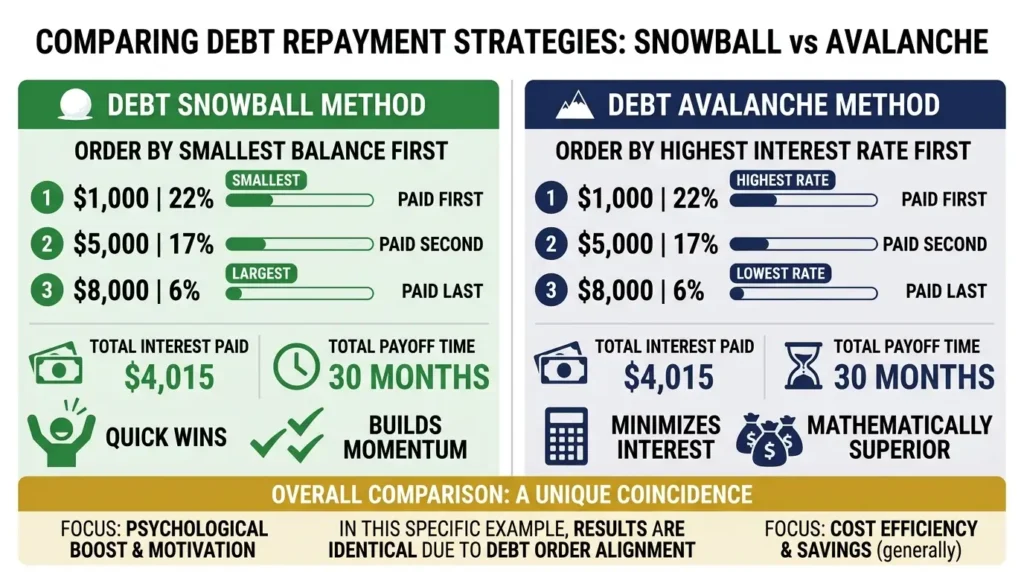
Here is the debt snowball vs debt avalanche comparison on the same three debts with $300 extra per month to put toward payoff:
Starting debts:
- Credit Card A: $1,000 balance at 22% APR — minimum payment $25
- Credit Card B: $5,000 balance at 17% APR — minimum payment $100
- Personal Loan: $8,000 balance at 6% APR — minimum payment $150
| Strategy | Payoff Order | Total Interest Paid | Time to Debt Free |
|---|---|---|---|
| Debt Snowball | $1K → $5K → $8K (smallest first) | $2,983 | 32 months |
| Debt Avalanche | $1K → $5K → $8K (same — because $1K is also highest rate) | $2,983 | 32 months |
In this example, debt snowball vs debt avalanche produces the same result because the smallest balance also happens to be the highest-rate debt. Here is an example where they differ significantly:
New starting debts — same $300 extra per month:
- Medical Bill: $500 at 0% APR
- Credit Card: $6,000 at 24% APR
- Car Loan: $9,000 at 5% APR
| Strategy | Payoff Order | Total Interest Paid | Time to Debt Free | Difference |
|---|---|---|---|---|
| Debt Snowball | $500 medical → $6K card → $9K car | $4,215 | 34 months | Baseline |
| Debt Avalanche | $6K card → $500 medical → $9K car | $3,196 | 34 months | Saves $1,019 |
In this scenario, the debt avalanche saves $1,019 in interest over the same 34-month period. The payoff timeline is identical — but the avalanche puts over $1,000 back in your pocket. This is the core mathematical argument in the debt snowball vs debt avalanche debate.
Debt Snowball vs Debt Avalanche: Head-to-Head Comparison
| Feature | Debt Snowball | Debt Avalanche |
|---|---|---|
| Payoff order | Smallest balance first | Highest interest rate first |
| Total interest paid | More (sometimes significantly) | Less — always equal or better |
| Payoff timeline | Same or slightly longer | Same or slightly shorter |
| Motivation factor | High — quick early wins | Lower — first win may take longer |
| Mathematically optimal | No | Yes |
| Psychologically optimal | Often yes | Depends on discipline |
| Best for | People who need motivation and momentum | Disciplined people who want maximum savings |
Which Method Should You Choose?
The debt snowball vs debt avalanche decision ultimately comes down to one question: what drives you?
Choose the Debt Snowball If:
- You have struggled to stick with debt payoff plans in the past
- You need visible, frequent wins to stay motivated
- Your debts have similar interest rates (so the math difference is small)
- You have several small balances you can knock out quickly
- You are paying off debt for the first time and need to build momentum
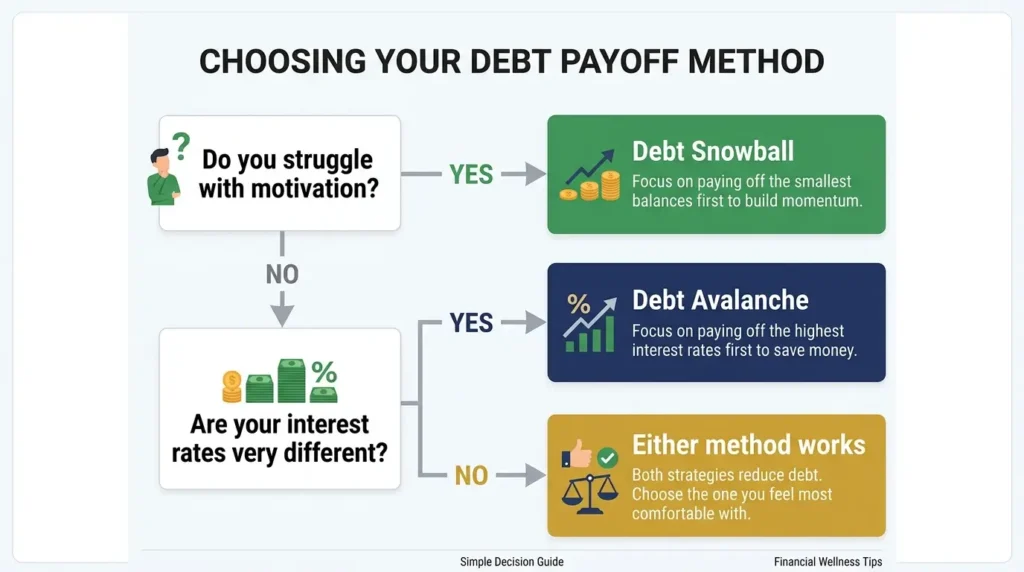
Choose the Debt Avalanche If:
- You are disciplined and motivated by numbers rather than milestones
- You have high-rate debt (20%+ APR) that is costing you significantly
- Your highest-rate debt also has a large balance (so the interest savings are substantial)
- You are comfortable with delayed gratification
- Saving the maximum amount in interest is your top priority
Use a Hybrid Approach
Many people find the most success with a hybrid of debt snowball vs debt avalanche — pay off one or two small quick-win balances first for motivation, then switch to the avalanche method for the remaining larger debts. This approach captures the psychological benefit of the snowball while minimizing total interest like the avalanche.
How to Start the Debt Snowball or Avalanche Today
- List every debt — balance, interest rate, minimum payment
- Order them either smallest-to-largest (snowball) or highest-to-lowest rate (avalanche)
- Set every account to autopay the minimum to avoid missed payments
- Find extra money for debt payoff — cut subscriptions, apply windfalls, consider a side hustle
- Direct every extra dollar to the top debt on your list
- When each debt is eliminated, roll the full payment to the next one
A budget is essential for both methods — you need to know exactly how much extra you can put toward debt each month. Read our guide on how to make a budget to set up a system that frees up maximum cash for debt payoff. For the full credit card debt elimination strategy, read our guide on how to get out of credit card debt.
What to Do After You Are Debt Free
Whether you used the debt snowball or debt avalanche, becoming debt free is a transformational financial milestone. Once all debts are paid off, redirect every former debt payment immediately to wealth building:
- Build a full 3–6 month emergency fund if not yet complete. Read our guide on how to build an emergency fund.
- Max out your Roth IRA ($7,500/year in 2026)
- Increase your 401(k) contributions to capture the full employer match and beyond
- Start building your net worth intentionally — read our guide on what is net worth.
Frequently Asked Questions
Is debt snowball or debt avalanche better?
The debt avalanche saves more money in interest — it is mathematically superior. The debt snowball provides faster psychological wins and is proven to help more people actually complete their debt payoff. The best method is the one you will stick with. If motivation is your challenge, use the snowball. If discipline is strong, use the avalanche.
How much money does the debt avalanche save over the debt snowball?
The savings vary depending on your specific debts. When interest rates are similar across debts, the difference is small — sometimes less than $100. When you have high-rate debt ($6,000+ at 24% APR) alongside low-rate debt, the avalanche can save $500–$2,000 or more in total interest over the same payoff period.
Can I switch from debt snowball to debt avalanche?
Yes — you can switch methods at any time. Many people start with the snowball to build momentum, knock out one or two small debts quickly, then switch to the avalanche for the remaining larger balances. This hybrid approach is increasingly popular and works very well in practice.
Does the debt snowball actually work?
Yes. Research from Harvard Business School found that focusing on one debt at a time — especially starting with smaller balances — significantly increases the likelihood of completing debt payoff compared to spreading extra payments across multiple debts. The psychological wins from the snowball method are a genuine and powerful motivator for many people.
Should I use debt snowball or debt avalanche for student loans?
For student loans with varying interest rates, the debt avalanche is mathematically better — target the highest-rate loan first. If you have multiple small subsidized loan balances alongside larger unsubsidized ones, a hybrid approach works well: pay off the small balances quickly for a win, then avalanche the remaining high-rate loans.
Final Thoughts: Debt Snowball vs Debt Avalanche — Both Beat Doing Nothing
In the debt snowball vs debt avalanche debate, there is no universally wrong answer — only the wrong method for your personality. The debt snowball keeps you motivated with early wins. The debt avalanche saves you the most money. Both completely destroy debt if you stick with them. The debt snowball vs debt avalanche comparison only matters if you actually pick one and start.
Choose your method today, list your debts, set up autopay on every minimum payment, and throw every extra dollar at the top debt on your list. Whether you snowball or avalanche your way to debt freedom, the destination is the same — and it changes everything. For more on managing debt strategically, read our guide on debt consolidation explained to see if combining debts could accelerate your payoff timeline.