


📢 Disclosure: This post contains affiliate links. We may earn a commission at no extra cost to you. We only recommend products we genuinely believe in.
How to negotiate a higher salary is one of the highest-return financial skills you will ever develop — and most people never use it. Learning how to negotiate a higher salary can add thousands of dollars to your annual income, but the benefits compound far beyond the first paycheck. Every raise you negotiate increases the base from which future raises are calculated, boosts your 401(k) contributions, and raises your Social Security benefit. This complete guide on how to negotiate a higher salary gives you the research strategy, exact scripts, and timing advice to ask for — and get — the salary you deserve in 2026.
Why Most People Never Negotiate a Higher Salary
Studies consistently show that less than 40% of workers negotiate their salary at all — and among those who do not negotiate, the most common reason is fear. Fear of seeming greedy. Fear of the offer being rescinded. Fear of an awkward conversation. These fears are almost entirely unfounded. Employers expect negotiation — it signals confidence and professional self-awareness. In fact, most hiring managers have room built into their initial offers specifically for salary negotiation.
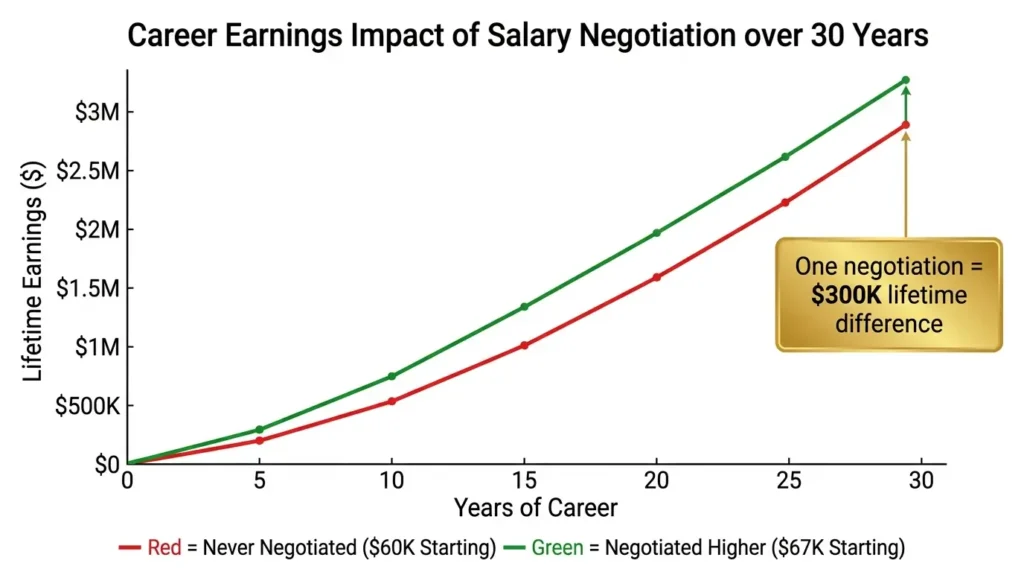
The real cost of not knowing how to negotiate a higher salary is staggering. An employee who accepts $60,000 without negotiating — versus one who negotiates to $67,000 — earns approximately $300,000 more over a 30-year career, assuming 3% annual raises on each base. That is the lifetime financial impact of one 15-minute conversation.
Step 1 — Research Your Market Value Before You Negotiate
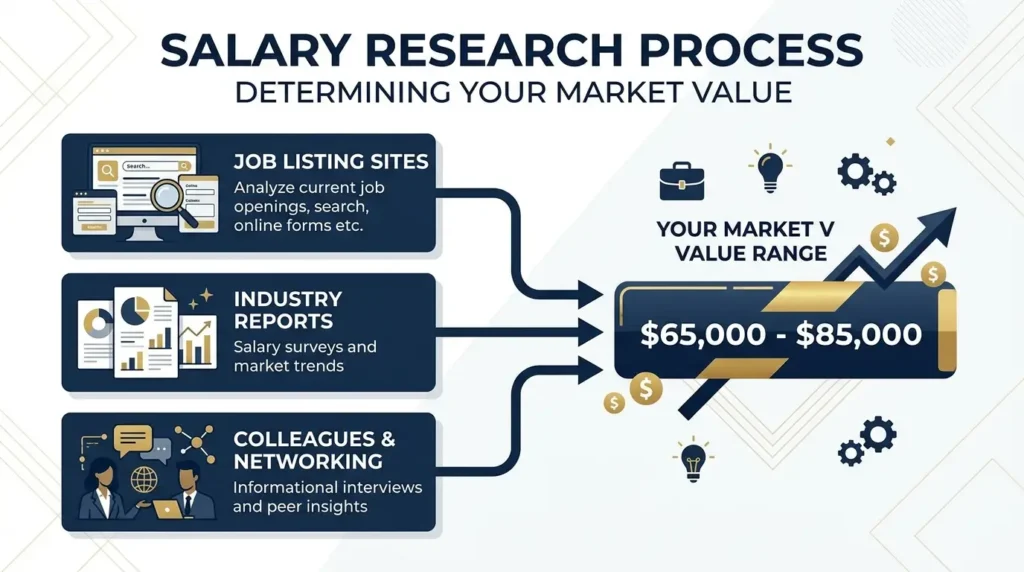
The foundation of how to negotiate a higher salary is data. You cannot ask for a specific number without knowing what the market pays for your role, experience level, and location. Here is how to research your market value:
- Check salary data on sites like Glassdoor, LinkedIn Salary, Levels.fyi (for tech), and the Bureau of Labor Statistics
- Look at job listings for similar roles — many now include salary ranges by law in states like California, New York, and Colorado
- Talk to peers in similar roles at other companies — salary transparency conversations are increasingly normalized
- Factor in your location — the same role in New York City pays 30–50% more than in a mid-sized US city
- Factor in your experience level and specific skills — certifications, languages, and specialized tools add measurable value
Your goal is to arrive at a market value range — for example, $72,000 to $85,000 for your role and experience level. When you negotiate a higher salary, you will anchor to the top of your range, not the middle.
Step 2 — Document Your Value and Contributions
Market data tells you what the job is worth. Your track record tells you what you are worth. Before you negotiate a higher salary, build a concrete list of your contributions and their measurable impact:
- Revenue generated or sales targets exceeded
- Cost savings you identified or implemented
- Projects delivered on time or under budget
- New processes you created that improved team efficiency
- Clients retained, problems solved, or conflicts resolved
- Skills or certifications you acquired since your last review
Quantify everything you can. “I managed a team” is weak. “I managed a team of 6 and delivered 3 projects totaling $500,000 in contract value on time and under budget” is compelling. Numbers make your case impossible to dismiss when you negotiate a higher salary.
Step 3 — Choose the Right Timing to Negotiate a Higher Salary
Timing matters enormously when you negotiate a higher salary. The best moments to ask:
- During a job offer negotiation — this is the single best moment to negotiate a higher salary because you have maximum leverage before accepting
- After a major win — completing a big project, landing a key client, or receiving external recognition
- At your annual performance review — when compensation is already on the agenda
- After taking on significant new responsibilities — if your role has expanded materially since your last raise
- When you have received an outside offer — an external offer gives you the strongest possible leverage
The worst times to negotiate a higher salary: when the company is in financial difficulty, immediately after making a mistake, or less than 6 months after your last raise.
What to Say When Negotiating a Higher Salary
The exact words you use when you negotiate a higher salary matter. Here are proven scripts for common scenarios:
Script 1 — For a Job Offer
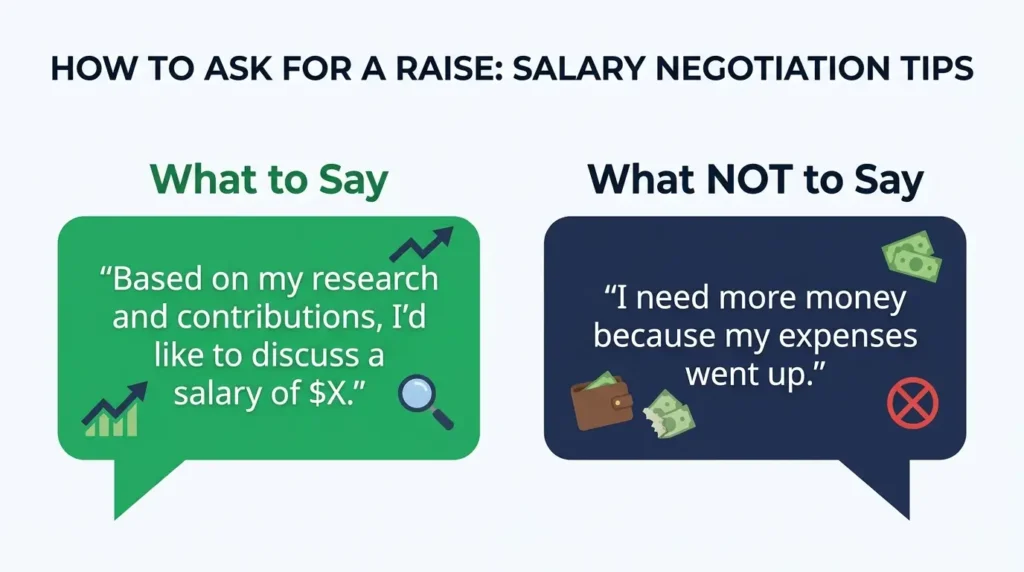
“Thank you so much for the offer — I am genuinely excited about this role and the team. Based on my research into market rates for this position and my [X years of experience / specific skills], I was expecting something in the range of [your target number]. Is there flexibility to get closer to that figure?”
Script 2 — For a Current Employer Raise
“I would like to discuss my compensation. Over the past year, I have [specific achievement 1] and [specific achievement 2], which contributed to [measurable result]. Based on my research into market rates for this role and my contributions, I believe a salary of [target number] is appropriate. Can we discuss getting there?”
Script 3 — Counter to a Low Offer
“I appreciate the offer. I was hoping we could get to [specific number]. Given my background in [relevant experience] and what I bring to this role, I believe that number reflects the value I will deliver. Is that something we can work toward?”
What NOT to Say
- “I need more money because my rent went up” — personal expenses are irrelevant to employers
- “I think I deserve a raise” — this signals entitlement without evidence
- “My coworker makes more than me” — this damages relationships and rarely works
- “I’ll take whatever you can offer” — this eliminates your leverage entirely
How to Handle Common Responses When You Negotiate a Higher Salary
| Employer Response | Your Reply |
|---|---|
| “That is above our budget” | “I understand. What is the maximum you can offer? I want to find a way to make this work.” |
| “We cannot do more right now” | “Could we agree to a 6-month review with a salary increase if I meet these specific targets?” |
| “Everyone starts at the same level” | “I understand the structure. Given my [specific experience], I hope there is flexibility for an exception.” |
| “Let me check with the team” | “Of course. I am excited about this opportunity — I look forward to hearing back. By when can I expect an update?” |
Beyond Salary: Negotiate the Full Compensation Package
If you cannot negotiate a higher salary itself, other components of your compensation package are often more flexible:
- Signing bonus — a one-time payment that does not affect the base salary budget
- Remote work flexibility — eliminates commuting costs worth $3,000–$8,000/year
- Extra vacation days — one additional week of PTO is worth approximately 2% of salary
- 401(k) match improvement — an additional 1% match is worth hundreds per year
- Professional development budget — courses, certifications, and conference attendance
- Equity or stock options — especially valuable at growth-stage companies
A $5,000 signing bonus, an extra week of PTO, and full remote flexibility can add $10,000+ in annual value even when the base salary cannot move. Every extra dollar you negotiate goes directly into your financial foundation — whether it funds your emergency fund, retirement, or investments. Read our guide on saving for retirement at 25 to understand how directing income increases to your 401(k) multiplies their long-term value dramatically.
The Long-Term Financial Impact of Negotiating a Higher Salary
| Starting Salary | After 10 Years (3% annual raise) | After 20 Years | After 30 Years | Total Lifetime Earnings Difference |
|---|---|---|---|---|
| $60,000 (no negotiation) | $80,635 | $108,367 | $145,651 | Baseline |
| $65,000 (+$5K negotiated) | $87,353 | $117,398 | $157,872 | +$162,000 |
| $70,000 (+$10K negotiated) | $94,071 | $126,429 | $170,093 | +$324,000 |
Negotiating $10,000 more at the start of your career generates over $324,000 in additional lifetime earnings — before factoring in the additional retirement contributions, Social Security benefits, and investment growth that higher income enables. To understand how this extra income compounds when invested, read our guide on what is compound interest and our guide on what is net worth.
Frequently Asked Questions
How do I negotiate a higher salary without losing the offer?
Job offers are almost never rescinded because a candidate negotiated respectfully. Always express genuine enthusiasm for the role before making your ask. Use a collaborative tone — “I am excited about this opportunity, and I was hoping we could get to X” — rather than an ultimatum. Employers expect negotiation and respect candidates who advocate for themselves professionally.
How much should I ask for when negotiating a higher salary?
Ask for the top of your researched market range — not the middle. If market data shows $70,000–$85,000 for your role, anchor at $85,000. Employers will often meet you in the middle, landing you at $77,000–$80,000 — well above where you would have landed starting at $70,000. Always ask for a specific number, not a range.
Is it too late to negotiate salary after accepting an offer?
It is significantly harder after accepting, but not impossible in the first 24–48 hours. If you have genuinely received new information (a competing offer, new data about the role’s scope), you can reopen respectfully. However, the ideal time to negotiate a higher salary is before accepting — this is your moment of maximum leverage.
How often should I negotiate a higher salary?
Negotiate at every job offer, at every annual performance review, and whenever your responsibilities expand significantly. Do not wait for your employer to offer you more — they rarely do unprompted. Most financial advisors suggest reviewing your market value annually and asking for a raise whenever you are meaningfully underpaid relative to the market.
What if my employer says no when I negotiate a higher salary?
Ask what specific milestones or timeline would make the raise possible, and get that agreement in writing. If the answer is a firm no with no path forward, use it as data: the market pays you more than your employer will. A job offer elsewhere — even if you do not take it — is often the most effective leverage for getting a yes on your next ask.
Final Thoughts: How to Negotiate a Higher Salary Is a Financial Superpower
Knowing how to negotiate a higher salary is one of the highest-return skills in personal finance — more impactful per hour invested than almost any other financial strategy. The research takes a few hours. The conversation takes 15 minutes. The financial impact lasts your entire career. Every time you negotiate a higher salary, you reset your income baseline upward — compounding every raise, every bonus, every retirement contribution for the rest of your working life.
Once you negotiate a higher salary and increase your income, make sure every extra dollar has a plan. Use the 50/30/20 budget rule to allocate income increases intentionally — directing the gain toward your emergency fund, retirement savings, and investments rather than lifestyle inflation. Income growth is only financially powerful when paired with intentional spending.