

📢 Disclosure: This post contains affiliate links. We may earn a commission at no extra cost to you. We only recommend products we genuinely believe in.
The best investment apps for beginners make it possible to start building wealth with as little as $1 — no broker, no phone calls, no paperwork. Finding the best investment apps for beginners in 2026 is easier than ever, but with dozens of options available, knowing which one fits your goals and experience level matters. This complete guide on the best investment apps for beginners covers every top pick, compares key features side by side, and shows you exactly how to make your first investment today.
What Makes a Great Investment App for Beginners?
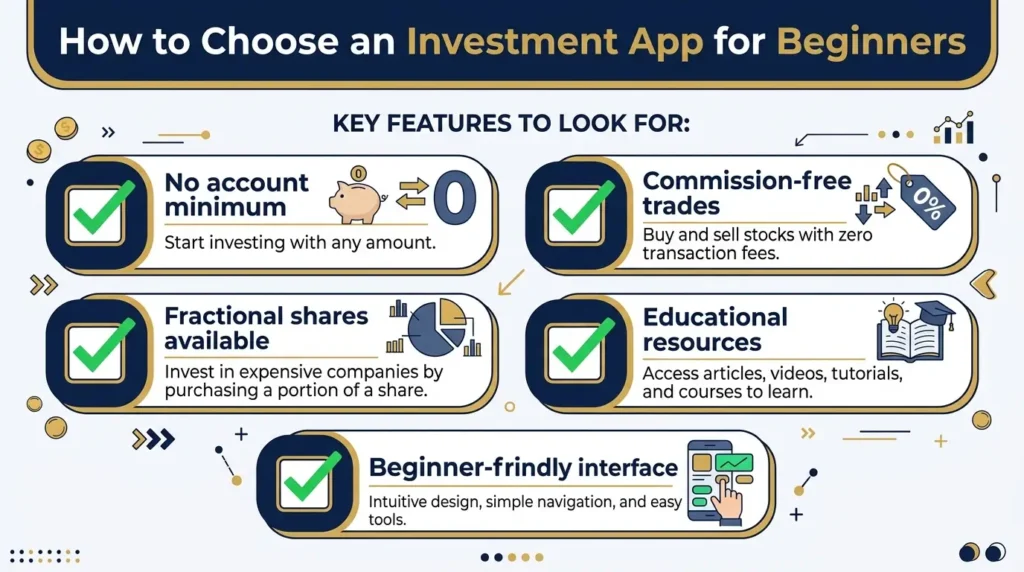
Not every investment app is designed with beginners in mind. The best investment apps for beginners share these essential qualities:
- No account minimum — you can open and fund an account with any amount
- Commission-free trades — no fee every time you buy or sell a stock or ETF
- Fractional shares — the ability to buy a portion of one share for as little as $1
- Educational resources — guides, tutorials, and explanations built into the app
- Beginner-friendly interface — simple navigation without overwhelming data
- SIPC protection — your investments are protected up to $500,000
Before downloading any investment app, make sure you have a $1,000 emergency fund in place and no high-interest credit card debt. Read our guide on how to build an emergency fund first — investing money you might need in an emergency is one of the most common beginner mistakes.
Best Investment Apps for Beginners: Our Top Picks
Here are the best investment apps for beginners available in 2026, ranked by overall beginner experience, features, and cost.
1. Fidelity — Best Overall Investment App for Beginners
Fidelity is the top pick among the best investment apps for beginners because it combines zero account minimums, commission-free trades, fractional shares starting at $1, and some of the best free educational content available anywhere. It offers both taxable brokerage accounts and Roth IRAs — the ideal combo for a beginning investor.
- Account minimum: $0
- Trading commissions: $0
- Fractional shares: Yes — starting at $1
- Account types: Brokerage, Roth IRA, Traditional IRA, 401(k)
- Best for: Beginners who want a full-featured platform with excellent education
2. Charles Schwab — Best for Long-Term Beginner Investors
Charles Schwab is another top-tier option among the best investment apps for beginners, offering zero-commission trades, no account minimum, and access to Schwab’s own low-cost index funds. Its app is clean and easy to navigate for new investors who want a professional platform without complexity.
- Account minimum: $0
- Trading commissions: $0
- Fractional shares: Yes — via Schwab Stock Slices ($5 minimum)
- Account types: Brokerage, Roth IRA, Traditional IRA
- Best for: Beginners focused on long-term index fund investing
3. Acorns — Best Investment App for Micro-Investing Beginners
Acorns is one of the best investment apps for beginners who want to start investing automatically without thinking about it. It rounds up your everyday purchases to the nearest dollar and invests the spare change into a diversified portfolio of ETFs. Perfect for complete beginners who find investing intimidating.
- Account minimum: $0
- Fee: $3/month (Personal) or $5/month (Family)
- Fractional shares: Yes — automatic
- Account types: Taxable brokerage, IRA
- Best for: Complete beginners who want fully automated investing with no decisions
4. Robinhood — Best for Beginners Who Want Simplicity
Robinhood pioneered commission-free trading and remains one of the most recognizable names among the best investment apps for beginners. Its interface is extremely simple — arguably too simple for some — but that minimalism makes it approachable for first-time investors who want to buy stocks and ETFs without overwhelming options.
- Account minimum: $0
- Trading commissions: $0
- Fractional shares: Yes — starting at $1
- Account types: Taxable brokerage, IRA (Robinhood Gold required)
- Best for: Beginners who want the simplest possible interface
5. Vanguard — Best for Index Fund Beginners
Vanguard is the gold standard for low-cost index fund investing and is widely considered one of the best investment apps for beginners focused on long-term retirement wealth. Vanguard’s own index funds have some of the lowest expense ratios in the industry — meaning more of your money stays invested and grows through compound interest.
- Account minimum: $0 for brokerage; $1,000 for some mutual funds
- Trading commissions: $0
- Fractional shares: Limited
- Account types: Brokerage, Roth IRA, Traditional IRA, 401(k)
- Best for: Beginners focused on low-cost index funds and retirement saving
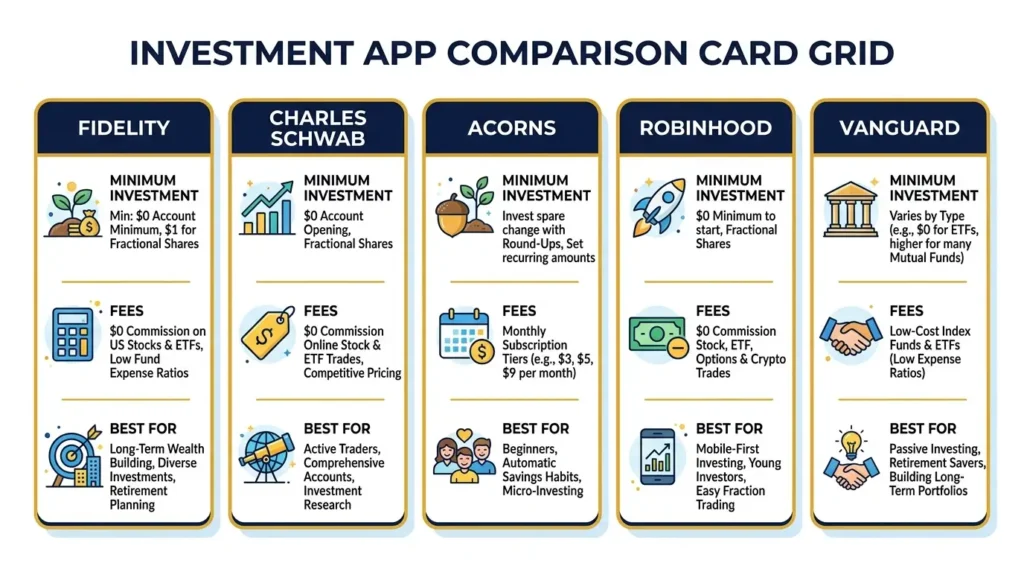
Best Investment Apps for Beginners: Side-by-Side Comparison
| App | Min. Account | Commissions | Fractional Shares | Roth IRA | Best For |
|---|---|---|---|---|---|
| Fidelity | $0 | $0 | Yes ($1 min) | Yes | Overall best beginner app |
| Charles Schwab | $0 | $0 | Yes ($5 min) | Yes | Long-term index investing |
| Acorns | $0 | $3–$5/month | Yes (auto) | Yes | Automated micro-investing |
| Robinhood | $0 | $0 | Yes ($1 min) | Yes (Gold) | Simplest interface |
| Vanguard | $0 | $0 | Limited | Yes | Low-cost index funds |
What to Look for in an Investment App for Beginners
When evaluating the best investment apps for beginners, these are the criteria that matter most:
No Account Minimum
The best investment apps for beginners allow you to open an account and start investing with any amount — even $1. Account minimums used to be a barrier for new investors, but all the top beginner apps have eliminated them entirely.
Commission-Free Trading
Every commission you pay reduces your returns. The best investment apps for beginners charge $0 commissions on stocks and ETF trades. This standard is now industry-wide among major platforms — avoid any app that still charges per-trade fees.
Fractional Shares
Fractional shares let you invest in any company regardless of share price. If a stock costs $500 per share, you can still invest $10 and own 2% of one share. This feature makes the best investment apps for beginners truly accessible with any budget. Read our guide on how to start investing with $100 for the full beginner strategy.
Roth IRA Support
The best investment apps for beginners should offer a Roth IRA option — the most tax-advantaged account available to most Americans. All growth and withdrawals in retirement are completely tax-free. Read our complete guide on what a Roth IRA is to understand why this account should be your first investment account.
How to Get Started with an Investment App for Beginners
Once you have chosen from the best investment apps for beginners, here is the exact process to make your first investment:
- Download the app and create an account — you will need your SSN, address, and bank account details
- Choose your account type — open a Roth IRA if you have earned income; otherwise open a taxable brokerage account
- Fund your account — link your bank account and transfer your starting amount ($1 or more)
- Choose your first investment — for most beginners, a low-cost S&P 500 index fund or total market ETF is the best starting point
- Set up automatic monthly contributions — even $25 or $50/month builds the habit that creates long-term wealth through compound interest
The strategy of investing a fixed amount every month regardless of market conditions is called dollar-cost averaging — read our guide on dollar-cost averaging explained to understand exactly why this approach beats trying to time the market. And to understand how your investments grow over time, read our guide on what is compound interest.
Common Mistakes Beginners Make with Investment Apps
- Investing before having an emergency fund — if you need the money in 6 months, keep it in a savings account, not the market
- Checking the app every day — daily market fluctuations cause anxiety and bad decisions. Check monthly at most.
- Buying individual stocks as a first investment — start with diversified index funds, not single companies
- Stopping contributions when the market drops — market dips are buying opportunities, not reasons to quit
- Ignoring the Roth IRA option — tax-free growth over decades is one of the most powerful wealth-building tools available
Frequently Asked Questions
What is the best investment app for beginners in 2026?
Fidelity is the best overall investment app for beginners in 2026. It offers $0 account minimum, $0 commissions, fractional shares starting at $1, Roth IRA support, and excellent free educational resources. For fully automated micro-investing, Acorns is the easiest option for complete beginners.
Which investment app has no minimum balance for beginners?
Fidelity, Charles Schwab, Acorns, and Robinhood all have $0 account minimums — you can open an account and start investing with any amount. Fidelity and Robinhood allow fractional share purchases starting at $1, making them accessible for absolute beginners with any budget.
Is Robinhood good for beginner investors?
Robinhood is good for beginners who want a simple, clean interface with $0 commissions and fractional shares. However, it has fewer educational resources than Fidelity or Schwab, and its gamified design has been criticized for encouraging frequent trading. For long-term index fund investing, Fidelity or Schwab are better choices for beginners.
Should beginner investors use Fidelity or Vanguard?
Both are excellent for beginners. Fidelity has a better app experience, more educational content, and fractional shares starting at $1 — making it the better choice for most new investors. Vanguard is ideal if you specifically want to invest in Vanguard’s own index funds, which have some of the lowest expense ratios available.
How much money do I need to start using an investment app?
With the best investment apps for beginners in 2026, you can start with as little as $1. Fidelity and Robinhood offer fractional shares starting at $1. Acorns can invest spare change automatically — even cents at a time. The amount matters far less than starting early and contributing consistently every month.
Final Thoughts: The Best Investment Apps for Beginners Make Starting Easy
The best investment apps for beginners have removed every barrier that once kept new investors on the sidelines — no minimums, no commissions, no confusing paperwork. The only thing standing between you and your first investment is the decision to start. Pick one of the best investment apps for beginners from this list, open a Roth IRA, deposit whatever amount you can afford today, and set up a monthly automatic contribution.
Starting with $25/month at age 25 and never increasing it will produce more wealth by age 65 than waiting until 35 to start with $200/month. That is the power of time and compound interest working together. Use one of the best investment apps for beginners today — your future self will thank you.