

📢 Disclosure: This post contains affiliate links. We may earn a commission at no extra cost to you. We only recommend products we genuinely believe in.
A Roth IRA is an individual retirement account funded with after-tax dollars. It can provide tax-free qualified withdrawals in retirement, but contribution eligibility, annual limits and withdrawal rules all matter. This guide explains how a Roth IRA works in 2026 and the tradeoffs to understand before opening one.
In this complete guide, you’ll learn exactly what a Roth IRA is, how it works, who qualifies, the 2026 contribution limits, and how to open one in 15 minutes — even if you’re a complete beginner. If you’re just starting out, read our guide on what is a credit score first to build your personal finance foundation.
What Is a Roth IRA?
A Roth IRA (Individual Retirement Account) is a retirement account funded with after-tax contributions. Investment earnings can grow without current taxation inside the account, and qualified distributions can be tax-free if IRS requirements are met.
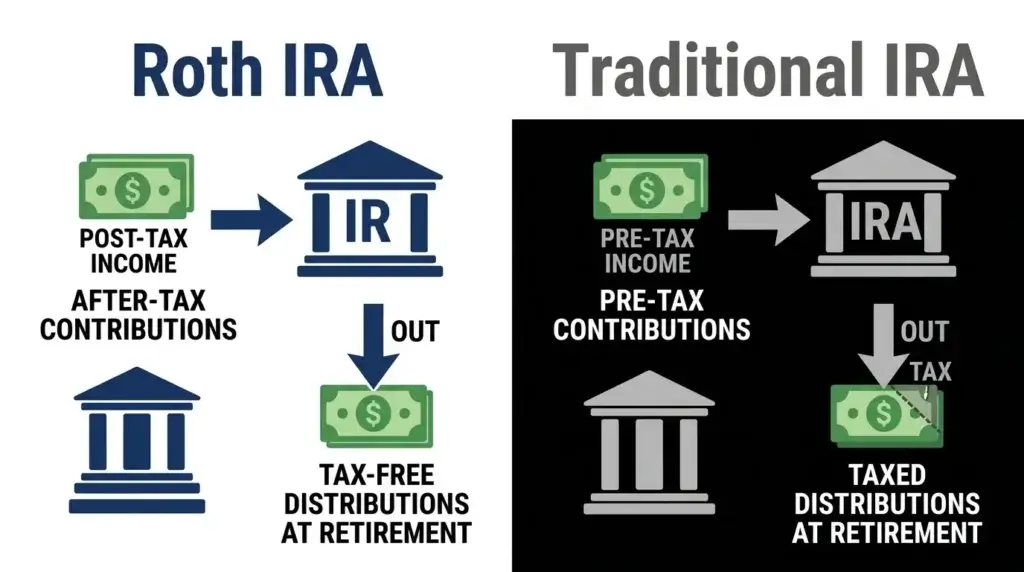
Regular Roth IRA contributions are made with after-tax dollars. Qualified withdrawals can include both contributions and earnings without federal income tax, while nonqualified distributions can have different tax or penalty treatment.
A traditional IRA may allow a deduction for contributions depending on your circumstances, while Roth IRA contributions are not deductible. Traditional IRA distributions are generally taxable to the extent they represent pre-tax amounts, while qualified Roth IRA distributions can be tax-free. The better tax treatment depends on your situation.
How Does a Roth IRA Work?
Here is a simple breakdown of how a Roth IRA operates:
- You open an account at a brokerage like Fidelity, Charles Schwab, or Vanguard.
- You contribute after-tax dollars — money you’ve already paid income tax on.
- Investments inside the account can grow without current taxation while they remain in the Roth IRA.
- Qualified distributions can be tax-free when the applicable Roth IRA requirements are satisfied.
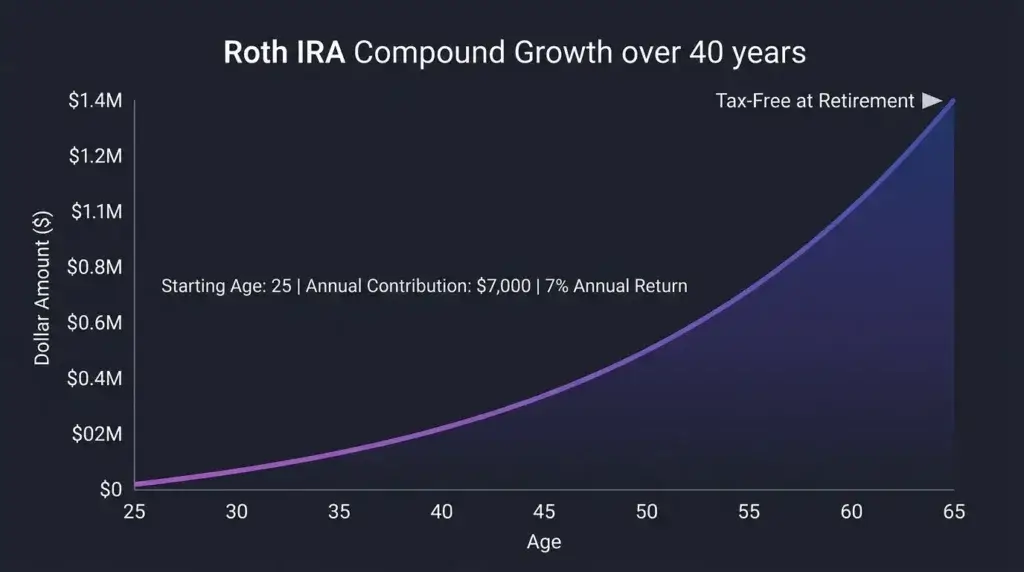
Long investment horizons can make compounding meaningful, but market returns are not guaranteed and future IRA contribution limits can change. For example, a hypothetical constant annual contribution and return can illustrate growth, but it should not be treated as a forecast. If you want to start with a smaller amount, read our guide on how to start investing with $100.
Roth IRA Contribution Limits for 2026
The IRS sets annual limits on how much you can contribute. According to the IRS official Roth IRA page, the 2026 limits are:
| Age | 2026 Contribution Limit |
|---|---|
| Under 50 | $7,500 per year |
| Age 50 or older | $8,600 per year (includes $1,100 catch-up) |
The IRA limit is an aggregate annual limit across your traditional and Roth IRAs, not a separate limit for each account. Your contribution also cannot exceed your eligible taxable compensation for the year, and Roth IRA income limits can reduce or eliminate the amount you are allowed to contribute.
Who Qualifies for a Roth IRA? (2026 Income Limits)
Not everyone can contribute to a Roth IRA. Here is who qualifies for 2026:
| Filing Status | Full Contribution | Reduced | No Contribution |
|---|---|---|---|
| Single / Head of Household | Under $153,000 | $153,000–$168,000 | Over $168,000 |
| Married Filing Jointly | Under $242,000 | $242,000–$252,000 | Over $252,000 |
| Married Filing Separately | $0 | $0–$10,000 | Over $10,000 |
If your income is above the direct-contribution limit, some taxpayers consider a Roth conversion strategy. This can create tax and pro-rata-rule complications, so review the IRS rules or consult a qualified tax professional before using that approach.
Roth IRA vs Traditional IRA: Key Differences
The two main types of IRAs work in opposite ways. For a detailed comparison, read our complete guide on Roth IRA vs Traditional IRA. Here is a quick summary:
| Feature | Roth IRA | Traditional IRA |
|---|---|---|
| Tax on contributions | Contributions are not deductible | Contributions may be deductible depending on circumstances |
| Tax on withdrawals | Qualified distributions can be tax-free | Distributions are generally taxable to the extent they represent pre-tax amounts |
| Required distributions for original owner | No lifetime RMDs for the original owner | RMD rules generally apply at the applicable starting age |
| Early withdrawals | Regular contributions are generally distributed first; earnings and conversions follow separate rules | Tax and additional-tax rules can apply, subject to exceptions |
| Who may prefer it | Depends on current vs future tax situation, eligibility and planning goals | Depends on deductibility, current vs future tax situation and planning goals |
Roth IRA Withdrawal Rules
Withdrawing Your Contributions (Anytime)
Roth IRA ordering rules generally treat regular contributions as distributed before conversions and earnings. Because regular contributions were already taxed, withdrawing those contribution amounts is generally not subject to federal income tax or the 10% additional tax. Different rules apply to conversions and earnings.
Withdrawing Your Earnings (The 5-Year Rule)
For Roth IRA earnings to be part of a qualified distribution, the five-tax-year requirement must be met and the distribution must also satisfy a qualifying condition, such as being made after age 59½, because of disability, after death, or for a qualifying first-home distribution within IRS limits. Nonqualified distributions can have different tax and additional-tax treatment, and exceptions may apply.
Where to Open a Roth IRA in 2026
You can open a Roth IRA at any major brokerage. For a full comparison, check our guide on the best investment apps for beginners. Here are the top options:
- Fidelity — One established brokerage option; review current fees, investment choices and account features before opening an IRA.
- Charles Schwab — Another established brokerage option; compare its current account terms and investment lineup.
- Vanguard — Known for broad low-cost fund offerings; compare platform features and any applicable account or fund minimums.
- Betterment — A robo-advisor option that can automate portfolio management for a fee.
How to Open a Roth IRA: Step by Step
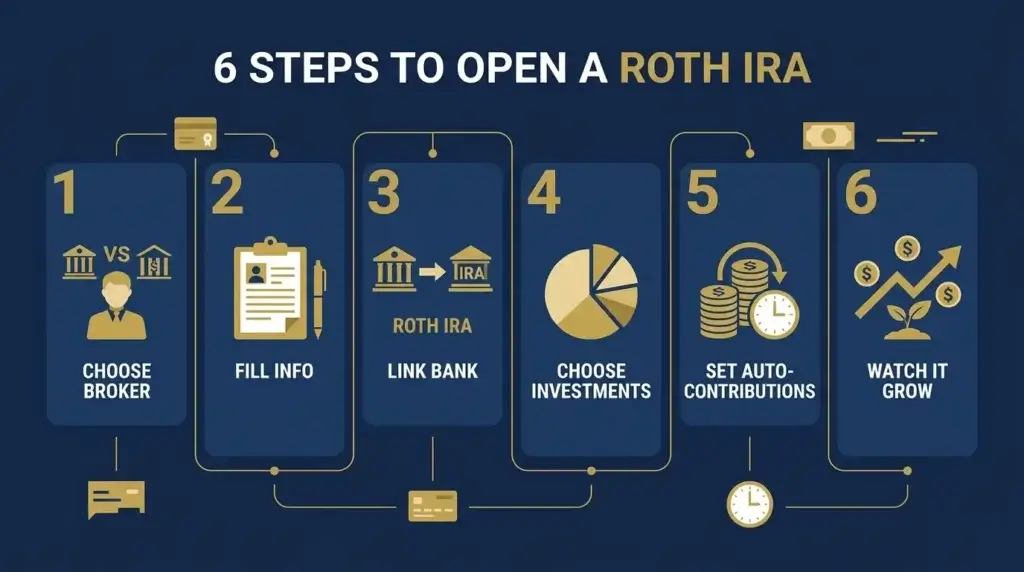
- Compare brokerages or robo-advisors based on fees, investments, service and account features
- Go to their website and click “Open an Account” then “Roth IRA”
- Fill in your personal information: name, Social Security number, employment info
- Link your bank account to make your first deposit
- Choose your investments (or let the robo-advisor choose for you)
- Set up automatic monthly contributions — even $50 per month makes a difference
Opening time varies by provider and whether identity verification or funding requires additional steps. If you want to understand why investment horizon matters, read our guide on saving for retirement at 25.
Frequently Asked Questions About Roth IRAs
Can I have both a Roth IRA and a 401(k)?
Yes. You can generally contribute to both a workplace 401(k) and a Roth IRA if you are eligible. How you split contributions depends on the employer match, plan fees and investment choices, Roth IRA income limits, taxes, liquidity needs and your overall retirement strategy.
What if I contribute too much to my Roth IRA?
The IRS charges a 6% excise tax on excess contributions. Contact your brokerage immediately to remove the excess before the tax filing deadline.
Can I open a Roth IRA for my child?
Yes. A custodial Roth IRA allows minors with earned income to start investing early — one of the most powerful financial gifts you can give a child.
Is a Roth IRA safe?
A Roth IRA is an account type, not a guaranteed investment. The investments you choose can gain or lose value. SIPC protection at a member brokerage is designed for certain missing customer assets if the brokerage fails; it does not protect against market losses.
Can I withdraw Roth IRA contributions without penalty?
Regular Roth IRA contributions are generally treated as distributed before conversions and earnings under IRS ordering rules. Because those contributions were already taxed, withdrawing regular contribution amounts is generally not subject to federal income tax or the 10% additional tax. Conversions and earnings follow different rules.
The Bottom Line
A Roth IRA can be a useful retirement account for people who are eligible and who value after-tax contributions, tax-free qualified distributions and no lifetime required minimum distributions for the original owner. Whether it is preferable to a traditional IRA or workplace plan depends on taxes, income, investment options and retirement goals.
Before opening a Roth IRA, compare brokerage fees, investment choices, service and account features. Then read our comparison of Roth IRA vs Traditional IRA and our guide on how to retire early for broader retirement-planning context.
Disclaimer: This article is for informational and educational purposes only. It does not constitute tax or financial advice. Consult a qualified tax professional for personalized guidance. Contribution limits are based on IRS guidelines for 2026 and are subject to change.