

📢 Disclosure: This post contains affiliate links. We may earn a commission at no extra cost to you. We only recommend products we genuinely believe in.
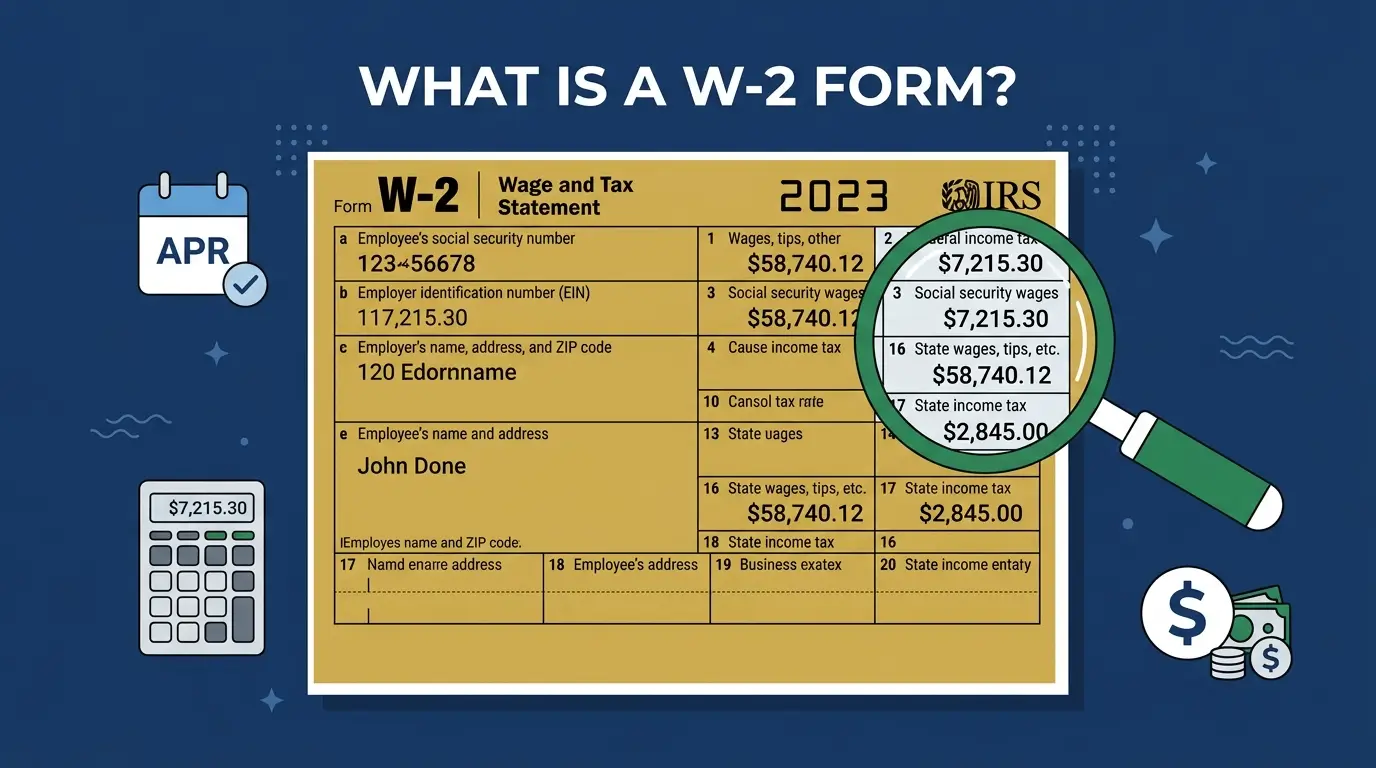
What is a W-2 form? A W-2 form is the official tax document your employer sends you each January that reports your annual wages and the taxes withheld from your paychecks throughout the year. Understanding what is a W-2 form is essential for every employee in America — because this single document is the foundation of your entire tax return. Without your W-2 form, you cannot accurately file your federal and state income taxes. This complete guide on what is a W-2 form explains every box, how it differs from a 1099, what to do if there is an error, and exactly how to use your W-2 form to file your taxes in 2026.
What Is a W-2 Form — The Simple Definition
A W-2 form, officially called the “Wage and Tax Statement,” is a federal tax document that your employer is required by law to send you by January 31 each year. The W-2 form summarizes three things: how much you earned from that employer during the year, how much federal income tax was withheld from your paychecks, and how much was withheld for Social Security and Medicare (FICA taxes).
Your employer also sends a copy of your W-2 form directly to the IRS — so the IRS already knows your income before you even file your return. The W-2 form is what makes it possible for the IRS to verify that your tax return is accurate. If you have multiple jobs, you receive a separate W-2 form from each employer.
Who Receives a W-2 Form?
You receive a W-2 form if you are an employee — meaning your employer withholds taxes from your paycheck throughout the year. The IRS requires employers to issue a W-2 form to every employee they paid at least $600 in wages, salaries, or tips during the tax year, or from whom any federal income tax was withheld regardless of the amount.
If you are a freelancer, independent contractor, or self-employed, you receive a 1099 form instead of a W-2 form — because no taxes are withheld from your payments. You are responsible for paying your own taxes quarterly.
How to Read Every Box on a W-2 Form
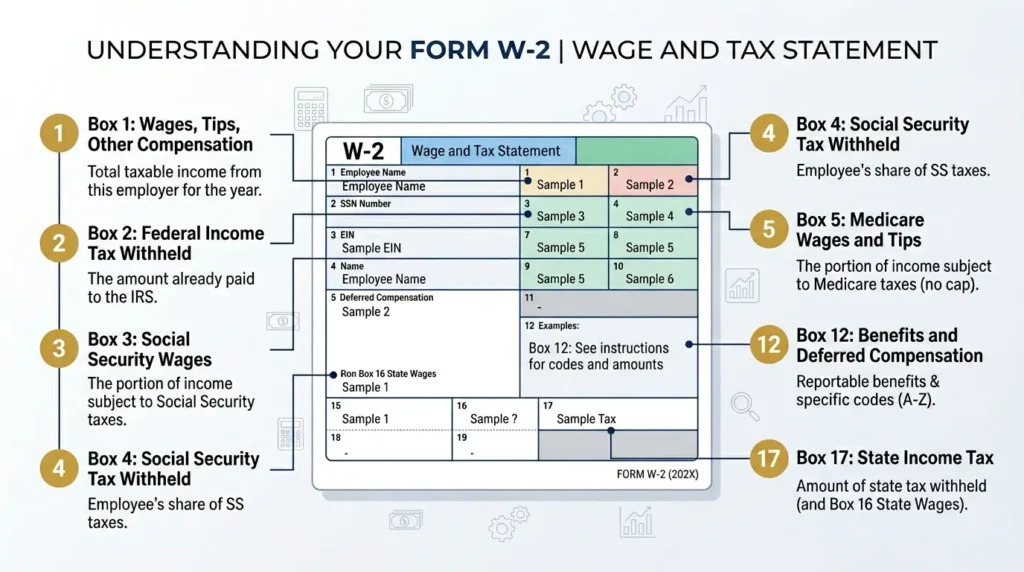
The W-2 form contains multiple numbered boxes. Here is what each key box means:
| Box | What It Shows | Why It Matters |
|---|---|---|
| Box 1 | Wages, tips, and other compensation | Your taxable income from this employer — this goes on your 1040 |
| Box 2 | Federal income tax withheld | Amount already paid to the IRS — credited against your tax bill |
| Box 3 | Social Security wages | Wages subject to Social Security tax (cap: $176,100 in 2026) |
| Box 4 | Social Security tax withheld | 6.2% of Box 3 — paid into Social Security |
| Box 5 | Medicare wages and tips | All wages subject to Medicare tax (no cap) |
| Box 6 | Medicare tax withheld | 1.45% of Box 5 (additional 0.9% if wages over $200K) |
| Box 12 | Various benefit codes | 401(k) contributions (code D), HSA contributions (code W), and more |
| Box 13 | Checkboxes | Statutory employee, retirement plan participant, third-party sick pay |
| Box 16 | State wages | Your wages subject to state income tax |
| Box 17 | State income tax withheld | Amount withheld for your state tax return |
Box 1 (your federal taxable wages) is often lower than your total salary because it is reduced by pre-tax contributions — your 401(k) contributions, health insurance premiums, and FSA/HSA deposits are subtracted before Box 1 is calculated. This is one reason your W-2 wages may look lower than your actual salary. To understand how 401(k) contributions reduce your taxable wages, read our guide on what a 401(k) is.
W-2 Form vs 1099 Form
| Feature | W-2 Form | 1099 Form |
|---|---|---|
| Who receives it | Employees | Independent contractors, freelancers |
| Who sends it | Your employer | Your client or payer |
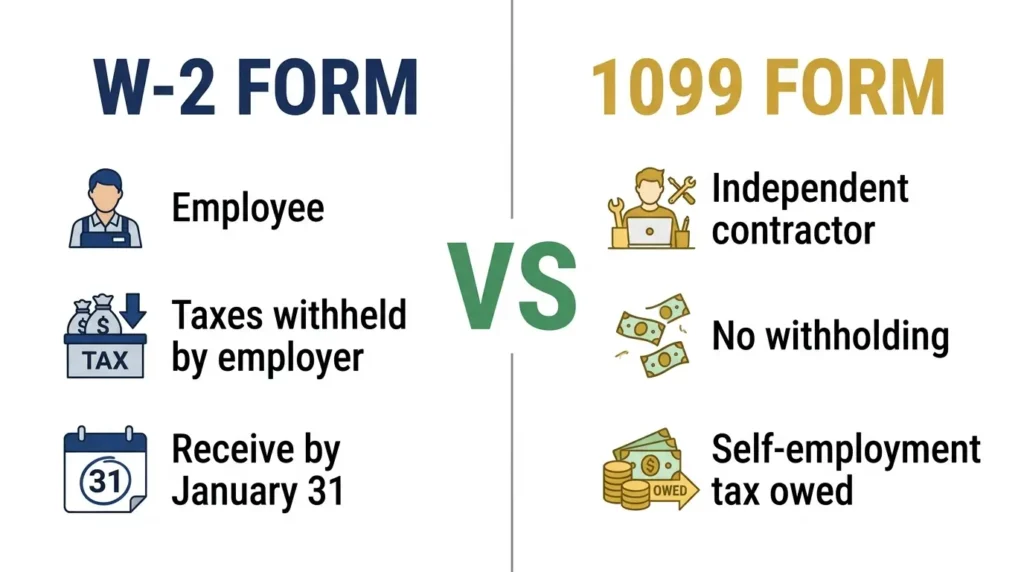
| Taxes withheld | Yes — federal, state, FICA | No — you pay your own taxes |
| Self-employment tax | No — employer pays half of FICA | Yes — you pay the full 15.3% FICA |
| Deadline to receive | January 31 | January 31 |
| Tax filing impact | Usually simpler — taxes were withheld | More complex — quarterly estimated taxes often required |
The key practical difference: W-2 employees have taxes withheld throughout the year, so tax season is primarily about reconciling what was withheld versus what you actually owe. 1099 recipients must calculate and pay estimated taxes quarterly — and often owe a large tax bill in April if they did not.
When Do You Receive Your W-2 Form?
Your employer is legally required to send your W-2 form by January 31 of the following year. For the 2025 tax year (taxes filed in 2026), your employer must provide your W-2 form by January 31, 2026. It may arrive by mail to your address on file or electronically through your employer’s payroll portal (ADP, Workday, Gusto, etc.).
If you have not received your W-2 form by February 15, contact your employer’s HR or payroll department first. If they cannot resolve it, the IRS can also contact your employer on your behalf — but this process takes time, so do not wait too long.
How to Use Your W-2 Form to File Taxes
Once you have your W-2 form in hand, here is exactly how to use it:
- Verify your personal information — check that your name, Social Security number, and address are correct. Errors can delay your refund.
- Note the Box 1 amount — this is your federal taxable income from this employer and goes on line 1a of your Form 1040.
- Note the Box 2 amount — this is your federal tax already paid. It is credited against your tax liability.
- Note Box 17 — this goes on your state tax return.
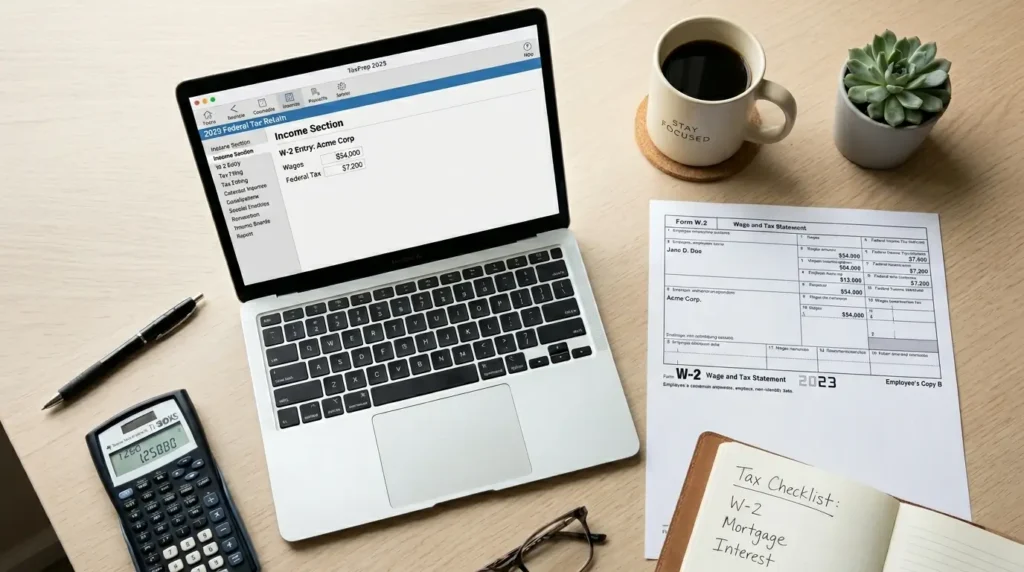
- Enter all figures into your tax software or give the form to your tax preparer.
- If you have multiple W-2 forms (multiple jobs), add all Box 1 amounts together for your total federal wages, and all Box 2 amounts for total federal tax withheld.
If Box 2 (taxes withheld) is more than your actual tax liability, you receive a refund. If it is less, you owe the difference. The goal of proper W-4 withholding throughout the year is to have these numbers match — neither a large refund nor a large tax bill. A large refund means you gave the IRS an interest-free loan; that money could have been in a high-yield savings account earning 4%–5% APY all year.
What to Do If Your W-2 Form Has an Error
Errors on a W-2 form are more common than most people realize. Common errors include wrong Social Security number, incorrect name spelling, or wrong wage amounts. Here is what to do:
- Contact your employer’s payroll or HR department immediately and explain the error
- Your employer must issue a corrected W-2 form (called a W-2c) if the error affects the tax figures
- Do not file your taxes until you have the corrected W-2c — filing with incorrect figures may require an amended return later
- If your employer refuses to correct the error or cannot be reached, contact the IRS at 1-800-829-1040
Frequently Asked Questions
What is a W-2 form used for?
A W-2 form is used to file your federal and state income tax return. It reports your annual wages and the taxes already withheld from your paychecks. You use the figures from your W-2 form to complete your Form 1040, determine whether you owe additional taxes or are owed a refund, and verify that the IRS’s records match your actual income.
When should I receive my W-2 form in 2026?
Your employer is legally required to send your W-2 form by January 31, 2026, for the 2025 tax year. Most employers send W-2 forms electronically through payroll portals (ADP, Workday, Gusto) by mid-January. If you have not received yours by February 15, contact your employer’s HR or payroll department. If unresolved, contact the IRS for assistance.
What is the difference between a W-2 and a W-4 form?
A W-4 form is what you fill out when you are hired — it tells your employer how much federal income tax to withhold from your paychecks throughout the year. A W-2 form is what your employer sends you after the year ends — it reports what you actually earned and how much was actually withheld. The W-4 determines withholding; the W-2 reports results.
Why are my W-2 wages lower than my salary?
Box 1 of your W-2 form shows your taxable wages — which is your gross salary minus pre-tax deductions. Pre-tax 401(k) contributions, health insurance premiums paid by payroll deduction, FSA and HSA contributions, and commuter benefits all reduce your Box 1 wages. This is not an error — these deductions lower your taxable income, which reduces your tax bill.
What if I lost my W-2 form?
If you lost your W-2 form, contact your employer’s payroll department and request a duplicate. Most employers can send a replacement electronically through your payroll portal immediately. If you cannot reach your employer, you can contact the IRS, which may have a copy on file. As a last resort, you can use Form 4852 as a substitute W-2 when filing, though this may slow your return processing.
Final Thoughts: Your W-2 Form Is the Starting Point for Tax Season
Now that you understand what is a W-2 form and how to read every box, you have the foundation to file your taxes accurately and confidently. Your W-2 form is not just a tax document — it is a snapshot of your entire year of earnings and tax payments. Review it carefully every year for errors, understand how pre-tax deductions reduce your Box 1 wages, and use it alongside your other tax documents to complete your return.
Once your taxes are filed, use your refund — if you get one — strategically. A tax refund is money you overpaid throughout the year. Rather than spending it, direct it toward your emergency fund, your highest-interest debt, or your Roth IRA. Every tax refund is an opportunity to make a significant one-time contribution to your financial future.