

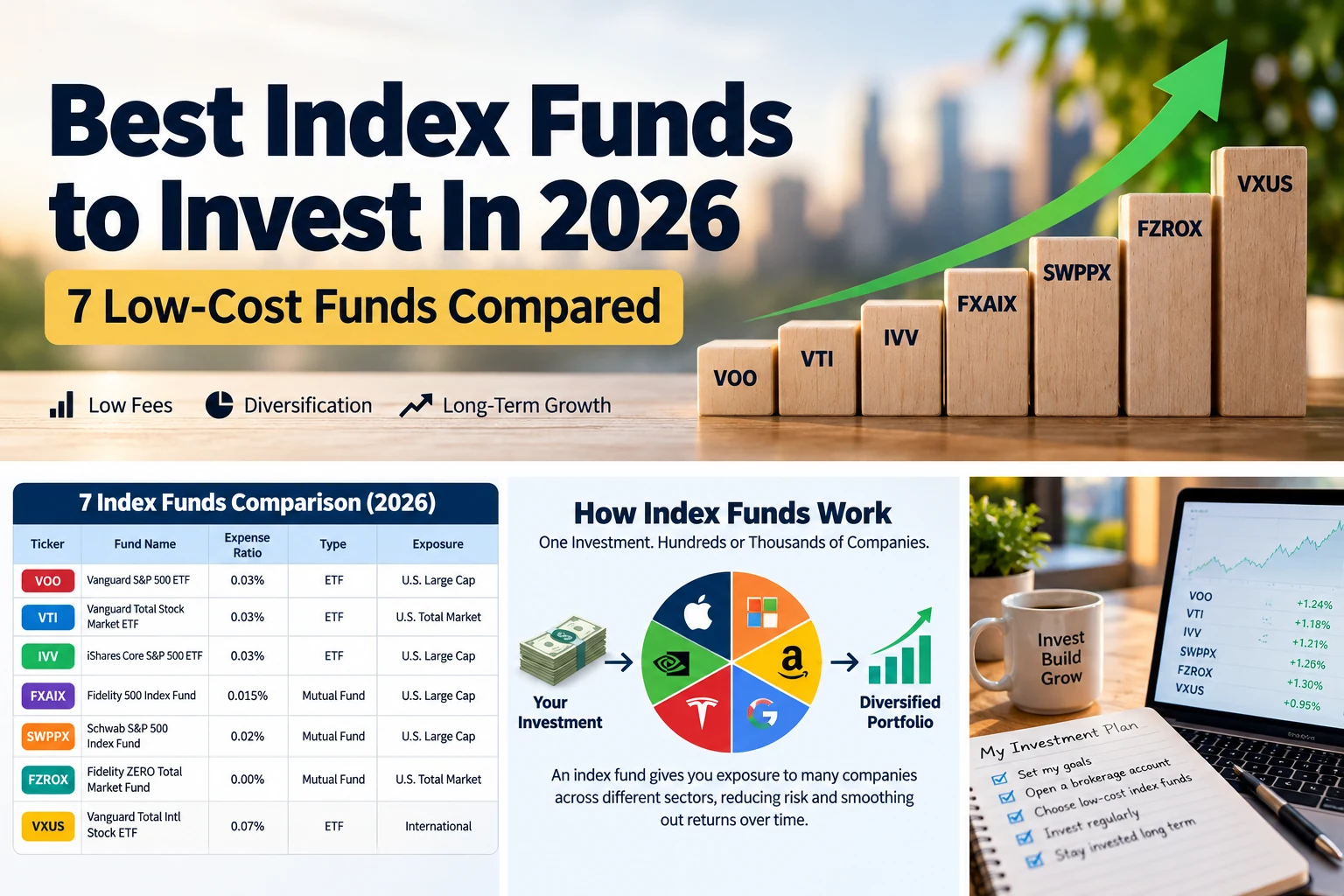
Looking for the best index funds to invest in for 2026? The strongest choices are usually not the funds with the flashiest recent returns. For long-term investors, the more useful comparison is often the index a fund tracks, its expense ratio, diversification, fund structure, tax characteristics, and any platform restrictions.
This guide compares seven widely used low-cost index funds for U.S. investors in 2026. It is designed to help you understand the differences—not to tell you which fund you personally should buy.
If you are completely new to the subject, start with our guide to how to invest in index funds. If you already understand the basics and want the mechanics of placing an order, see how to buy index funds step by step.
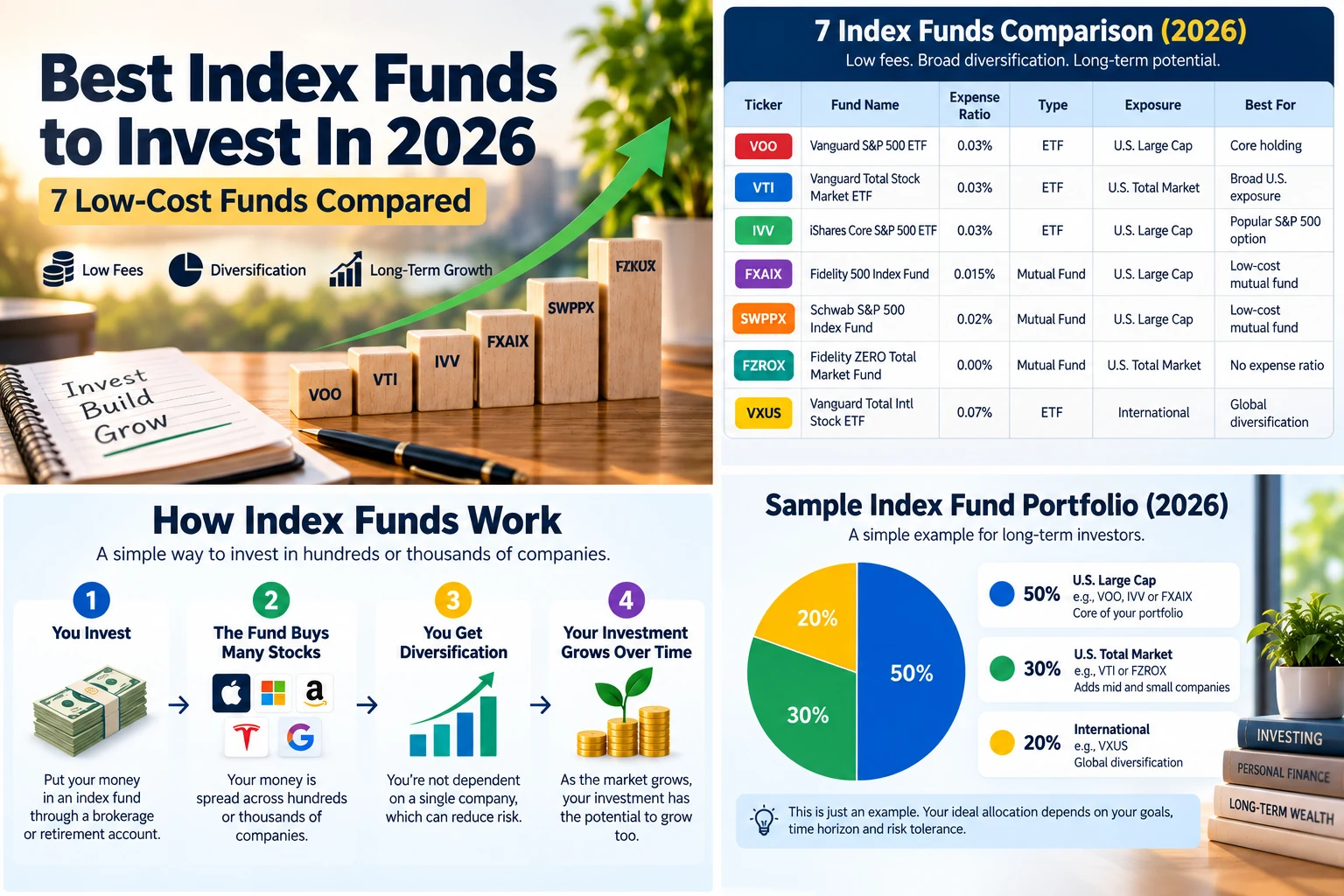
Best Index Funds to Invest In 2026: Quick Comparison
| Fund | Ticker | Structure | Main Exposure | Expense Ratio | Why It Stands Out |
|---|---|---|---|---|---|
| Vanguard S&P 500 ETF | VOO | ETF | S&P 500 | 0.03% | Low-cost large-cap U.S. exposure |
| Vanguard Total Stock Market ETF | VTI | ETF | Broad U.S. stock market | 0.03% | Broader U.S. diversification |
| iShares Core S&P 500 ETF | IVV | ETF | S&P 500 | 0.03% | Large, liquid S&P 500 ETF |
| Fidelity 500 Index Fund | FXAIX | Mutual fund | S&P 500 | 0.015% | Very low-cost S&P 500 mutual fund |
| Schwab S&P 500 Index Fund | SWPPX | Mutual fund | S&P 500 | 0.02% | Low-cost mutual fund option |
| Fidelity ZERO Total Market Index Fund | FZROX | Mutual fund | Broad U.S. stock market | 0.00% | No expense ratio; Fidelity-only |
| Vanguard Total International Stock ETF | VXUS | ETF | Non-U.S. stocks | 0.05% | International diversification |
Expense ratios are based on the latest issuer information reviewed in October 2026. Fund costs and terms can change, so verify the current prospectus before investing.
How We Compared These Index Funds
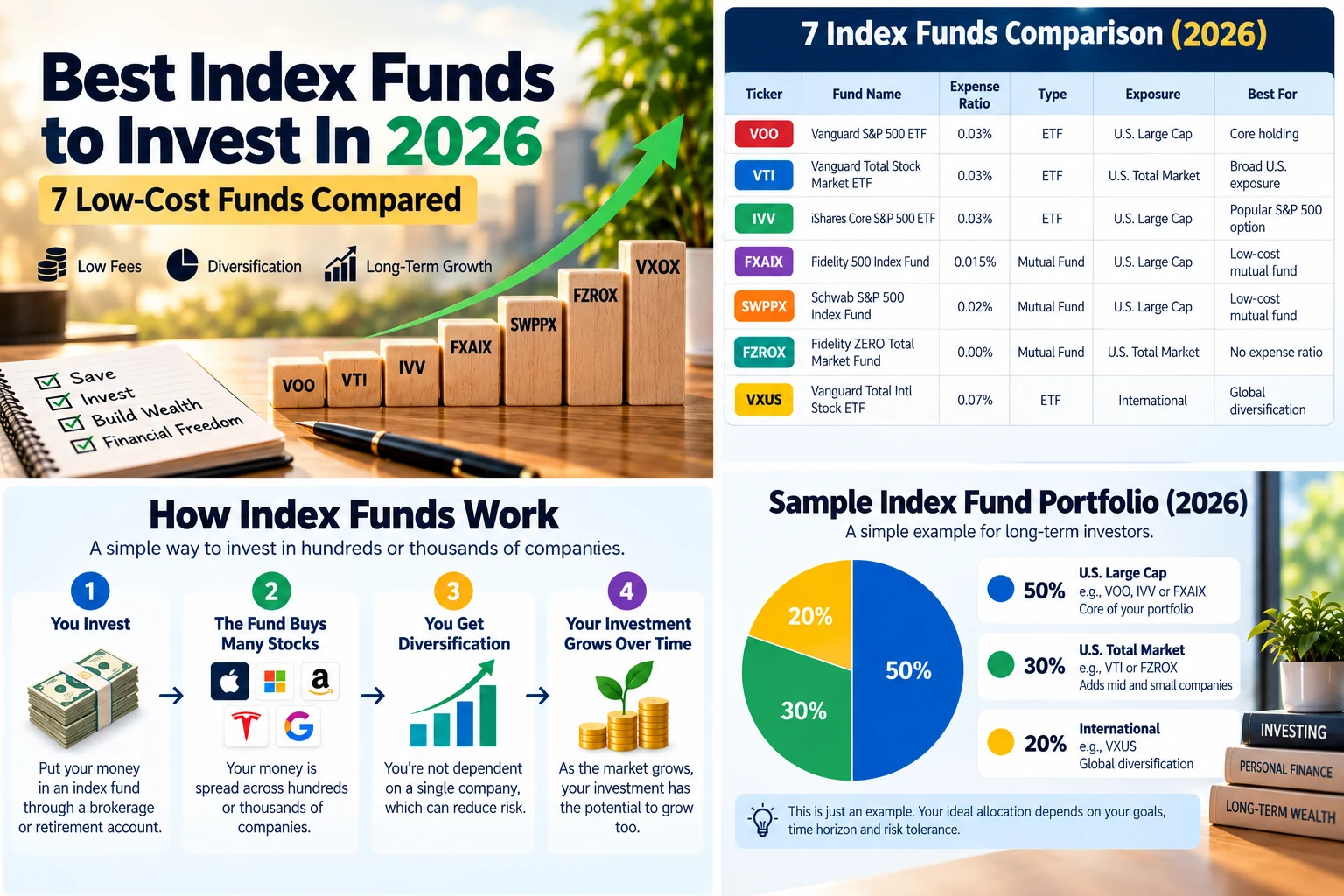
An index fund can be a mutual fund or an exchange-traded fund that seeks to track a market index. Investor.gov notes that index funds can differ in how they replicate an index, what they cost, and how closely they track their benchmarks. Fees matter because even small cost differences can compound over time.
For this comparison, we focused on five factors:
- Expense ratio: the annual fund operating cost deducted from fund assets.
- Index exposure: whether the fund tracks the S&P 500, the total U.S. market, or international stocks.
- Structure: ETF versus mutual fund.
- Availability: whether the fund can be bought broadly or is tied to a particular platform.
- Use within a portfolio: whether the fund is mainly suited to large-cap U.S. exposure, broader U.S. exposure, or international diversification.
Investor.gov also emphasizes that diversification depends on what a fund actually owns. Owning several funds does not automatically make a portfolio more diversified if those funds hold many of the same securities.
1. VOO — Vanguard S&P 500 ETF
VOO tracks the S&P 500 Index, giving investors exposure to large U.S. companies. Vanguard lists an expense ratio of 0.03%.
VOO can make sense for investors who specifically want large-cap U.S. market exposure through an ETF. It trades during market hours and is widely available through brokerage accounts.
One important limitation is that the S&P 500 does not represent the entire U.S. stock market. It is dominated by large companies, so investors wanting meaningful exposure to smaller U.S. companies may prefer a broader-market fund or combine large-cap exposure with other holdings.
Best suited for: investors seeking low-cost S&P 500 exposure through an ETF.
2. VTI — Vanguard Total Stock Market ETF
VTI is designed to track the broad U.S. stock market rather than only the largest 500 companies. Vanguard currently lists a 0.03% expense ratio.
The main difference between VTI and VOO is breadth. VTI includes large-, mid-, and small-cap U.S. stocks, while VOO focuses on the S&P 500.
That does not mean VTI will always outperform VOO. Large companies make up a substantial portion of the total U.S. market, so their performance can still have a major effect on VTI. The advantage is broader market coverage rather than a guaranteed return advantage.
Best suited for: investors who want broad U.S. stock exposure in a single ETF.
3. IVV — iShares Core S&P 500 ETF
IVV is another low-cost ETF tracking the S&P 500. iShares lists an expense ratio of 0.03%.
From an exposure perspective, IVV and VOO are very similar because both track the same benchmark. Owning both does not meaningfully expand your market exposure.
The decision between the two may come down to brokerage features, bid/ask spreads, tax lots, automatic-investing options, or simple platform preference rather than major differences in underlying holdings.
Best suited for: investors seeking an established, highly liquid S&P 500 ETF.
4. FXAIX — Fidelity 500 Index Fund
FXAIX is Fidelity’s S&P 500 index mutual fund. Fidelity reports a gross and net expense ratio of 0.015% as of April 29, 2026.
Unlike VOO and IVV, FXAIX is a mutual fund rather than an ETF. Mutual funds are generally priced once per trading day at net asset value, while ETFs trade throughout the market session.
For investors who prefer automatic recurring purchases in a Fidelity account, the mutual-fund structure may be convenient. However, account portability and transaction policies can matter if you later move assets to another brokerage.
Best suited for: Fidelity investors who prefer an S&P 500 mutual fund with a very low expense ratio.
5. SWPPX — Schwab S&P 500 Index Fund
SWPPX is Schwab’s S&P 500 index mutual fund. Its February 2026 summary prospectus filed with the SEC lists total annual fund operating expenses of 0.02%.
Like FXAIX, SWPPX offers S&P 500 exposure in mutual-fund form. Investors using Schwab may find it convenient for automated contributions or retirement accounts.
Because SWPPX, FXAIX, VOO, and IVV all target the S&P 500, the biggest distinction is usually structure, platform, costs, and trading characteristics—not dramatically different underlying exposure.
Best suited for: Schwab investors wanting a low-cost S&P 500 mutual fund.
6. FZROX — Fidelity ZERO Total Market Index Fund
FZROX stands out because Fidelity reports an expense ratio of 0.00%. The fund seeks broad U.S. stock-market exposure and had more than 2,600 holdings as of July 31, 2026.
The tradeoff is portability. FZROX is a proprietary Fidelity mutual fund. If you later transfer your account to another brokerage, you may not be able to transfer FZROX in kind and could need to sell it first. That issue may be especially relevant in a taxable brokerage account because selling can create a taxable capital gain or loss.
Inside an IRA, where selling investments generally does not by itself create current capital-gains tax, portability may be less of a tax concern, although account rules still matter.
Best suited for: Fidelity investors who value broad U.S. market exposure and a zero expense ratio.
7. VXUS — Vanguard Total International Stock ETF
VXUS differs from the other funds on this list because it focuses on stocks outside the United States. Vanguard currently lists an expense ratio of 0.05%.
VXUS is not a substitute for a U.S. total-market fund if your goal is U.S. exposure. Instead, it can be used as an international component alongside U.S. stock holdings.
International investing introduces additional risks, including currency, political, regulatory, and country-specific risks. But it can also reduce dependence on the performance of one national market.
Best suited for: investors seeking broad non-U.S. equity exposure as part of a diversified portfolio.
VOO vs VTI: Which Offers Broader Diversification?
VOO and VTI are often compared because both are low-cost Vanguard ETFs with a 0.03% expense ratio.
| Feature | VOO | VTI |
|---|---|---|
| Benchmark focus | S&P 500 | Broad U.S. stock market |
| Company sizes | Primarily large-cap | Large-, mid-, and small-cap |
| Expense ratio | 0.03% | 0.03% |
| Structure | ETF | ETF |
| Primary difference | Large-cap concentration | Broader market coverage |
Neither fund is universally better. VOO may appeal to investors who intentionally want the S&P 500. VTI may appeal to investors who prefer broader U.S. exposure in one fund.
ETF vs Mutual Fund: Which Structure Is Better for Index Investing?
Index funds can be structured as ETFs or mutual funds. If you need a refresher, our guide explaining what an ETF is covers the basics.
ETFs such as VOO, VTI, IVV, and VXUS trade during market hours. Mutual funds such as FXAIX, SWPPX, and FZROX transact at the fund’s calculated net asset value after the market close.
Investor.gov notes that ETFs can have tax-efficiency advantages in taxable accounts because many ETF transactions use in-kind exchanges, potentially reducing capital-gains distributions. That does not mean ETFs are always more tax-efficient in every situation, and investors can still owe tax when they sell ETF shares at a gain.
Mutual funds can be attractive for investors who value simple recurring dollar-based investing within the fund company’s platform.
How Much Do Expense Ratios Matter?
Expense ratios are not the only factor that matters, but they matter because they reduce investment returns. The SEC notes that even small differences in fund costs can create meaningful differences over long periods.
| Expense Ratio | Annual Fund Cost per $10,000 |
|---|---|
| 0.00% | $0 |
| 0.015% | $1.50 |
| 0.02% | $2.00 |
| 0.03% | $3.00 |
| 0.05% | $5.00 |
Those differences look small over one year, but the long-term effect grows with your balance and time invested. Still, choosing between two nearly identical funds based only on a one- or two-basis-point cost difference may be less important than choosing the right market exposure and account structure.
What to Check Before Choosing an Index Fund
Before investing, compare more than the ticker symbol. Ask:
- What index does the fund track?
- Does it hold large caps only or the broader market?
- Is it an ETF or mutual fund?
- What is the current expense ratio?
- Does the brokerage charge transaction fees?
- Can the fund be transferred to another brokerage?
- How concentrated are the largest holdings?
- Does the fund fit the rest of your portfolio?
- Are you investing through a taxable account, IRA, or employer plan?
Our index funds for beginners guide explains these planning decisions in more detail.
Should You Own More Than One Index Fund?
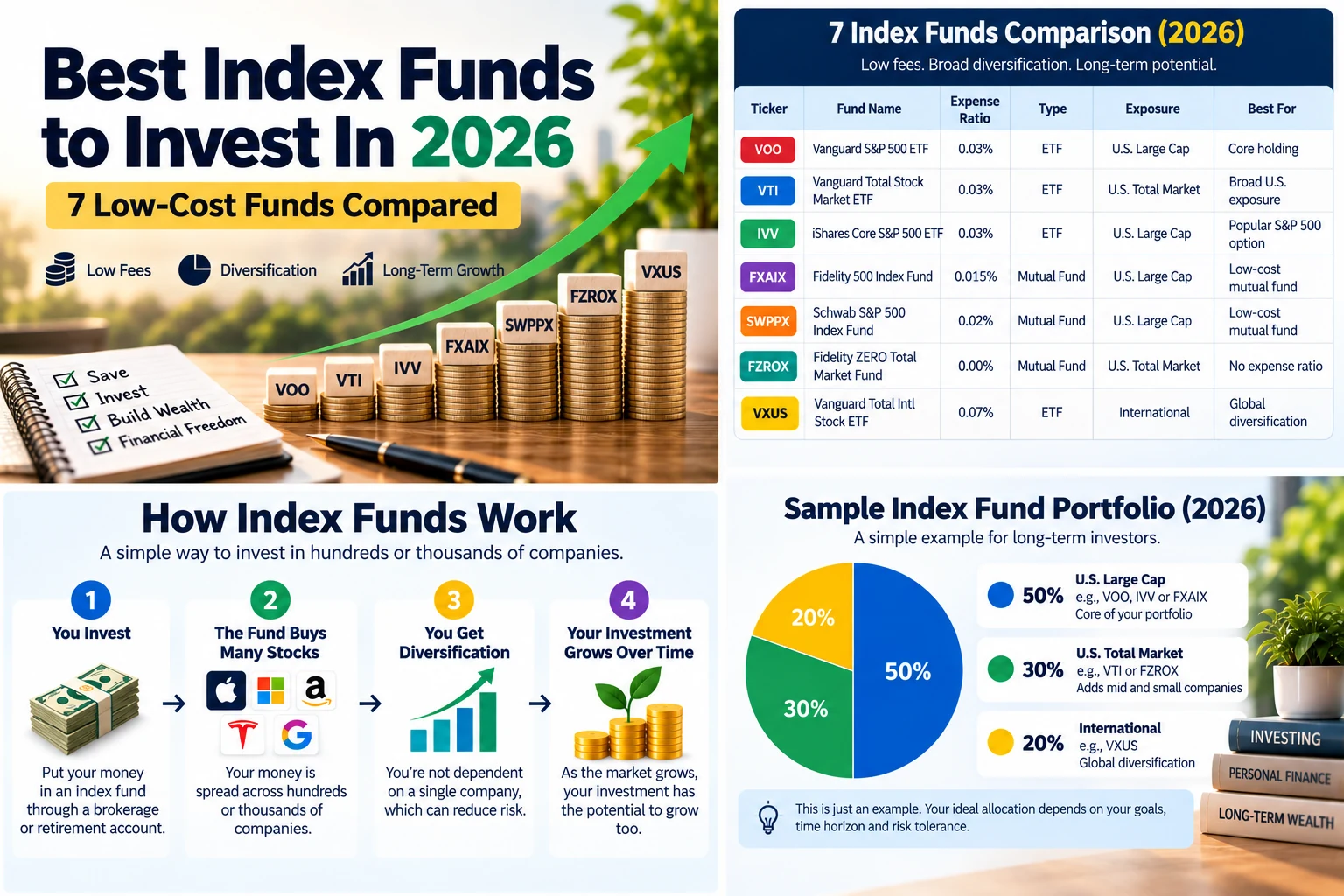
Sometimes—but only when the additional fund provides different exposure.
For example, owning VOO and IVV does not meaningfully broaden diversification because both track the S&P 500. Adding a broad international fund such as VXUS changes the geographic exposure. Combining a U.S. stock fund with a bond index fund would change the asset-class exposure.
The goal is not to accumulate as many funds as possible. It is to understand what each fund adds to your portfolio.
How to Invest in an Index Fund
Once you have selected a fund and account type, the process is generally straightforward:
- Open or use an eligible brokerage or retirement account.
- Fund the account.
- Search for the fund ticker.
- Review the fund name and prospectus to make sure you selected the correct security.
- Choose the amount you want to invest.
- Select an appropriate order type if you are buying an ETF.
- Review and submit the order.
For the full transaction walkthrough, read how to buy index funds. If you plan to invest a fixed amount regularly, our guide to dollar-cost averaging explains how recurring investing works.
Index Funds and Retirement Accounts
Index funds can be held in taxable brokerage accounts and many retirement accounts. Account type affects contribution limits, withdrawal rules, and taxation.
If you are considering a Roth IRA, review what a Roth IRA is before deciding where to hold your investments. Choosing the account is separate from choosing the fund.
Frequently Asked Questions
What is the best index fund to invest in for 2026?
There is no single best index fund for every investor. VOO and IVV offer low-cost S&P 500 exposure, VTI and FZROX provide broader U.S. market exposure, FXAIX and SWPPX are low-cost S&P 500 mutual funds, and VXUS provides international stock exposure. The right choice depends on the exposure, structure, account type, costs, and risks that fit your plan.
Is VOO or VTI better for beginners?
VOO focuses on the S&P 500, while VTI tracks a broader segment of the U.S. stock market including mid- and small-cap companies. Both currently have 0.03% expense ratios. The better fit depends on whether you intentionally want large-cap exposure or broader U.S. market coverage.
What is the lowest-cost index fund in this comparison?
FZROX currently reports a 0.00% expense ratio. However, it is a proprietary Fidelity mutual fund, so investors should also consider portability and account type rather than choosing a fund based on the expense ratio alone.
Are index funds safe?
Index funds are investments and can lose value. Their risks depend largely on the securities and index they track. A broad stock index fund can reduce company-specific risk through diversification, but it does not eliminate market risk or guarantee a profit.
Is an ETF better than an index mutual fund?
Neither structure is always better. ETFs trade intraday and may offer tax-efficiency advantages in taxable accounts, while mutual funds can be convenient for automatic investing. Compare costs, portability, taxes, trading features, and your brokerage before choosing.
Can I own both VOO and IVV?
You can, but both track the S&P 500, so owning both generally adds little diversification. If your goal is broader diversification, compare funds that provide different market, geographic, or asset-class exposure.
Final Thoughts
The best index funds to invest in for 2026 are not defined by one ticker symbol. A strong comparison starts with what the fund owns, how much it costs, how it is structured, where it can be held, and what role it would play in your portfolio.
VOO and IVV provide low-cost S&P 500 exposure. VTI expands the coverage to more of the U.S. market. FXAIX and SWPPX provide similar large-cap exposure in mutual-fund form. FZROX removes the expense ratio but comes with Fidelity-specific portability considerations. VXUS offers a way to add international exposure.
Before investing, review the latest prospectus and make sure the fund’s objective and risks match your financial situation and time horizon.