


A money market account minimum balance can range from $0 to several thousand dollars depending on the financial institution and the account.
But there’s an important detail that can make comparing accounts confusing: a bank may have more than one balance requirement.
The amount required to open a money market account isn’t necessarily the same as the amount required to earn the advertised APY or avoid a monthly fee.
Understanding these differences can help you compare money market accounts more accurately and avoid choosing an account that doesn’t fit the amount you plan to deposit.
If you’re unfamiliar with these accounts, start with our guide explaining what a money market account is.
What Is the Minimum Balance for a Money Market Account?
There is no universal minimum balance requirement for money market accounts.
Some accounts can be opened with $0, while others require $100, $500, $1,000 or more.
For example, Bankrate’s late-September 2026 comparison includes money market accounts with no minimum opening deposit as well as accounts requiring $100, $500 or $1,000 to open. Bankrate
The important question isn’t simply:
“What is the minimum balance?”
Instead, check which type of minimum the institution is referring to.
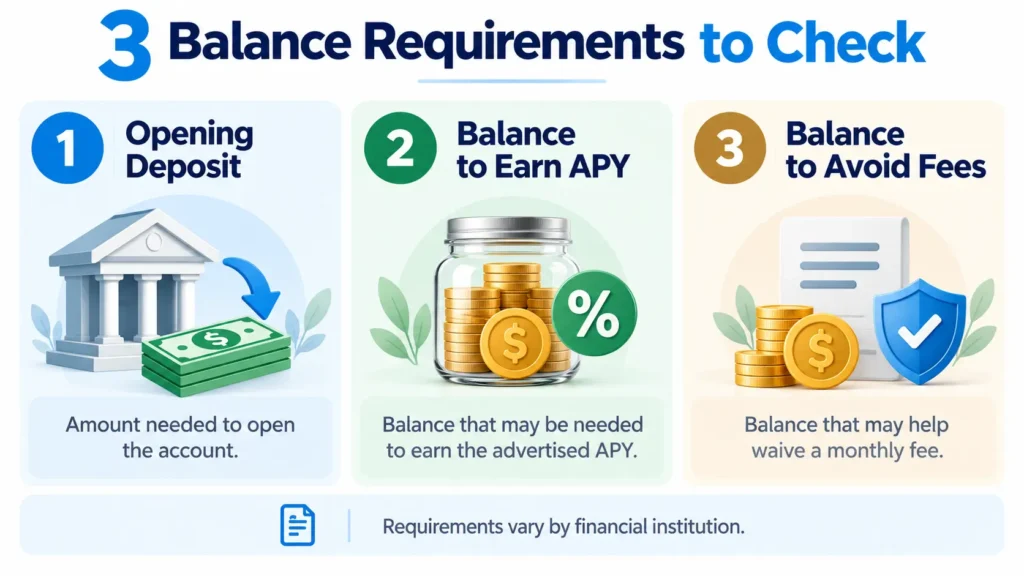
The 3 Money Market Account Minimums You Need to Understand
1. Minimum Opening Deposit
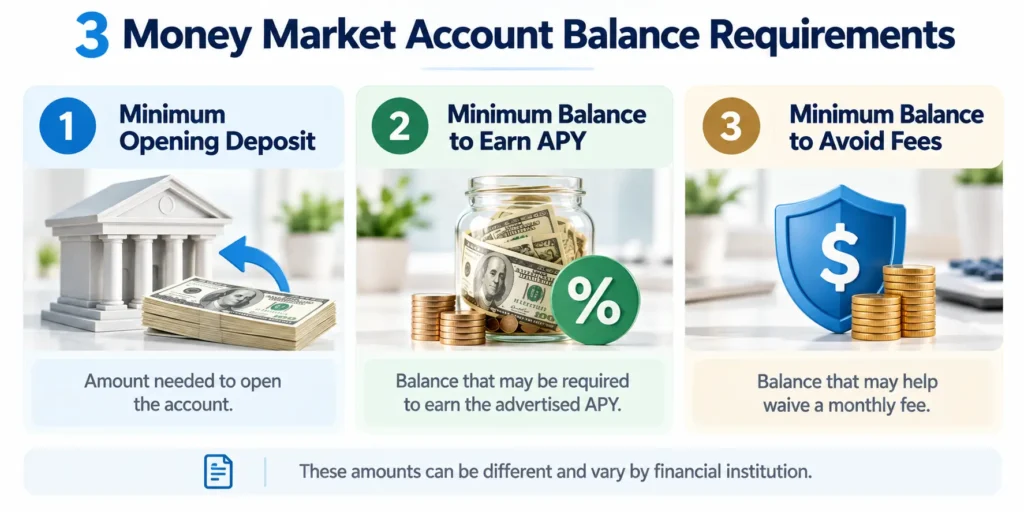
The minimum opening deposit is the amount of money you need to deposit when opening the account.
For example, an account might require:
$0 to open
or
$100 to open
or
$1,000 to open
Once the account is open, that amount doesn’t necessarily determine your APY or whether you’ll pay a monthly fee.
2. Minimum Balance to Earn the APY
Some banks require you to maintain a certain balance to earn the advertised annual percentage yield.
For example, an account could allow you to open it with $100 but require a larger balance to qualify for its highest APY.
Other money market accounts pay the same APY regardless of balance.
When comparing current money market account rates, always check whether the advertised APY applies to your expected deposit.
3. Minimum Balance to Avoid Monthly Fees
This is another separate requirement.
A bank might let you open an account with little or no money but charge a monthly maintenance fee unless your balance remains above a specified threshold.
That means an account with a $0 opening requirement doesn’t necessarily mean there are no balance requirements later.
Money Market Minimum Balance Examples
Here’s how different these requirements can be.
As of late September 2026, Bankrate lists examples including: Bankrate
| Account | Minimum to Open | Minimum for APY | Minimum to Avoid Monthly Fee |
|---|---|---|---|
| Zynlo Bank Money Market | $0 | $0 | $0 |
| Quontic Bank Money Market | $100 | $0 | $0 |
| CFG Bank Money Market | $1,000 | $1,000 | $1,000 |
| Vio Bank Money Market | $100 | $0 | $0 |
| UFB Direct Money Market | $0 | $0 | $5,000 |
| First Internet Bank Money Market | $100 | $0* | $4,000 |
*First Internet Bank uses balance tiers, and Bankrate notes that a substantially higher balance is required for its top yield. Bankrate
Rates and account requirements can change. Always verify current terms directly with the financial institution before opening an account.
This table demonstrates why looking only at the “minimum deposit” can be misleading.
Can You Open a Money Market Account With No Minimum Balance?
Yes.
Some money market accounts currently have no minimum opening deposit.
For example, Bankrate’s September 2026 comparison lists Zynlo Bank, Sallie Mae, UFB Direct, FNBO Direct, Ally Bank and NBKC among accounts with no minimum opening deposit. Bankrate
However, “no minimum to open” doesn’t automatically mean:
no monthly fee,
no minimum for the advertised APY, or
no balance tiers.
Check each requirement separately.
Why Do Some Money Market Accounts Require Higher Balances?
Money market accounts historically have tended to carry higher minimum balance requirements than ordinary savings accounts.
Current products vary considerably, however. Some online money market accounts now have no minimum balance requirement at all, while others require $1,000 or more. Bankrate also notes that money market accounts can have higher minimums than conventional savings accounts. Bankrate
Banks may also structure APYs or fees around balance tiers.
This makes your expected account balance an important part of the comparison.
Does a Higher Balance Get You a Higher APY?
Sometimes—but not always.
Some money market accounts use tiered interest rates.
For example:
| Balance | Illustrative APY |
|---|---|
| $0–$999 | Lower tier |
| $1,000–$9,999 | Middle tier |
| $10,000+ | Higher tier |
This is only an illustration; actual tiers vary by institution.
Other accounts offer the same APY across eligible balances.
So don’t assume that depositing more money automatically produces a better interest rate.
For more on how rates work, read what APY means for savings.
What Happens If Your Balance Falls Below the Minimum?
The consequences depend on the account.
Your bank could:
charge a monthly maintenance fee,
reduce the APY you earn,
move your balance into a different interest tier,
or apply another account-specific condition.
For example, Bankrate reports that CFG Bank requires $1,000 to earn interest and avoid its $10 monthly fee. UFB Direct, by contrast, has no minimum opening deposit in Bankrate’s comparison but has a $10 monthly service fee when the applicable balance requirement isn’t maintained. Bankrate
This illustrates why you should examine the entire fee schedule rather than only the opening deposit.
Minimum Balance vs. Minimum Opening Deposit
These terms are easy to confuse.
Minimum opening deposit means the amount required to establish the account.
Minimum balance can refer to the amount you must maintain to receive a particular benefit or avoid a particular consequence.
For example, imagine an account with:
$100 minimum opening deposit
$0 minimum to earn interest
$5,000 minimum to avoid a monthly fee
You could technically open the account with $100, but keeping only $100 in it might not make economic sense if that triggers a recurring fee.
How Fees Can Affect a Smaller Balance
Fees matter more when your balance is relatively small.
Suppose you maintain $1,000 in an account paying 4% APY.
Ignoring rate changes and compounding differences, that would generate roughly $40 of interest over one year.
Now imagine the account charges a $10 monthly fee because you don’t meet its minimum balance requirement.
That would equal $120 in annual fees.
In this simplified example, the fees would exceed the interest earned.
This is why APY alone shouldn’t determine which account you choose.
Money Market Minimum Balance vs. High-Yield Savings
Minimum balance requirements can also help distinguish some money market accounts from high-yield savings accounts.
Both types of accounts can offer competitive variable APYs, but money market accounts have traditionally been more likely to carry higher minimum balance requirements. Current online products, however, vary considerably. Bankrate
If you have a relatively small amount to deposit, compare:
the minimum opening deposit,
the balance required for the advertised APY,
monthly fees,
and the balance required to waive those fees.
Our money market account vs high yield savings account comparison explains the other differences between these two account types.
How Much Should You Keep in a Money Market Account?
There isn’t one amount that works for everyone.
Instead, the balance should reflect what you’re using the account for.
For an emergency fund, for example, you might base the amount on several months of essential expenses rather than on a bank’s minimum requirement.
If you’re building your reserve from scratch, see our guide on how to build an emergency fund.
For a short-term goal such as buying a home, the balance may gradually increase as you save toward your target. Our guide to saving for a house down payment covers that process in more detail.
The important point is that the account’s requirements should work with your savings amount, rather than forcing you to maintain more cash than you intended simply to avoid a fee.
Are Money Market Accounts FDIC Insured Regardless of the Minimum Balance?
At an FDIC-insured bank, eligible money market deposit accounts receive the same federal deposit-insurance framework as other eligible deposit accounts.
The standard FDIC coverage limit is $250,000 per depositor, per insured bank, for each account ownership category. Qualifying accounts at federally insured credit unions receive corresponding NCUA coverage.
Minimum balance requirements don’t determine whether an eligible deposit is federally insured. Bankrate
Remember that a money market mutual fund is different from a money market deposit account and isn’t FDIC-insured.
How to Compare Money Market Account Minimum Balance Requirements
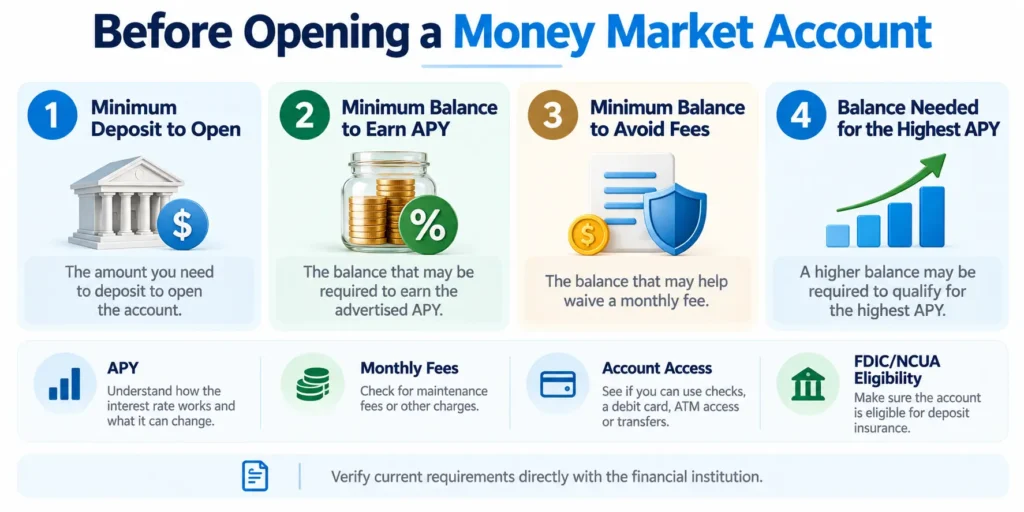
Before opening an account, check four numbers:
1. Minimum deposit to open
How much must you deposit initially?
2. Minimum balance to earn interest
Will your planned balance qualify for the advertised APY?
3. Minimum balance to avoid fees
Could your balance trigger a monthly maintenance charge?
4. Balance required for the highest APY
Does the account use different interest-rate tiers?
Then compare these requirements alongside APY, access options and other account features.
Our best money market accounts of 2026 provides a broader account comparison.
Frequently Asked Questions
What is the minimum balance for a money market account?
There is no universal minimum. Some money market accounts have no minimum opening deposit, while others require $100, $500, $1,000 or more. Requirements vary by institution and account.
Can I open a money market account with $100?
Yes, some money market accounts have a $100 minimum opening deposit. Others require less, more or no minimum at all.
Are there money market accounts with no minimum balance?
Yes. Some current money market accounts have no minimum opening deposit or minimum balance requirement. Always check separately for APY requirements and monthly fees.
What happens if I go below the minimum balance?
Depending on the account, you could incur a monthly fee, receive a different APY or become subject to other account-specific terms.
Do I need $1,000 for a money market account?
Not necessarily. Although some accounts require $1,000 or more, others can be opened with $100 or even $0.
Does a higher money market balance earn more interest?
A larger balance generally produces more dollar interest when the APY is the same. However, whether it qualifies for a higher APY depends on whether the institution uses balance tiers.
Is the minimum opening deposit the same as the minimum balance?
Not necessarily. The opening deposit establishes the account, while a separate minimum balance may be required to earn an APY or avoid fees.
Is there a penalty for going below the minimum balance?
Some institutions charge a monthly maintenance fee, while others don’t. Check the account’s current fee schedule and balance requirements.
Final Thoughts
A money market account minimum balance isn’t one universal number.
An account can have separate requirements for opening the account, earning its advertised APY and avoiding monthly fees.
Current examples show just how large the differences can be: some accounts have $0 minimums, while others require hundreds or thousands of dollars for particular benefits or to avoid fees. Bankrate
Before opening an account, compare the requirements with the amount you realistically expect to keep there.
Then compare the rate itself using our current money market account rates and broader account features in our best money market accounts of 2026.
Financial Disclaimer: The information on SmartCentHub.com is for educational and informational purposes only and does not constitute personalized financial, investment, tax or banking advice. Account rates, fees and minimum balance requirements can change. Verify current terms directly with the financial institution before opening an account.