

Money market accounts can be an attractive place to keep cash when you want to earn interest without locking your money away for months or years.
The best money market accounts in 2026 offer competitive annual percentage yields (APYs), relatively low fees and convenient access to your savings. Some accounts also provide checks or debit cards, making them more flexible than many traditional savings accounts.
Rates can vary significantly from one bank to another. As of September 2026, competitive money market accounts can offer APYs several times higher than the national average.
Below, we’ll compare some of the top money market account rates available in 2026 and explain what to consider before opening an account.
Rates checked: September 25, 2026. APYs are variable and may change at any time. Always verify the current APY, fees and account requirements directly with the financial institution before opening an account.
Best Money Market Accounts for September 2026
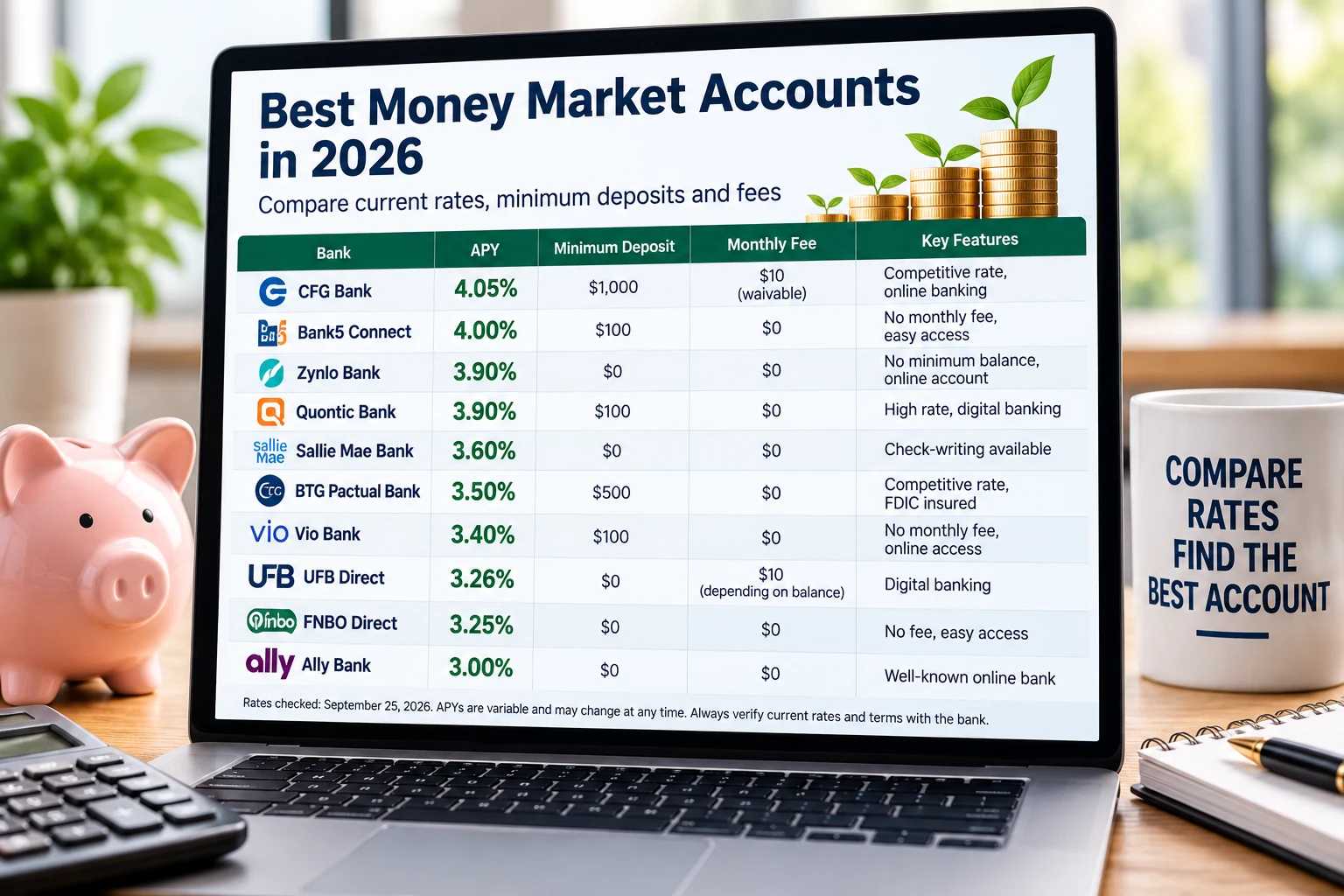
Here is a snapshot of several competitive money market accounts currently available.
| Bank | APY* | Minimum Opening Deposit | Monthly Fee |
|---|---|---|---|
| CFG Bank | 4.05% | $1,000 | $10, waivable |
| Bank5 Connect | 4.00% | $100 | $0 |
| Zynlo Bank | 3.90% | $0 | $0 |
| Quontic Bank | 3.90% | $100 | $0 |
| Sallie Mae Bank | 3.60% | $0 | $0 |
| BTG Pactual Bank | 3.50% | $500 | $0 |
| Vio Bank | 3.40% | $100 | $0 |
| UFB Direct | 3.26% | $0 | $10, depending on balance |
| FNBO Direct | 3.25% | $0 | $0 |
| Ally Bank | 3.00% | $0 | $0 |
*APYs and account information shown were checked in September 2026 and can change without notice. Eligibility and terms may vary.
What Is a Money Market Account?

A money market account, or MMA, is an interest-bearing deposit account offered by banks and credit unions.
It typically combines characteristics of a savings account with some of the accessibility associated with a checking account. Depending on the institution, an MMA may offer check-writing privileges, a debit card or ATM access.
If you’re new to this type of account, read our complete guide to what a money market account is before comparing individual options.
Money market deposit accounts at FDIC-insured banks are eligible for federal deposit insurance, subject to applicable coverage limits and ownership rules.
How We Compare Money Market Accounts
The highest APY isn’t necessarily the only factor worth considering.
When comparing money market accounts, look at:
- APY
- minimum opening deposit
- minimum balance requirements
- monthly maintenance fees
- ATM access
- debit card availability
- check-writing privileges
- withdrawal or transfer policies
- online and mobile banking features
- FDIC or NCUA insurance
A slightly lower APY may sometimes be worthwhile if an account has no monthly fee, no minimum balance and easier access to your money.
CFG Bank High Yield Money Market Account
CFG Bank currently offers one of the more competitive money market yields in Bankrate’s September 2026 comparison.
The account was listed at 4.05% APY with a $1,000 minimum opening deposit.
One important consideration is the balance requirement. Customers need to maintain the required balance to earn interest and avoid the monthly maintenance fee.
Best for
Savers who can comfortably maintain at least $1,000 and primarily want a competitive yield.
Keep in mind
The account may be less attractive for someone who expects their balance to frequently fall below the required minimum.
Bank5 Connect Money Market Account
Bank5 Connect was listed with a 4.00% APY and a relatively modest $100 minimum opening deposit.
The account does not charge a monthly maintenance fee and provides additional ways to access your funds.
Best for
People looking for a competitive APY without a large opening deposit.
Zynlo Bank Money Market Account
Zynlo Bank’s money market account was listed at 3.90% APY.
One of its biggest advantages is simplicity: Bankrate reports no minimum opening deposit and no monthly maintenance fee.
Best for
Savers who want a competitive rate without maintaining a large minimum balance.
Quontic Bank Money Market Account
Quontic Bank was also listed at 3.90% APY in September 2026.
The account requires only $100 to open and does not charge a monthly maintenance fee.
It may appeal to savers who want a combination of a competitive yield and relatively easy access to their funds.
Sallie Mae Money Market Account
Sallie Mae’s money market account was listed at 3.60% APY with no minimum opening deposit or monthly maintenance fee.
The account also offers check-writing privileges.
However, access options differ from accounts that provide ATM or debit-card functionality, so consider how frequently you expect to withdraw money.
Are the Highest Money Market Rates Always Best?
Not necessarily.
Imagine two accounts:
Account A: 4.05% APY but requires a minimum balance and may charge a monthly fee.
Account B: 3.90% APY with no minimum balance and no monthly maintenance fee.
For someone maintaining a large balance, Account A might produce more interest.
For someone with a smaller or fluctuating balance, Account B could potentially be more convenient.
This is why comparing the effective combination of APY, fees and balance requirements is more useful than choosing an account based solely on its advertised interest rate.
Money Market Account vs. High-Yield Savings Account
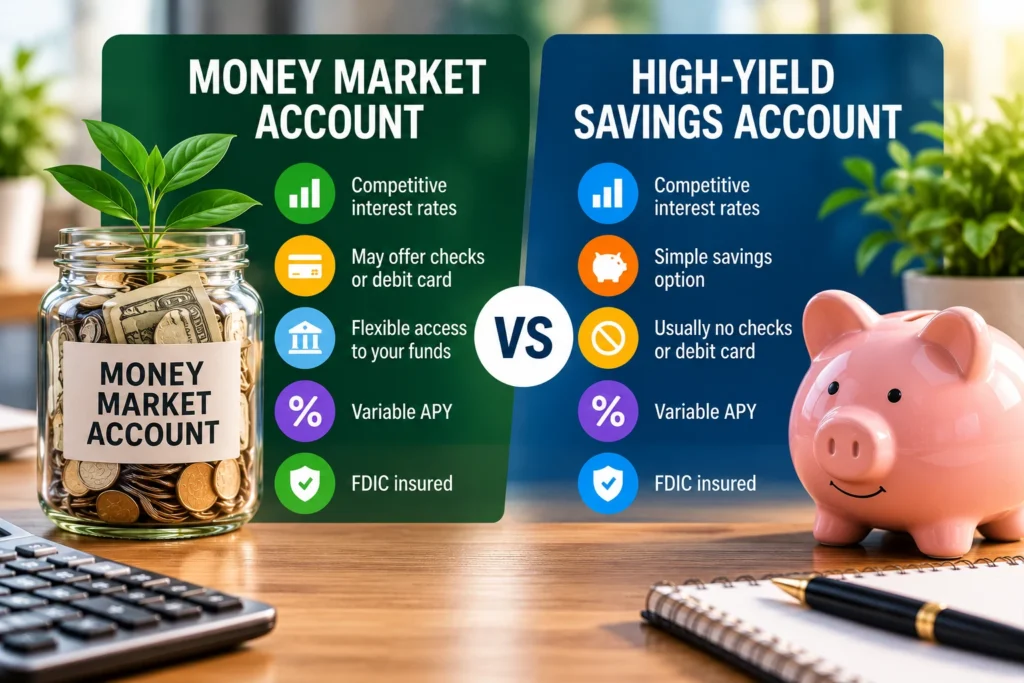
Money market accounts and high-yield savings accounts have many similarities.
Both can:
- earn interest
- provide relatively easy access to your savings
- offer variable APYs
- qualify for deposit insurance when held at an eligible insured institution
One important difference is accessibility.
Some money market accounts provide checks or debit cards, while high-yield savings accounts may offer fewer direct spending options.
If maximizing your savings rate is your main goal, compare these accounts with our guide to the best high-yield savings accounts of 2026.
Don’t assume a money market account automatically pays more than a high-yield savings account. Compare the actual APYs available when you’re ready to open an account.
Money Market Account vs. CD
A certificate of deposit generally requires you to leave your money deposited for a specified term in exchange for a stated interest rate.
A money market account generally provides more flexibility because your money isn’t committed to a fixed CD term.
That flexibility can be useful for an emergency fund or savings you may need to access.
However, CDs can be attractive when you don’t need immediate access to the money and want to know how the account’s rate will work during the CD term.
Learn more in our guide explaining what a CD account is.
Understanding APY
APY stands for annual percentage yield.
Unlike a simple interest rate, APY accounts for the effect of compounding during the year, making it useful when comparing deposit accounts.
For example, an account offering a higher APY will generally generate more interest than an otherwise identical account with a lower APY, assuming the balance and other conditions remain the same.
If you’re unfamiliar with this calculation, see our guide to what APY means for savings.
Are Money Market Accounts FDIC Insured?

Money market deposit accounts at FDIC-insured banks are eligible for FDIC deposit insurance.
The standard coverage amount is $250,000 per depositor, per insured bank, for each account ownership category.
Be careful not to confuse a money market deposit account with a money market mutual fund.
A money market mutual fund is an investment product and is not insured by the FDIC.
Before depositing money, confirm that the institution is FDIC-insured and understand how your account ownership category affects your coverage.
How Much Money Should You Keep in a Money Market Account?
There is no single balance that’s appropriate for everyone.
Money market accounts can be useful for:
- emergency savings
- short-term financial goals
- money reserved for a home down payment
- upcoming large expenses
- cash you want to keep relatively accessible while earning interest
If you’re building emergency savings from scratch, our guide on how to build an emergency fund explains how to get started.
Also pay attention to minimum balance requirements. A high advertised APY may not help if you can’t meet the balance required to earn it.
How to Choose the Best Money Market Account
Start by deciding what matters most to you.
If your goal is maximizing interest, compare APYs.
If you’re starting with a small balance, prioritize accounts with no or low minimum deposit requirements.
If you expect to access your money regularly, look at ATM access, checks, debit cards and withdrawal policies.
And if avoiding unnecessary costs is important, prioritize accounts with no monthly maintenance fee or a fee you can easily waive.
Before opening an account, verify:
- The current APY.
- Whether the APY applies to your balance.
- The minimum opening deposit.
- Minimum balance requirements.
- Monthly and transaction fees.
- Withdrawal and transfer rules.
- Whether the bank is FDIC-insured.
If you have never opened an account digitally, our guide to opening a bank account online walks through the process.
Bottom Line
The best money market account depends on more than the highest advertised APY.
As of September 2026, several online banks are offering money market yields well above the national average. But rates are variable, and an account’s minimum balance, fees and access options can have a significant impact on whether it makes sense for you.
Compare several accounts, verify current rates directly with the institution and make sure the account fits the way you plan to use your savings.
For money that you don’t expect to need immediately, you may also want to compare money market accounts with high-yield savings accounts and CDs before deciding where to keep your cash.
Frequently Asked Questions
What is the best money market account rate right now?
Money market rates change frequently. In Bankrate’s September 25, 2026 comparison, some of the money market accounts it tracks offer APYs around 4%, with CFG Bank listed at 4.05%. Other rate datasets may show higher rates depending on the institutions and products included. Always check the current rate before opening an account.
Which bank has the highest money market account rate?
The answer changes as banks adjust their APYs. Rather than choosing an account solely because it currently has the highest rate, compare minimum balances, fees and access features as well.
Can you lose money in a money market account?
A money market deposit account at an FDIC-insured bank is generally covered by federal deposit insurance within applicable limits. This is different from a money market mutual fund, which is an investment and isn’t FDIC-insured.
Are money market accounts better than savings accounts?
Neither account type is universally better. Money market accounts may offer checks or debit-card access, while high-yield savings accounts can sometimes offer equal or higher APYs. Compare current rates and account features.
Do money market accounts have minimum balances?
Some do and some don’t. Certain banks require a minimum opening deposit or ongoing balance to earn the advertised APY or avoid monthly fees, while others have no minimum balance requirement.
Is a money market account good for an emergency fund?
It can be. A competitive money market account can provide interest while keeping emergency savings relatively accessible. Check withdrawal rules, fees and access options before using one for this purpose.