

📢 Disclosure: This post contains affiliate links. We may earn a commission at no extra cost to you. We only recommend products we genuinely believe in.
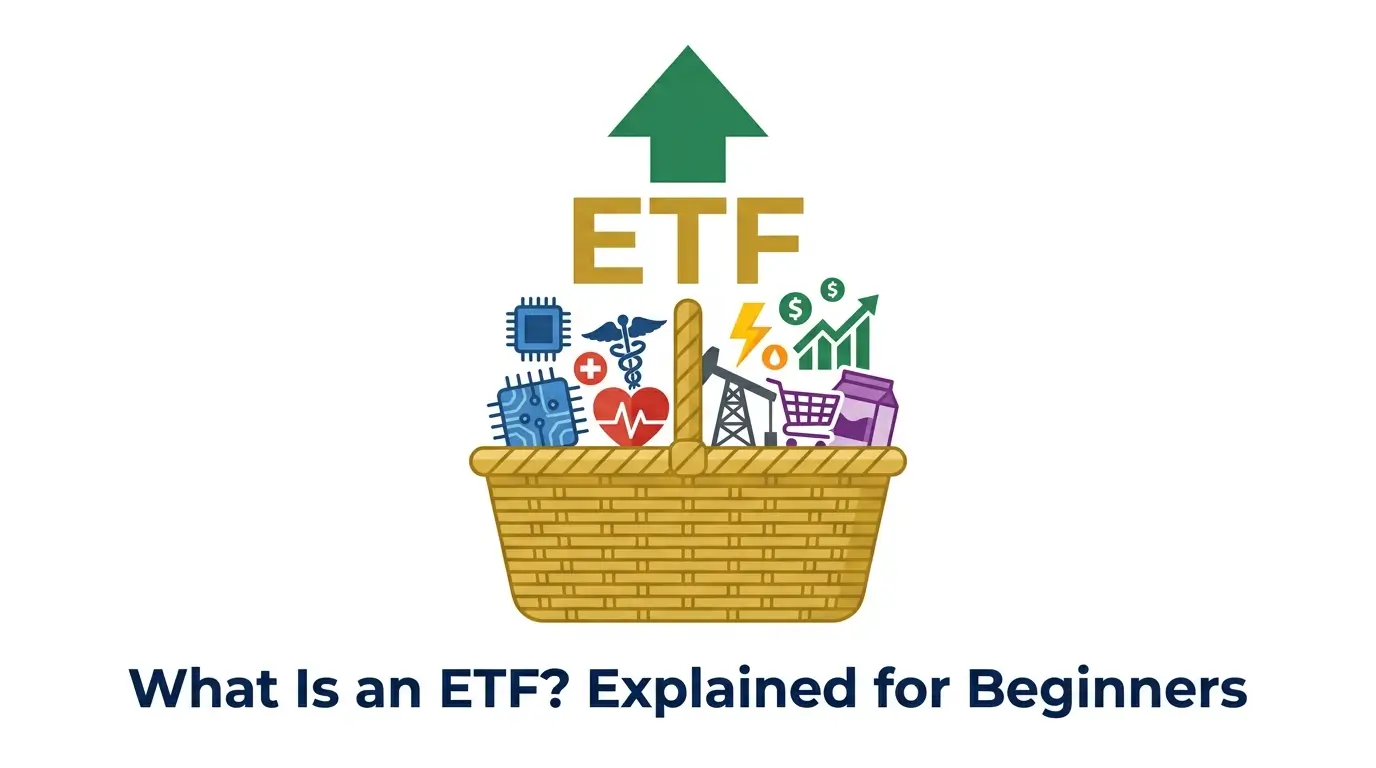
What is an ETF? An ETF, or exchange-traded fund, is a single investment that holds a collection of assets — typically stocks, bonds, or other securities — and trades on a stock exchange just like a regular share. Understanding what is an ETF is essential for any beginner investor because ETFs are one of the most accessible, cost-effective, and diversified investment tools available in 2026. This complete guide on what is an ETF explains exactly how they work, the different types available, how they compare to other investments, and how to buy your first one today.
What Is an ETF — The Simple Definition
What is an ETF in plain English? An ETF is a basket of investments bundled together into one product that you can buy and sell on a stock exchange throughout the trading day. When you buy one share of an S&P 500 ETF, you instantly own a tiny slice of all 500 companies in that index — giving you instant diversification for the price of a single share.
For example, if one share of an S&P 500 ETF costs $500, that $500 gives you exposure to Apple, Microsoft, Amazon, Google, and 496 other companies simultaneously. If you had tried to buy individual shares of all 500 companies, it would cost tens of thousands of dollars and require hundreds of separate transactions. What is an ETF at its core? It is simplicity and diversification in a single trade.
How Does an ETF Work?
An ETF tracks an index, a sector, a commodity, or a specific investment strategy. Here is the step-by-step process of how an ETF works:
- A fund company (like Vanguard, BlackRock, or Fidelity) creates an ETF that tracks a specific index — for example, the S&P 500
- The fund buys all the stocks in that index in proportion to their size
- The ETF is listed on a stock exchange with a ticker symbol (e.g., VOO, SPY, IVV)
- You buy shares of the ETF through your brokerage account just like buying a stock
- Your ETF share goes up and down in value as the underlying index moves
- Dividends from the underlying stocks are paid to you proportionally
The fund company earns money through an expense ratio — a small annual fee, typically 0.03%–0.20% for index ETFs. On a $10,000 investment, a 0.10% expense ratio costs just $10 per year. This is dramatically cheaper than actively managed mutual funds, which often charge 0.50%–1.50% or more.
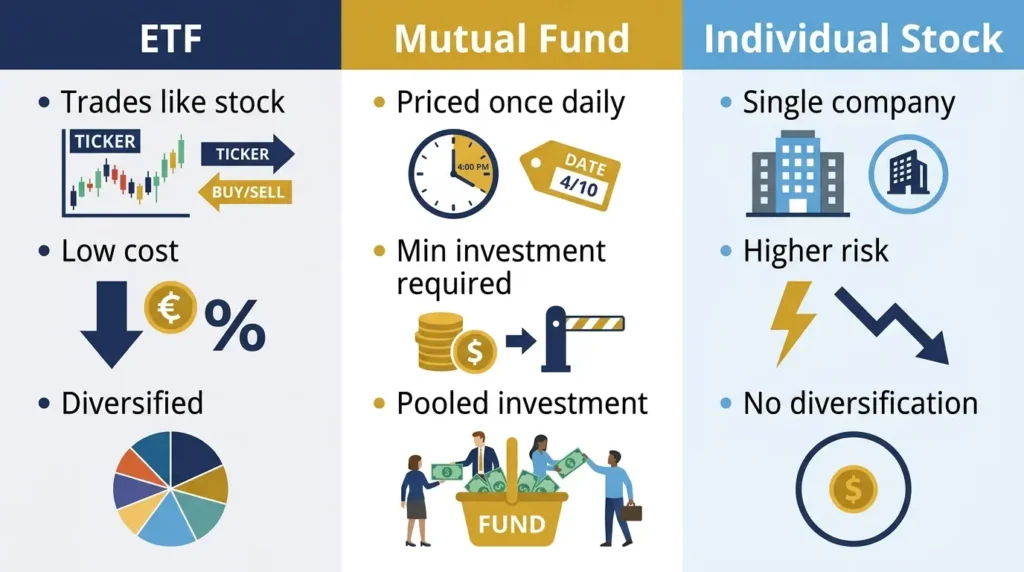
ETF vs Mutual Fund vs Individual Stock
| Feature | ETF | Mutual Fund | Individual Stock |
|---|---|---|---|
| Trading | Throughout the day (like a stock) | Once per day at closing price | Throughout the day |
| Diversification | High — hundreds of holdings | High — hundreds of holdings | None — single company |
| Minimum investment | Price of 1 share (or $1 with fractional) | Often $1,000+ | Price of 1 share (or $1 fractional) |
| Annual fee | 0.03%–0.20% (very low) | 0.50%–1.50% (higher) | None (no fee) |
| Tax efficiency | Very high | Lower | High |
| Best for | Most beginners | Retirement plan investors | Advanced investors |
For most beginners, an ETF is the ideal investment vehicle — it offers mutual fund-level diversification with stock-level accessibility and lower costs than either. To understand how consistent monthly ETF investing works over time, read our guide on dollar-cost averaging.
Types of ETFs for Beginners
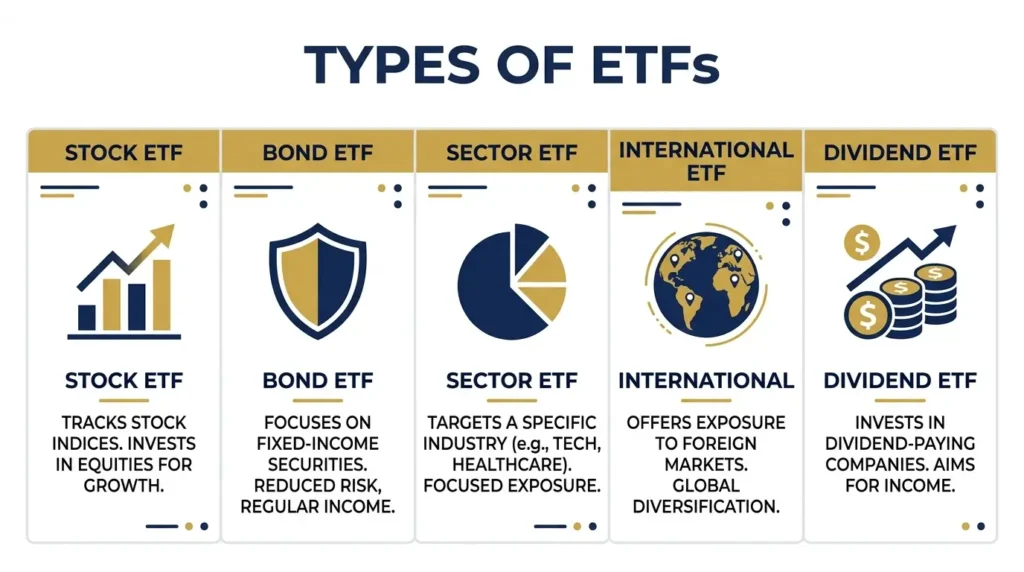
1. Stock Market ETFs
The most popular type of ETF for beginners. Stock market ETFs track broad market indexes like the S&P 500, the total US stock market, or the total world stock market. These are the best starting point when learning what is an ETF and how to invest in one.
- S&P 500 ETFs — track the 500 largest US companies. Historically return ~10% annually before inflation.
- Total market ETFs — include small, mid, and large cap US stocks for broader diversification
- International ETFs — include stocks from non-US companies for global exposure
2. Bond ETFs
Bond ETFs hold a collection of bonds — government, corporate, or municipal. They provide lower returns than stock ETFs but with significantly less volatility. Bond ETFs become more relevant as you approach retirement age and want to reduce risk in your portfolio.
3. Sector ETFs
Sector ETFs focus on a specific industry — technology, healthcare, energy, financial services, or consumer goods. They offer more targeted exposure than broad market ETFs but also carry more concentration risk. Best used as a small portion of a diversified portfolio, not as a primary investment.
4. Dividend ETFs
Dividend ETFs hold companies with a strong history of paying consistent dividends. They provide regular income in addition to potential price appreciation — making them popular with investors who want passive income from their portfolio.
What Is an ETF Expense Ratio?
The expense ratio is the annual cost you pay to own an ETF, expressed as a percentage of your investment. It is deducted automatically from the fund — you never write a check. Here is what the expense ratio costs in real dollars:
| ETF Type | Typical Expense Ratio | Annual Cost on $10,000 | Annual Cost on $100,000 |
|---|---|---|---|
| S&P 500 Index ETF | 0.03% | $3 | $30 |
| Total Market ETF | 0.03%–0.05% | $3–$5 | $30–$50 |
| Sector ETF | 0.10%–0.40% | $10–$40 | $100–$400 |
| Actively Managed ETF | 0.50%–1.00% | $50–$100 | $500–$1,000 |
The lower the expense ratio, the more of your investment return you keep. Over 30 years, the difference between a 0.03% and a 1.00% expense ratio on a $10,000 investment adds up to over $20,000 in lost returns. Always check the expense ratio before buying any ETF — low-cost index ETFs from Vanguard, Fidelity, and iShares consistently offer the lowest available fees.
Best ETFs for Beginners in 2026
When you understand what is an ETF and are ready to buy, these are the most recommended starting points for beginner investors in 2026:
- VOO (Vanguard S&P 500 ETF) — 0.03% expense ratio, tracks S&P 500, one of the most popular ETFs in the world
- VTI (Vanguard Total Stock Market ETF) — 0.03% expense ratio, tracks the entire US stock market including small caps
- IVV (iShares Core S&P 500 ETF) — 0.03% expense ratio, another excellent S&P 500 tracker
- FZROX (Fidelity Zero Total Market Index Fund) — 0.00% expense ratio, zero cost investing at Fidelity
- SCHB (Schwab US Broad Market ETF) — 0.03% expense ratio, broad US market exposure at Charles Schwab
For most beginners, one broad market ETF like VOO or VTI is all you need to start. There is no advantage to owning multiple S&P 500 ETFs — they all track essentially the same index. To open an account and start buying ETFs, read our guide on the best investment apps for beginners.
How to Buy an ETF
Once you understand what is an ETF, buying one takes less than 5 minutes:
- Open a brokerage account or Roth IRA — read our guide on what a Roth IRA is to choose the right account type
- Fund your account by transferring money from your bank
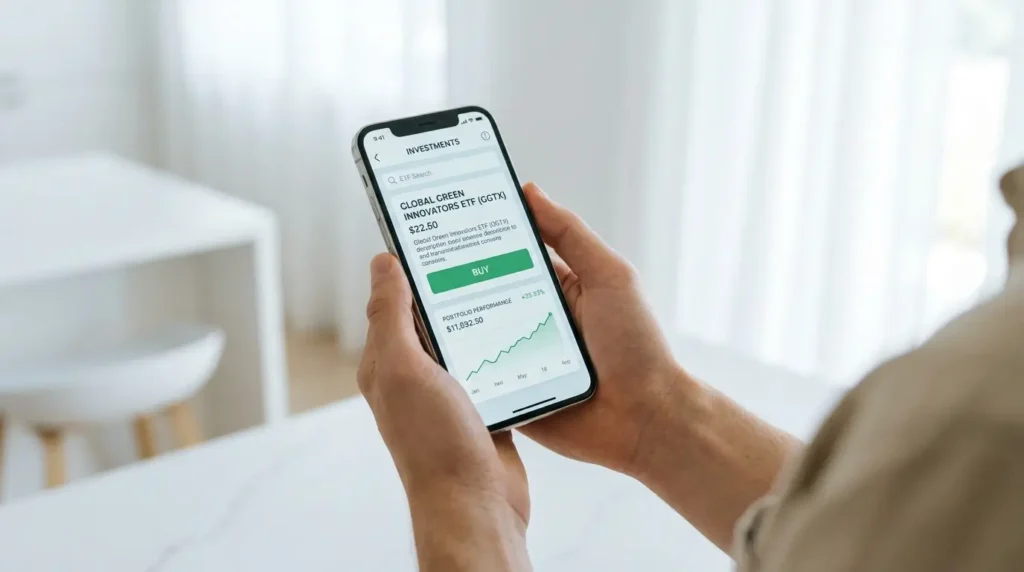
- Search for the ETF by its ticker symbol (e.g., VOO, VTI, IVV)
- Enter the dollar amount you want to invest — most brokerages now offer fractional shares for any amount
- Place a market order or limit order to buy
- Set up a monthly automatic contribution to invest consistently over time
The most powerful strategy for ETF investing is not trying to buy at the perfect price — it is investing a fixed amount every month regardless of market conditions. This is called dollar-cost averaging, and it is proven to outperform most market-timing strategies over the long term. Read our complete guide on dollar-cost averaging explained to master this approach. And to understand how your ETF investment grows exponentially over decades, read our guide on what is compound interest.
Frequently Asked Questions
What is an ETF in simple terms?
An ETF is a basket of investments — typically stocks or bonds — bundled into one product you can buy and sell on a stock exchange like a single share. When you buy one ETF share, you instantly own a small piece of every investment inside the fund. For example, one share of an S&P 500 ETF gives you exposure to 500 large US companies at once.
What is the difference between an ETF and an index fund?
The main difference is how they trade. An ETF trades throughout the day on a stock exchange like a stock. An index fund (mutual fund) is priced once per day after market close. Both can track the same index (like the S&P 500) and often have similar low costs. For most beginner investors, an ETF is slightly more flexible and accessible.
Are ETFs safe for beginners?
ETFs carry market risk — their value goes up and down with the market. However, broad market ETFs (like S&P 500 ETFs) are among the safest long-term investments for beginners because they are diversified across hundreds of companies. Historically, the S&P 500 has recovered from every downturn and returned approximately 10% annually over the long term.
How much money do I need to buy an ETF?
With fractional shares available at most major brokerages in 2026, you can buy an ETF with as little as $1. Full shares of popular ETFs like VOO cost around $500, but fractional share investing means you do not need that full amount. Fidelity, Schwab, and Robinhood all offer fractional ETF purchases starting at $1.
What is a good ETF to buy for beginners in 2026?
The best ETFs for beginners in 2026 are low-cost S&P 500 or total market ETFs: VOO (Vanguard S&P 500, 0.03%), VTI (Vanguard Total Market, 0.03%), and IVV (iShares S&P 500, 0.03%). These three ETFs give broad diversification at minimal cost and are the starting point recommended by most financial educators for beginner investors.
Final Thoughts: What Is an ETF and Why Every Beginner Should Own One
What is an ETF? It is the most beginner-friendly, cost-efficient, and diversified investment tool available in 2026 — and it is accessible to anyone with $1 and a brokerage account. An ETF eliminates the need to pick individual stocks, pays lower fees than mutual funds, and gives you instant exposure to hundreds of companies with a single purchase.
Pick one broad market ETF, open a Roth IRA, and set up a monthly automatic contribution. That single decision — consistently buying one low-cost ETF over 20 or 30 years — is the foundation of the wealth-building strategy used by the most successful long-term investors. For the complete picture of how to start, read our guide on how to start investing with $100. And for the long-term retirement strategy, read our guide on saving for retirement at 25.