

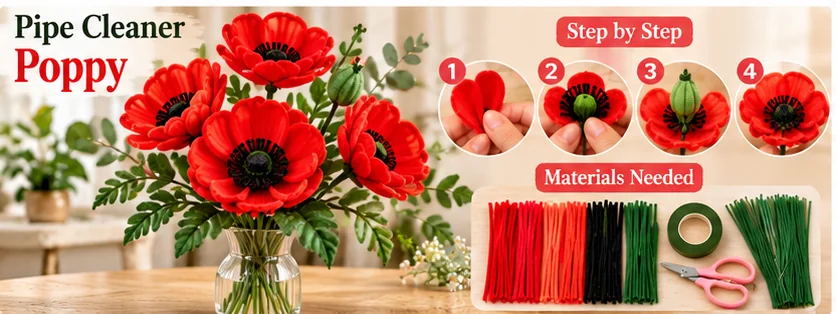
A pipe cleaner poppy is a bold handmade flower with broad petals and a dark textured center. Its open shape makes it a useful contrast to dense blooms such as peonies and ranunculus, and it works beautifully in handmade bouquets, floral gifts, and decorative arrangements.
This tutorial shows you how to build a poppy entirely from chenille stems, shape the petals, create the center, attach a sturdy stem, and finish the flower with simple greenery.
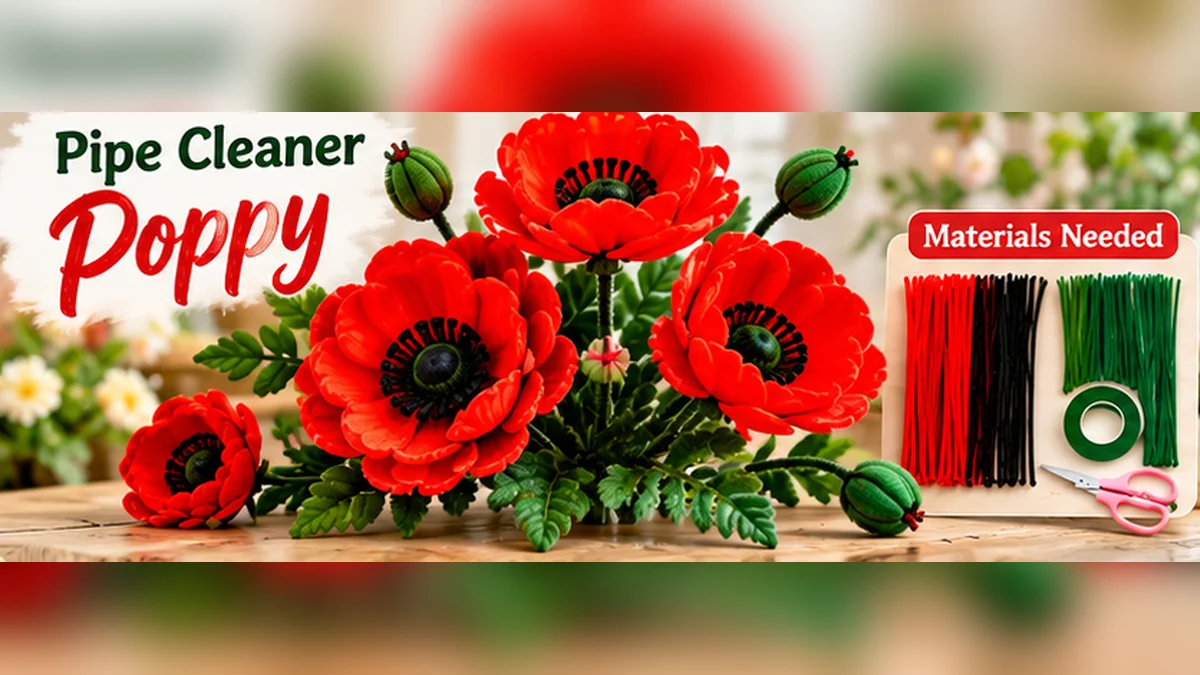
Materials for a Pipe Cleaner Poppy
- Red, coral, pink, orange, or white pipe cleaners for petals
- Black or dark brown pipe cleaners for the center
- Green pipe cleaners
- Floral stem wire or a sturdy craft stem
- Green floral tape
- Scissors or wire cutters
- Artificial stamens, optional
- Hot glue, optional for reinforcement
What Gives a Poppy Its Distinctive Look?
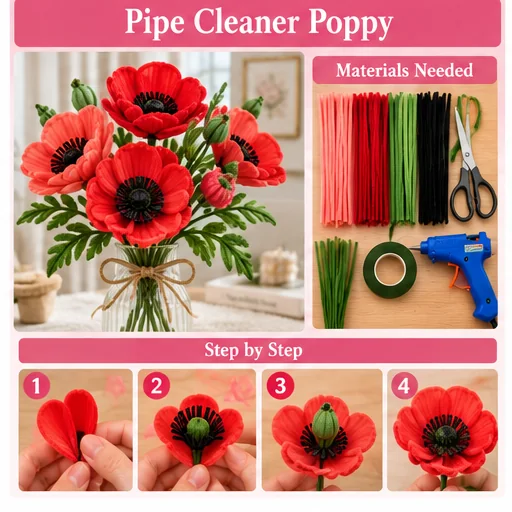
A handmade poppy should have an open flower face, broad softly curved petals, and a noticeable dark center. The petals do not need perfect symmetry. Slightly irregular edges and different angles can actually make the finished bloom look more natural.
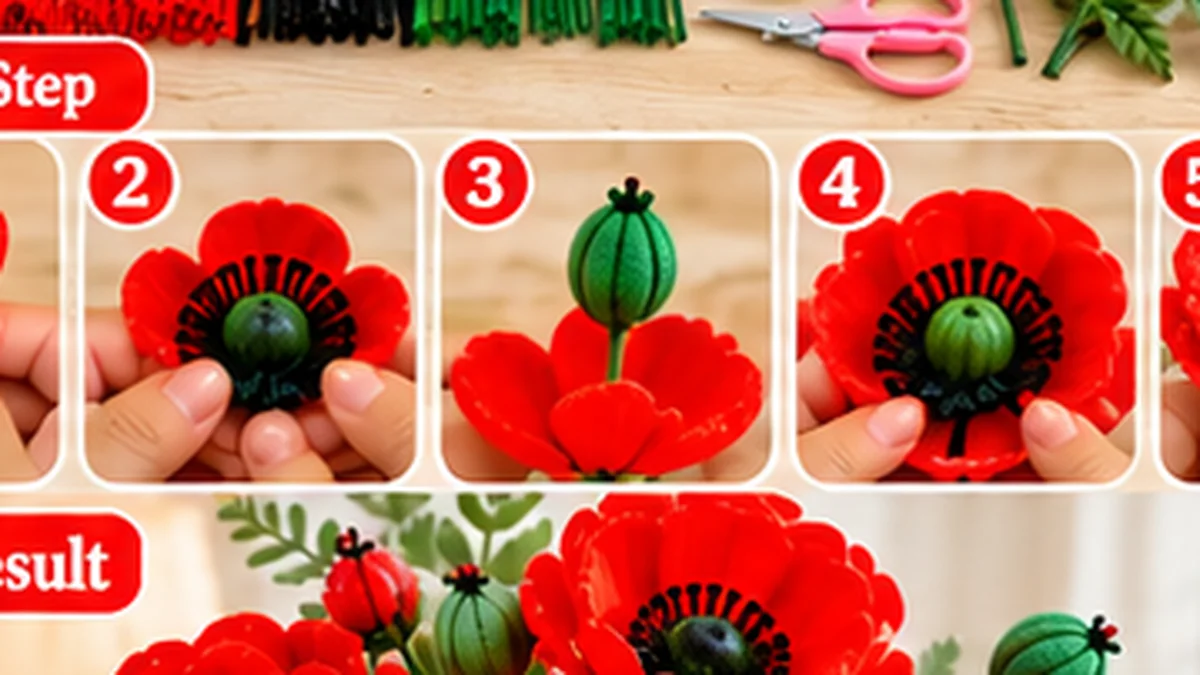
Step 1: Make the Dark Poppy Center
Coil a dark pipe cleaner into a compact disk. For additional texture, make several tiny dark loops around the disk or add a small bundle of artificial stamens. Keep the center relatively flat so it remains visible after the petals are attached.
Step 2: Form the First Broad Petal
Fold several short sections of your petal-colored chenille stem into a wider petal shape. Secure the pieces together at the base, then gently spread and curve the upper portion. Aim for a broad fan-like petal rather than a narrow loop.
Step 3: Make the Remaining Petals
Repeat the same method to create the other petals. Vary their width and curve slightly. A poppy can look convincing with a relatively small number of large petals, so focus on shaping rather than making dozens of identical pieces.
Step 4: Arrange the Petals Around the Center
Position the petals around the dark center and overlap their side edges. Secure them underneath the flower. Rotate the bloom while you work to make sure there are no large empty gaps.
Step 5: Shape the Open Flower
Bend the petals upward slightly near their bases, then let the outer portions curve away from the center. Avoid folding every petal to exactly the same height. The dark middle should remain clearly visible from the front.
Step 6: Attach a Sturdy Stem
Attach the flower head to floral wire or another firm craft stem. Wrap the connection with green floral tape and continue downward until the upper stem looks clean and secure.
Step 7: Add Green Sepals
Create several small pointed green loops and arrange them under the flower head. These pieces cover visible twists and help the back of the bloom transition naturally into the stem.
Step 8: Make a Poppy Bud
For extra variety, coil a short section of petal color into a compact oval and partially surround it with green chenille. Attach the bud to a separate stem and bend it slightly rather than keeping it perfectly upright.
Step 9: Add Leaves
Shape green chenille stems into elongated leaves and attach them lower on the stem. Keep the leaves lighter than the large flower head so the bloom remains the focal point.
How to Make a Pipe Cleaner Poppy Look Realistic
- Make broad petals instead of narrow loops.
- Keep the dark center visible.
- Overlap the petal edges.
- Use slightly different curves for each petal.
- Do not flatten the flower into one plane.
- Add one or two buds for variation.
- Use a sturdy stem to support the open bloom.
Pipe Cleaner Poppy Color Ideas
Classic Red Poppy
Bright or deep red petals with a black center create the most recognizable high-contrast version.
Iceland Poppy Inspired Colors
Try peach, orange, yellow, cream, or pale pink for a softer mixed arrangement with an airy spring look.
White Poppy
White petals paired with a dark center create dramatic contrast and work well beside pastel handmade flowers.
Pipe Cleaner Poppy vs Anemone
Both flowers can feature a dark center, but the petal treatment is different. A poppy generally has fewer, broader, softer-looking petals, while an anemone can have a more orderly ring of defined petals. Compare the construction with our pipe cleaner anemone tutorial.
Using Poppies in a Handmade Bouquet
The open shape of a poppy adds useful contrast beside dense flowers. Pair it with a pipe cleaner ranunculus or pipe cleaner peony, then use smaller flowers and greenery to fill the spaces.
When the individual flowers are complete, follow our realistic pipe cleaner flower bouquet tutorial to balance the heights, secure the stems, and wrap the finished arrangement.
Common Mistakes to Avoid
If your poppy looks like a daisy, the petals are probably too narrow and evenly spaced. Widen them and overlap the sides. If the center disappears, open the petals outward rather than folding them over the middle.
A second common problem is making the flower perfectly flat. Give the petal bases a slight lift and curve the upper edges independently.
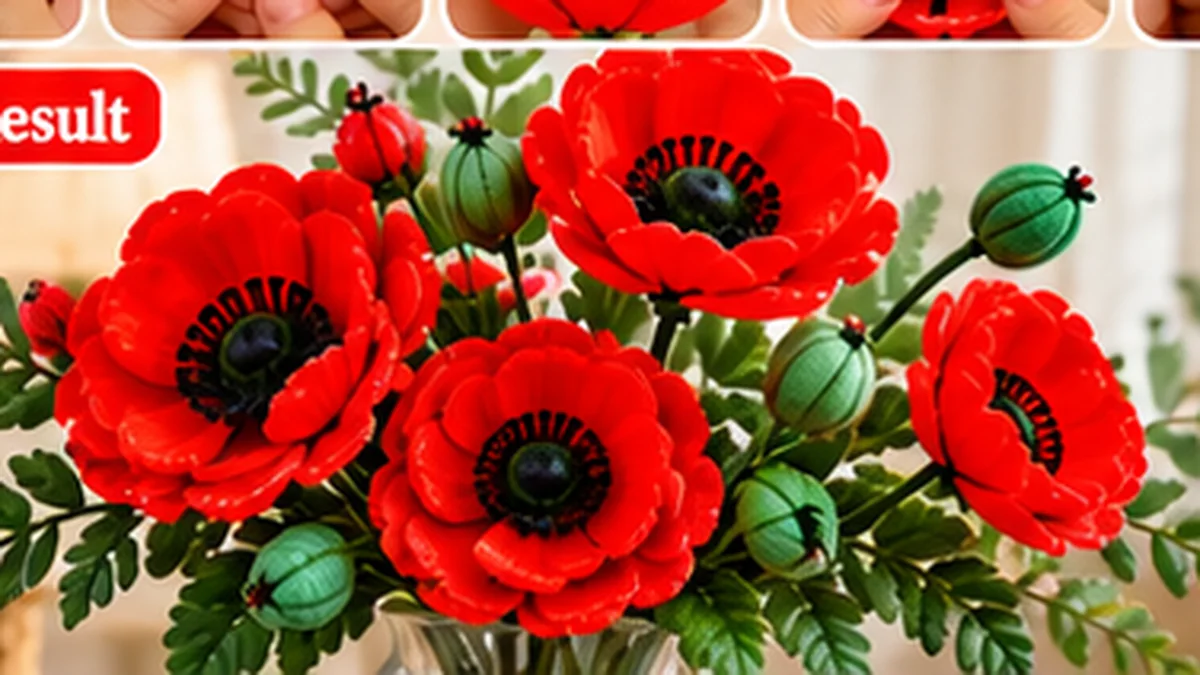
Pipe Cleaner Poppy Bouquet Ideas
Use red poppies as bold accents in a neutral bouquet, combine peach and cream poppies for a softer arrangement, or mix several warm poppy colors with green foliage. Because the flower face is large and open, a few blooms can provide plenty of visual impact.
How Many Petals Should a Pipe Cleaner Poppy Have?
A handmade poppy does not need dozens of petals. Its character comes from a smaller number of broad overlapping petals surrounding a visible dark center. Instead of chasing an exact count, make enough petals to create a full open face without obvious gaps.
Vary the width and curvature slightly. If every petal is identical and evenly spaced, the flower can look more like a simple daisy. Overlap the sides and let a few edges sit higher or lower than the others.
How to Create Natural Poppy Petal Movement
Begin by lifting each petal slightly at its base, then curve the upper section away from the center. Avoid a sharp fold across the middle. The goal is a soft open surface with enough variation to catch light differently across the bloom.
Check the flower from the side as well as the front. A completely flat profile usually looks less realistic. A few millimeters of height difference between petals can create noticeably more dimension.
How to Make a Textured Poppy Center
Start with a compact black or dark brown coil. Add tiny loops or short chenille pieces around it if you want more texture. Keep the center relatively flat and firmly attached so it remains visible after the petals are positioned.
For red, coral or white poppies, a very dark center creates strong contrast. For softer decorative versions, dark brown can produce a less graphic result while still defining the middle of the flower.
How to Make Poppy Buds
Form a small oval from the petal color and partially cover it with green chenille sepals. Attach the bud to a reinforced stem and bend the upper section gently. Buds should remain noticeably smaller and more closed than the main flower.
Use one or two buds near open blooms to create different heights in an arrangement. They are also useful for filling narrow spaces without adding another large flower head.
Best Flowers to Pair With Pipe Cleaner Poppies
The broad open poppy contrasts well with dense flowers such as a pipe cleaner ranunculus or pipe cleaner peony. For another dark-centered flower, compare it with the pipe cleaner anemone. When the stems are complete, the bouquet tutorial explains how to balance the full arrangement.
How to Store and Reshape Pipe Cleaner Poppies
Keep the flowers dry and avoid stacking anything on their open petals. If a bloom becomes flattened, lift the petal bases first and then restore the curves along the outer edges. Reshape the center last so it remains compact and clearly visible.
Pipe Cleaner Poppy Troubleshooting
If the poppy looks too symmetrical, change the curve and overlap of individual petals. If it resembles an anemone, use fewer, broader petals with softer edges. If the dark center disappears, bend the petal bases upward and the upper portions outward until the center is clearly visible again.
A drooping bloom needs a stronger stem because broad open petals can create more leverage than a compact flower. Reinforce the stem before wrapping it with floral tape. If the back looks bulky, reorganize the petal connections and cover them with small green sepals.
Making a Coordinated Poppy Set
Combine fully open flowers with smaller buds and vary the petal curves rather than duplicating one model. For a warm palette, mix red, coral and peach. For a softer arrangement, use cream, pale pink and peach with consistent dark centers and green stems.
How Much Chenille Do You Need for a Poppy?
A pipe cleaner poppy uses fewer petals than many layered flowers, but each petal needs enough material to form a broad surface. Prepare the petal pieces together so you can compare their width before assembly. Set aside dark chenille for the center, green pieces for sepals and leaves, and a firm stem to support the open bloom.
Choosing the Right Poppy Petal Size
Large petals create the characteristic open silhouette, but they should remain proportional to the center. Make one test petal and place it beside the dark disk before forming the rest. If it overwhelms the center, reduce its width slightly. If it looks narrow and pointed, broaden the upper section.
How to Make a Smaller Pipe Cleaner Poppy
Scale down the center and petals together and keep the same overlapping arrangement. A compact poppy can work as an accent flower beside larger blooms. Do not compensate for smaller petals by adding many extra layers, because that changes the open character of the flower.
Poppy Color Combinations for Bouquets
Classic red with a dark center creates strong contrast. Coral, peach and orange can be mixed for a warm arrangement, while cream and pale pink create a softer palette. If several poppies are used together, vary the shades and degree of opening so the group feels natural rather than repetitive.
Best Uses for Handmade Poppies
Poppies work well as focal accents in vase arrangements, handmade gifts and seasonal floral decor. Their open faces add visual space between dense flowers. Position some stems at a slight angle so the blooms can be seen from different directions instead of facing forward in a straight row.
Final Quality Check Before Display
Make sure the dark center is visible, the petals overlap without forming a perfect symmetrical ring, and the flower has depth when viewed from the side. Check that the stem does not bend under the head and that the green sepals cover bulky connections underneath.
Quick Poppy Finishing Check
Before adding the flower to an arrangement, check the petal overlap, the visibility of the dark center and the strength of the stem. Curve any flat edges individually and make sure the bloom has a little depth from the side. The final poppy should look open and airy rather than perfectly flat or tightly layered.
FAQS
Is a pipe cleaner poppy beginner friendly?
Yes. The flower uses a small number of large petals, so the main skill is learning how to shape and arrange them around the center.
Can I make pipe cleaner poppies without glue?
Many parts can be secured by twisting the chenille stems and wrapping the flower base. Glue is optional reinforcement depending on your construction method.
Why does my poppy look too flat?
Lift the petals slightly at their bases and give each upper edge a different curve. Avoid positioning every petal on the same plane.
Can I make poppies in colors other than red?
Yes. Peach, orange, yellow, pink, cream, and white can all be used for decorative handmade poppy-inspired flowers.
Final Tips
A convincing pipe cleaner poppy depends on three details: broad petals, an open flower face, and a strong contrasting center. Once you master the basic red version, experiment with softer colors and buds to create a varied handmade flower arrangement.
1 thought on “How to Make a Pipe Cleaner Poppy: Easy Flower Tutorial”