

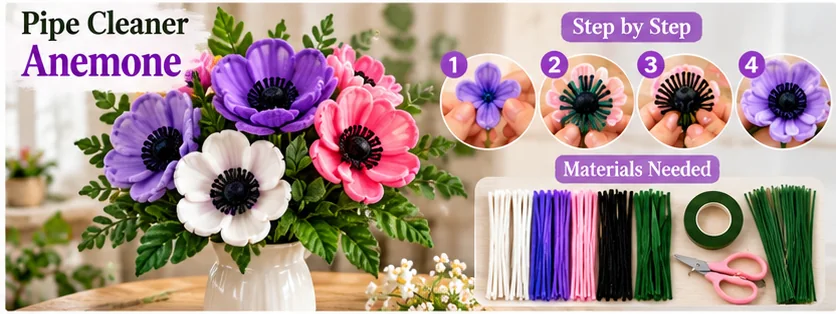
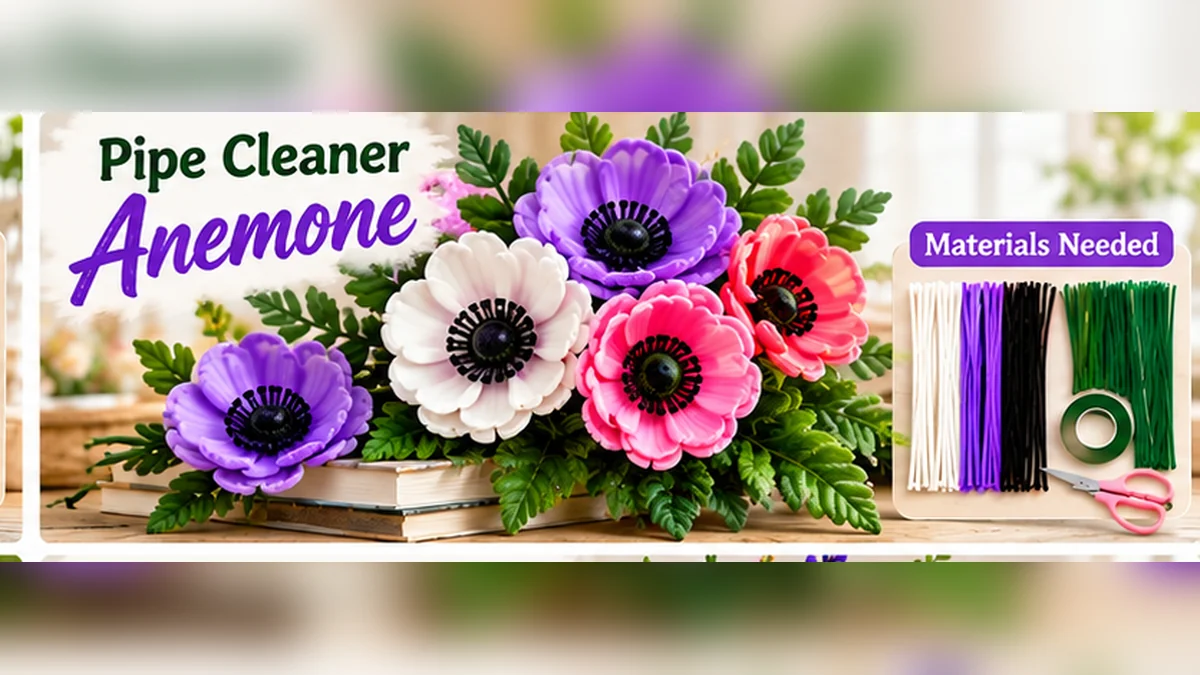
A pipe cleaner anemone is a striking handmade flower because its dark center contrasts beautifully with soft, rounded petals. The design is simpler than very dense layered flowers, but careful shaping can make it look polished enough for bouquets, gifts, and floral decor.
This step-by-step tutorial shows you how to make the center, build the petals, add a sturdy stem and leaves, and shape the finished chenille flower for a realistic-looking arrangement.
Materials for a Pipe Cleaner Anemone
- White, pink, red, purple, or blue pipe cleaners for petals
- Black or dark brown pipe cleaner for the center
- Green pipe cleaners
- Floral stem wire or a sturdy craft stem
- Green floral tape
- Scissors or wire cutters
- Small black beads or artificial stamens, optional
- Hot glue, optional for reinforcement
What Makes an Anemone Easy to Recognize?
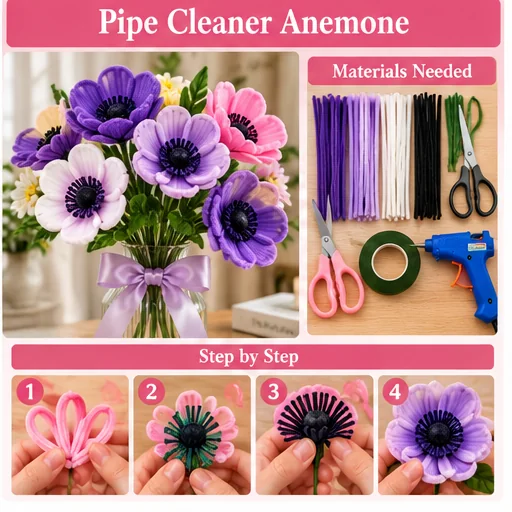
The bold center is the key visual feature. Around it, broad petals create an open flower rather than a tight spiral. For a convincing handmade version, keep the center compact and dark while allowing the petals to spread outward with gentle curves.
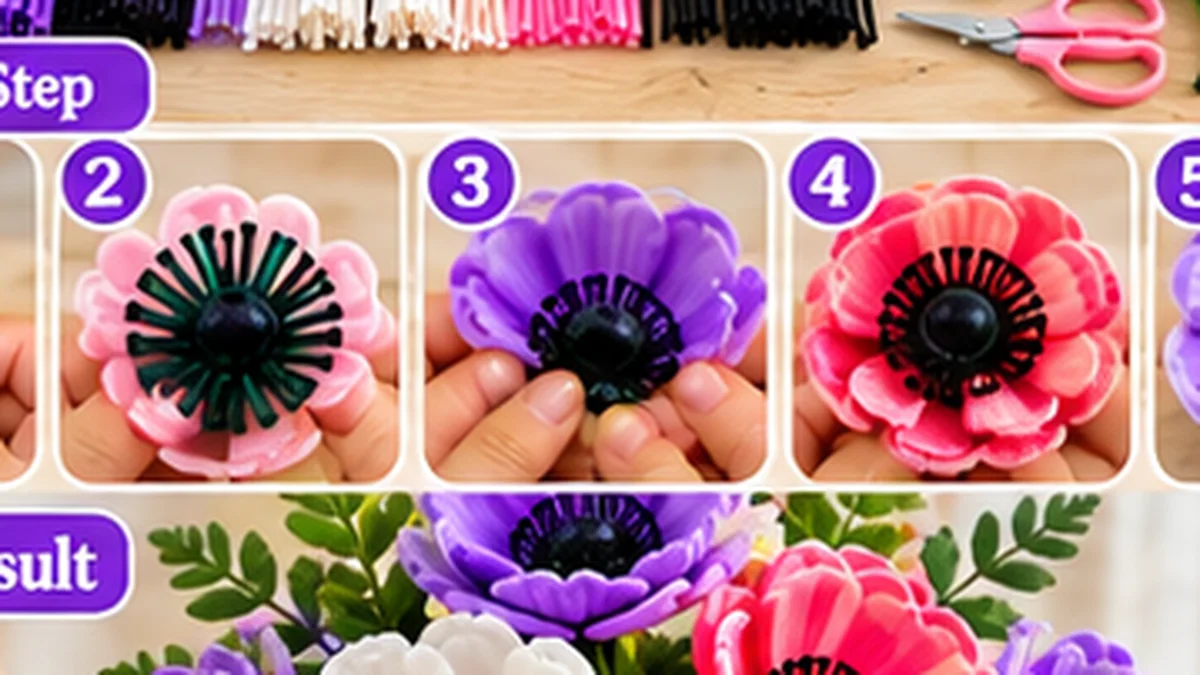
Step 1: Make the Dark Flower Center
Coil a short black or dark brown chenille stem into a compact round center. If you want extra texture, surround the coil with short dark loops or a small bundle of artificial stamens. Secure the center firmly so it keeps its shape while the petals are added.
Step 2: Form the First Petals
Make broad loops from your chosen petal color. Pinch each loop at the base and gently widen the upper section with your fingers. The petals should look softer and broader than narrow pointed flower petals.
Step 3: Arrange Petals Around the Center
Place the first petals evenly around the dark center. Overlap their edges slightly so there are no large gaps. Keep the bases close together, but avoid twisting so tightly that the petals lose their rounded shape.
Step 4: Add a Second Petal Layer
For a fuller flower, add another ring of petals behind the first. Position the second layer between the gaps of the front petals. Make these petals slightly larger or open them a little farther outward to create depth.
Step 5: Shape the Open Bloom
An anemone should look open rather than tightly closed. Bend the petal bases gently upward, then curve the upper portions outward. Rotate the flower and adjust individual petals until the center remains visible from the front.
Step 6: Attach the Stem
Place a sturdy floral stem against the underside of the flower. Secure it to the petal connections and wrap the base with green floral tape. Continue the tape down the upper portion of the stem for a clean transition.
Step 7: Add Green Sepals
Create several small pointed green loops and position them underneath the flower head. The sepals hide the construction and make the back of the bloom look more finished.
Step 8: Make Simple Leaves
Shape green pipe cleaners into leaves and attach them lower on the stem. Keep the greenery relatively light so the dark center and colorful petals remain the focal point.
How to Make a Pipe Cleaner Anemone Look Realistic
- Keep the center noticeably darker than the petals.
- Make petals broad rather than narrow.
- Overlap petals slightly.
- Stagger a second layer behind the first.
- Keep the flower face open so the center remains visible.
- Curve petals instead of leaving them flat.
- Hide bulky connections beneath green sepals.
Best Pipe Cleaner Anemone Colors
White Anemone
White petals with a black center create the strongest contrast and work beautifully in neutral or wedding-inspired arrangements.
Pink Anemone
Blush or bright pink petals paired with a dark center make a cheerful focal flower for gift bouquets.
Purple Anemone
Purple and lavender versions combine well with cool-toned hydrangeas and green foliage.
Red Anemone
Red petals create a bold statement bloom that can be used sparingly in a mixed handmade bouquet.
How to Use Anemones in a Pipe Cleaner Bouquet
Anemones work well as open-faced accent flowers. Their visible dark centers add contrast beside dense blooms. Pair them with a pipe cleaner peony or compact pipe cleaner ranunculus to create variation in shape.
For a larger rounded element, add a pipe cleaner hydrangea. When all flowers are ready, use our realistic pipe cleaner flower bouquet tutorial to arrange and wrap the stems.
Common Mistakes to Avoid
If the flower looks like a daisy, the petals may be too narrow and evenly spaced. Widen the petal loops and overlap them more. If the dark center disappears, open the petals farther outward instead of folding them over the middle.
A perfectly flat flower can also look artificial. Give the petals different curves and angles while keeping the overall bloom open.
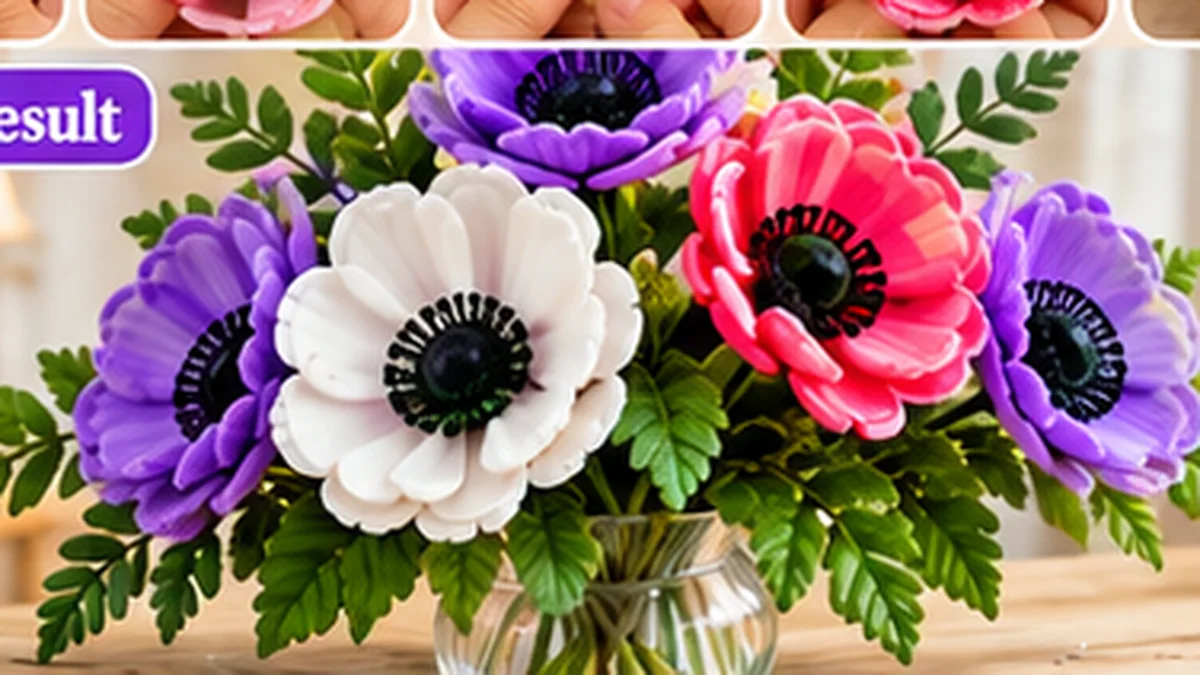
Pipe Cleaner Anemone Bouquet Ideas
Try white anemones with blush peonies for a soft romantic arrangement, purple anemones with lavender hydrangeas for a cool palette, or red anemones as small accents among neutral cream flowers. Because the dark center attracts attention, a few anemones can have a strong visual impact.
How Many Petals Should a Pipe Cleaner Anemone Have?
The exact count is less important than the open circular shape. Make enough broad petals to surround the dark center without leaving large gaps. If you add a second layer, stagger it behind the first rather than placing each petal directly underneath another one.
Keep checking the flower from the front. The center should remain clearly visible. If petals begin covering it, bend their bases upward slightly and curve the upper sections outward.
How to Make the Dark Center More Realistic
The center provides the strongest contrast in a pipe cleaner anemone. A compact dark coil works for a simple version, while short loops around the coil create additional texture. You can also use optional artificial stamens, but keep them grouped closely so the center does not become wider than the petal ring.
Black creates the strongest contrast, while very dark brown gives a softer effect. Whatever color you choose, keep the center noticeably darker than the petals if you want the characteristic anemone look.
How to Shape Broad Anemone Petals
Avoid making long narrow loops. Form each petal with a broader upper section and pinch only the base. Curve the surface gently with your fingers rather than leaving it flat. Small differences in width and angle can make the handmade flower look more natural.
After all petals are attached, rotate the flower and adjust the side view. The bloom should have some depth even though its face remains open.
Anemone Buds and Half-Open Flowers
For a more varied arrangement, make one or two smaller flowers with petals held closer to the center. These half-open blooms create a transition between tight buds and fully open anemones. Keep their stems slightly shorter or angle them outward when arranging a bouquet.
Best Flowers to Pair With Pipe Cleaner Anemones
The open shape works well beside dense flowers. Pair anemones with a layered pipe cleaner peony, compact pipe cleaner ranunculus, or rounded pipe cleaner hydrangea. For a complete arrangement, follow the realistic pipe cleaner flower bouquet tutorial.
How to Store Pipe Cleaner Anemones
Store finished flowers where the open petals will not be pressed flat. If a bloom is compressed, reshape each petal separately and then check that the dark center remains visible. Keep the craft dry and dust it gently to preserve the chenille texture.
Pipe Cleaner Anemone Troubleshooting
If the flower resembles a daisy, widen the petals and overlap their side edges. If the dark center is hidden, open the petals outward and reduce any unnecessary inner layer. If the bloom is completely flat, lift the petal bases slightly while keeping the upper portions open.
A center that is too large can overpower the petals. Reduce its diameter or make the surrounding petals broader. If the flower head moves on the stem, reinforce the underside before adding sepals and floral tape.
Making a Coordinated Anemone Set
Use the same dark center across several flowers and vary the petal colors or sizes. White, blush and lavender can form a soft collection, while red and white create stronger contrast. Make one flower slightly more closed to avoid a row of identical open faces in the final bouquet.
How Much Chenille Do You Need for an Anemone?
An anemone generally needs less petal material than a dense peony or ranunculus because the bloom stays open. Prepare enough of the petal color for one or two rings, plus a dark chenille stem for the center and green pieces for sepals and leaves. A firm floral stem helps the open flower hold its angle in a bouquet.
Choosing the Right Petal Width
Petal width is one of the easiest ways to distinguish an anemone from a daisy-like craft flower. Keep the base narrow enough to gather around the center, then broaden the upper portion. If the first test petal looks too thin, adjust it before making the full set so the finished ring remains consistent.
How to Make a Smaller Anemone
Reduce the petal dimensions and center diameter together. Keeping a large dark center with tiny petals changes the balance of the flower. A smaller bloom can use a single petal layer, while a larger version can support a staggered second layer for additional depth.
Color Combinations for Anemone Bouquets
White petals with a black center create a classic high-contrast look. Blush pink, lavender and red also work well when the center remains dark. For a coordinated bouquet, repeat one petal color in another flower type or use the same green foliage throughout the arrangement.
Best Uses for Handmade Anemones
The visible center makes anemones effective accent flowers in bouquets and vase arrangements. They also work as individual decorative stems because the flower is recognizable from the front. In mixed arrangements, avoid hiding the center behind dense neighboring blooms. Give each anemone enough open space for its face to remain visible.
Final Quality Check Before Display
Look at the flower from the front, side and back. Confirm that the center is secure, the petals are broad and individually curved, the underside connections are covered, and the stem supports the chosen angle. Make these adjustments before placing the flower into a tightly arranged bouquet.
Quick Anemone Finishing Check
Before display, confirm that the dark center remains the strongest focal point and that no petal folds over it unnecessarily. Rotate the stem and compare the petal spacing from several angles. Reshape any narrow-looking loops into broader curves and cover visible attachment points underneath with green sepals.
When several anemones are used together, vary their height and direction. One flower can face forward, another can turn slightly to the side, and a smaller bloom can sit lower in the arrangement. This simple variation makes the group feel less repetitive and helps every dark center remain visible.
One Last Tip for a Natural Anemone Shape
After the flower is assembled, avoid making every petal curve identical. Keep one or two slightly higher, let others open farther outward, and rotate the bloom while shaping it. This small amount of asymmetry helps the pipe cleaner anemone look more natural while preserving its clear dark center and open silhouette.
FAQS
Is a pipe cleaner anemone beginner friendly?
Yes. The flower uses simple loop petals and a compact center. Careful shaping is more important than complicated construction.
What color should the center be?
Black or very dark brown creates the classic high-contrast appearance, although you can adapt the colors for decorative designs.
Can I make an anemone without glue?
Many components can be secured by twisting the chenille stems and wrapping the base. Glue is optional if you want additional reinforcement.
Why does my anemone look too flat?
Curve the petals individually and angle the second layer differently from the first. Small changes in height and direction create more dimension.
Final Tips
The easiest way to make a recognizable pipe cleaner anemone is to emphasize contrast: a compact dark center surrounded by broad, open petals. Once you master one flower, make several in coordinated colors and combine them with denser blooms to create a varied handmade bouquet.
2 thoughts on “How to Make a Pipe Cleaner Anemone: Easy Flower Tutorial”