

📢 Disclosure: This post contains affiliate links. We may earn a commission at no extra cost to you. We only recommend products we genuinely believe in.
How to save money on groceries is one of the most impactful budgeting skills you can develop — because groceries are one of the largest and most controllable monthly expenses for most American households. Learning how to save money on groceries does not mean eating poorly or spending hours clipping coupons. It means shopping smarter with a few simple strategies that collectively cut your grocery bill by $100–$300 per month without sacrificing the quality of your meals. This complete guide on how to save money on groceries gives you 15 proven tips that work in 2026.
How Much Should You Spend on Groceries?
Before applying tips to save money on groceries, it helps to know what reasonable grocery spending looks like. The USDA publishes monthly food cost reports for American households. In 2026, typical monthly grocery spending for a single adult ranges from $250 (thrifty plan) to $400+ (liberal plan). For a family of four, $600–$1,100 is common depending on eating habits.
Most budgeting frameworks suggest keeping groceries at 10%–15% of your after-tax income. Under the 50/30/20 budget rule, groceries fall in the 50% “needs” category. If your grocery spending is above 15% of your income, these tips to save money on groceries will have an immediate and significant impact on your budget.
Tip 1 — Meal Plan Every Week Before You Shop
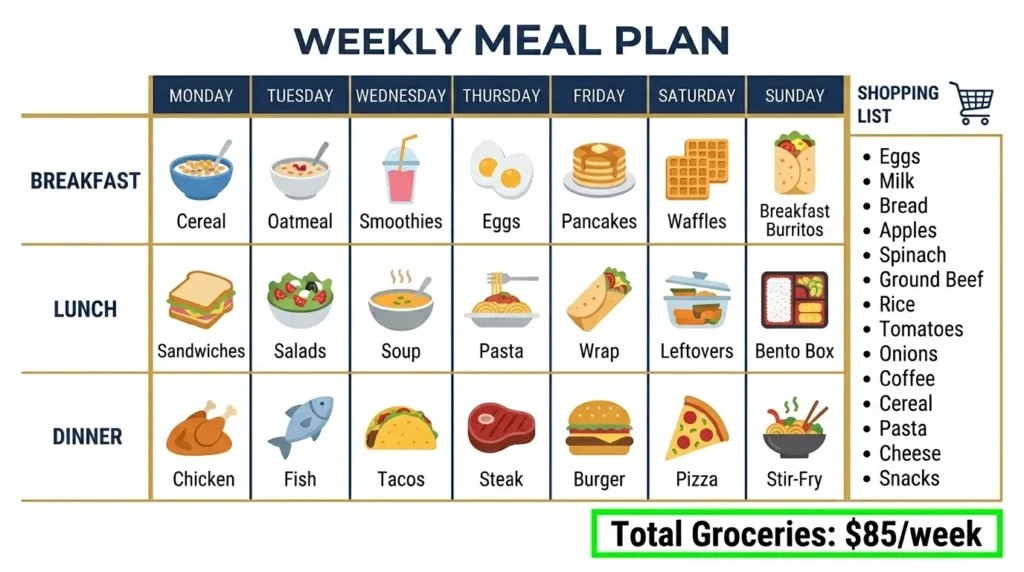
Meal planning is the single most effective strategy to save money on groceries — because it eliminates the two biggest sources of food waste and overspending: impulse purchases and unused food that goes bad. Here is the process:
- Decide what you will eat for 7 days — breakfast, lunch, and dinner
- Check what you already have at home before writing your shopping list
- Build your shopping list from the meal plan — only buy what you will actually use
- Shop the list only — no deviations
Households that meal plan consistently spend 20%–25% less on groceries than households that shop without a plan. At $700/month in grocery spending, that is $140–$175 saved every single month just from planning ahead.
Tip 2 — Never Shop Hungry
Shopping hungry is one of the most studied and consistent predictors of grocery overspending. Research shows that hungry shoppers buy significantly more high-calorie, impulse, and unnecessary items than satiated shoppers. Eat before every grocery trip — even a small snack — and watch how much easier it is to stick to your list. This single habit costs nothing and consistently saves money on groceries every week.
Tip 3 — Shop with a List and Stick to It
A detailed shopping list is the foundation of how to save money on groceries consistently. Write your list organized by store section (produce, dairy, meat, dry goods) to minimize time in the store and reduce the temptation to browse. Studies show that shoppers with detailed lists spend 23% less than those without one. Keep a running list on your phone throughout the week so nothing gets forgotten — which prevents a second trip that always costs more money.
Tip 4 — Use Cashback and Grocery Apps
Several free apps pay you cash back on grocery purchases with no coupons required:
- Ibotta — upload your receipt after shopping and earn cash back on specific items. Average user saves $30–$50/month.
- Fetch Rewards — scan any grocery receipt and earn points redeemable for gift cards
- Flashfood — buy near-expiration grocery items at 50%–70% off directly from participating stores
- Store loyalty apps — Kroger, Publix, Target Circle, and most major chains offer personalized digital coupons that automatically apply at checkout
Tip 5 — Buy in Bulk for Non-Perishables
Buying in bulk at warehouse stores (Costco, Sam’s Club, BJ’s) saves money on groceries for any item that has a long shelf life and you use consistently. The best bulk buys: paper products, cooking oils, nuts, rice, pasta, canned goods, coffee, and household cleaners. The key rule: only buy in bulk if you will actually use it before it expires. Bulk buying perishables you cannot consume leads to waste — which costs more, not less.
Tip 6 — Shop the Sales and Plan Around Them
Most grocery stores rotate sales on a 4–6 week cycle. Check your store’s weekly circular before meal planning — then build your meals around what is on sale that week. Chicken thighs on sale this week? Plan three chicken-based meals. Ground beef marked down? Make a double batch of chili and freeze half. This “reverse meal planning” approach consistently saves money on groceries without sacrificing meal variety.
Tip 7 — Buy Store Brands Over Name Brands
Store brands — also called private label or generic brands — are manufactured by the same companies that produce name brand products, often in the same facilities. The quality difference is minimal or nonexistent on most grocery staples, but the price difference is significant. Store brands typically cost 20%–40% less than name brand equivalents.
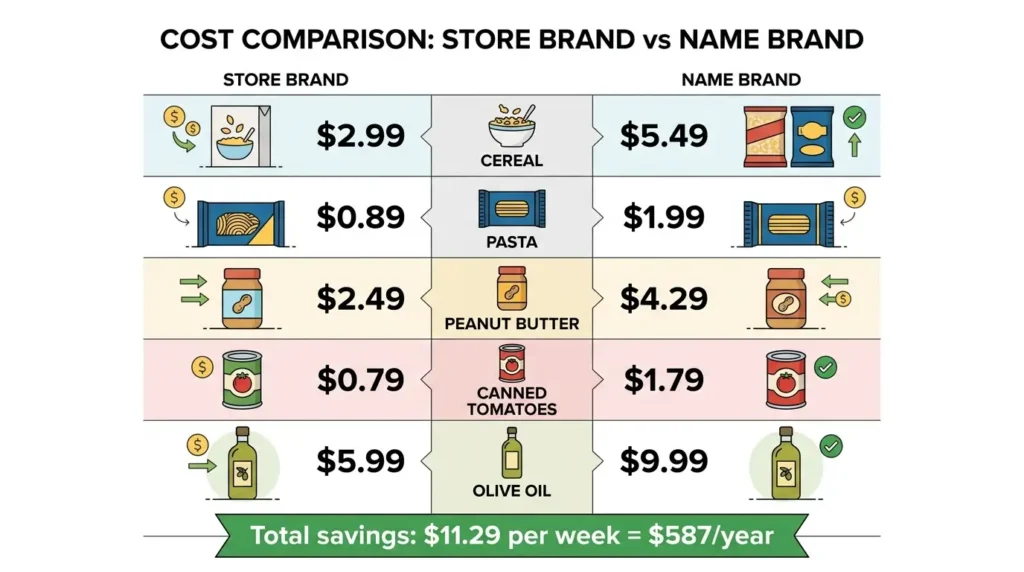
| Item | Name Brand Price | Store Brand Price | Monthly Savings (weekly purchase) |
|---|---|---|---|
| Pasta (16 oz) | $1.99 | $0.89 | $4.40 |
| Cereal (18 oz) | $5.49 | $2.99 | $10.00 |
| Peanut butter (16 oz) | $4.29 | $2.49 | $7.20 |
| Olive oil (16 oz) | $9.99 | $5.99 | $16.00 |
| Canned tomatoes (28 oz) | $1.79 | $0.79 | $4.00 |
Switching just these five items to store brands saves approximately $587/year — with no change in meal quality. Apply this across your entire cart and the savings on groceries compound significantly.
Tip 8 — Reduce Food Waste
The average American household throws away approximately $1,500 worth of food per year — roughly 30%–40% of all food purchased. Reducing food waste is one of the most overlooked ways to save money on groceries because you are not buying less — you are using more of what you already buy. Strategies to reduce food waste:
- Store produce correctly — most fruits and vegetables have specific storage needs that extend their life
- Use the FIFO method (First In, First Out) — move older items to the front of the fridge or pantry
- Freeze before it goes bad — meat, bread, cooked grains, and many vegetables freeze well for weeks or months
- Plan one “use it up” dinner per week — cook with whatever leftover vegetables, proteins, and grains are in the fridge
Tip 9 — Eat Less Meat
Meat is the most expensive item in most grocery carts. Replacing two or three meat-based dinners per week with plant-based protein alternatives — beans, lentils, eggs, tofu, or canned tuna — can save $40–$80/month depending on your household size. Beans and lentils cost $1–$2 per pound and provide the same protein as chicken or beef at a fraction of the price. This does not require going vegetarian — simply reducing meat frequency saves money on groceries significantly.
Tip 10 — Use a Cashback Credit Card for Groceries
If you pay your balance in full every month (never carrying a balance), using a cashback credit card for grocery purchases earns 2%–6% back on every dollar you spend. Some cards offer elevated grocery rewards:
- Cards with 3%–6% cash back at grocery stores
- Cards with rotating quarterly categories that include grocery stores
- Store-specific credit cards that offer extra points or cash back at that chain
On $500/month in grocery spending, 3% cash back earns $180/year — free money for purchases you were already making. Only use this strategy if you pay the full balance every month. Credit card interest at 24% APR eliminates any grocery savings instantly.
More Tips to Save Money on Groceries
- Tip 11: Shop at discount grocery stores (Aldi, Lidl, Trader Joe’s) — consistently 20%–30% cheaper than traditional supermarkets on comparable items
- Tip 12: Cook double portions and freeze half — halves the effective cost of a meal by eliminating future cooking nights
- Tip 13: Avoid pre-cut and pre-packaged convenience items — pre-shredded cheese, sliced fruit, and pre-washed salads cost 40%–200% more than whole versions
- Tip 14: Compare unit prices, not package prices — the larger package is not always cheaper per ounce
- Tip 15: Set a weekly grocery budget and track spending — people who track grocery spending consistently overspend less
How Much Can You Save on Groceries?
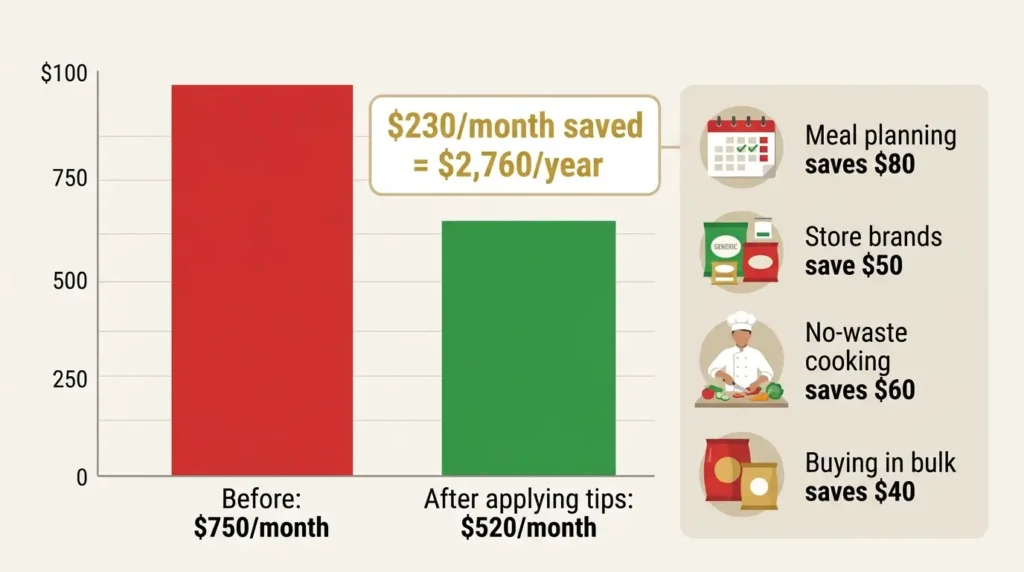
| Strategy | Monthly Savings Estimate | Annual Savings |
|---|---|---|
| Meal planning | $100–$150 | $1,200–$1,800 |
| Store brand switching | $40–$60 | $480–$720 |
| Reduce food waste | $50–$80 | $600–$960 |
| Cashback apps + cards | $20–$40 | $240–$480 |
| Reduce meat frequency | $40–$80 | $480–$960 |
| Total combined savings | $250–$410/month | $3,000–$4,920/year |
Consistently applying five to six of these strategies can realistically save $250–$400 per month on groceries. Directed toward your financial goals, that is $3,000–$4,920 per year — enough to fully fund a Roth IRA or make a significant dent in high-interest debt. Build grocery savings into your monthly budget using our guide on how to make a budget.
Frequently Asked Questions
What is the most effective way to save money on groceries?
The most effective single strategy to save money on groceries is meal planning. Households that plan meals before shopping consistently spend 20%–25% less than those who shop without a plan — because meal planning eliminates impulse purchases and food waste simultaneously. Combined with store brand switching and cashback apps, meal planning can cut grocery spending by $200–$300 per month.
How much should a single person spend on groceries per month?
The USDA’s thrifty food plan for a single adult in 2026 is approximately $250–$300/month. A moderate budget is $350–$450/month. Most personal finance experts suggest keeping grocery spending at 10%–12% of your after-tax income. If you earn $50,000/year ($4,167/month take-home), $400–$500/month on groceries is reasonable.
Do store brand groceries taste the same as name brands?
For most grocery staples, store brands are virtually identical to name brands in quality — often manufactured by the same companies. Items where store brands work especially well: pasta, rice, canned goods, cooking oils, flour, sugar, dairy products, and frozen vegetables. Items where some shoppers prefer name brands: specialty sauces, snack foods, and beverages. Try store brands on staples first and switch back only if quality genuinely differs.
Is Aldi actually cheaper for groceries?
Yes — studies consistently show that Aldi is 20%–30% cheaper than traditional supermarkets on comparable items. Aldi keeps costs low by carrying a limited selection, using store brands almost exclusively, and operating lean stores. The quality is consistently high — Aldi has won numerous taste tests against name brands. Shopping primarily at Aldi rather than a traditional supermarket saves most households $150–$250/month.
How do I stop overspending at the grocery store?
The most reliable ways to stop overspending on groceries: shop with a detailed list and never deviate from it, eat before you shop, leave your credit card at home and use cash or a debit card with a set limit, avoid shopping when tired or stressed, and shop alone rather than with children or a partner who adds items. Tracking your grocery spending monthly in a budget app also creates accountability.
Final Thoughts: Save Money on Groceries Every Week Starting Now
Knowing how to save money on groceries is one of the fastest ways to free up significant cash in your monthly budget — without changing your income or making dramatic lifestyle sacrifices. Start with the three highest-impact tips: meal plan this weekend, switch five items to store brands on your next shopping trip, and download one cashback app. Those three actions alone can save $150–$200/month in the first month.
Direct every dollar you save on groceries to a specific financial goal. Use your grocery savings to build your emergency fund, pay off high-interest debt, or invest for your future. The goal of learning how to save money on groceries is not just a cheaper shopping cart — it is the financial freedom that comes from redirecting those dollars to what truly matters. For a complete system to track and manage these savings, read our guide on the best budgeting apps 2026.