

📢 Disclosure: This post contains affiliate links. We may earn a commission at no extra cost to you. We only recommend products we genuinely believe in.
The 50/30/20 budget rule is one of the simplest and most effective personal finance frameworks ever created. Instead of tracking every single dollar you spend, it divides your after-tax income into just three categories — needs, wants, and savings. If you’ve ever felt overwhelmed by budgeting, this rule might be exactly what you need to finally get your finances under control.
In this complete guide, you’ll learn exactly what the 50/30/20 budget rule is, how to apply it to your own income, real-world examples at different income levels, the advantages and limitations of this approach, and how to adapt it when the standard percentages don’t quite fit your situation.
What Is the 50/30/20 Budget Rule?
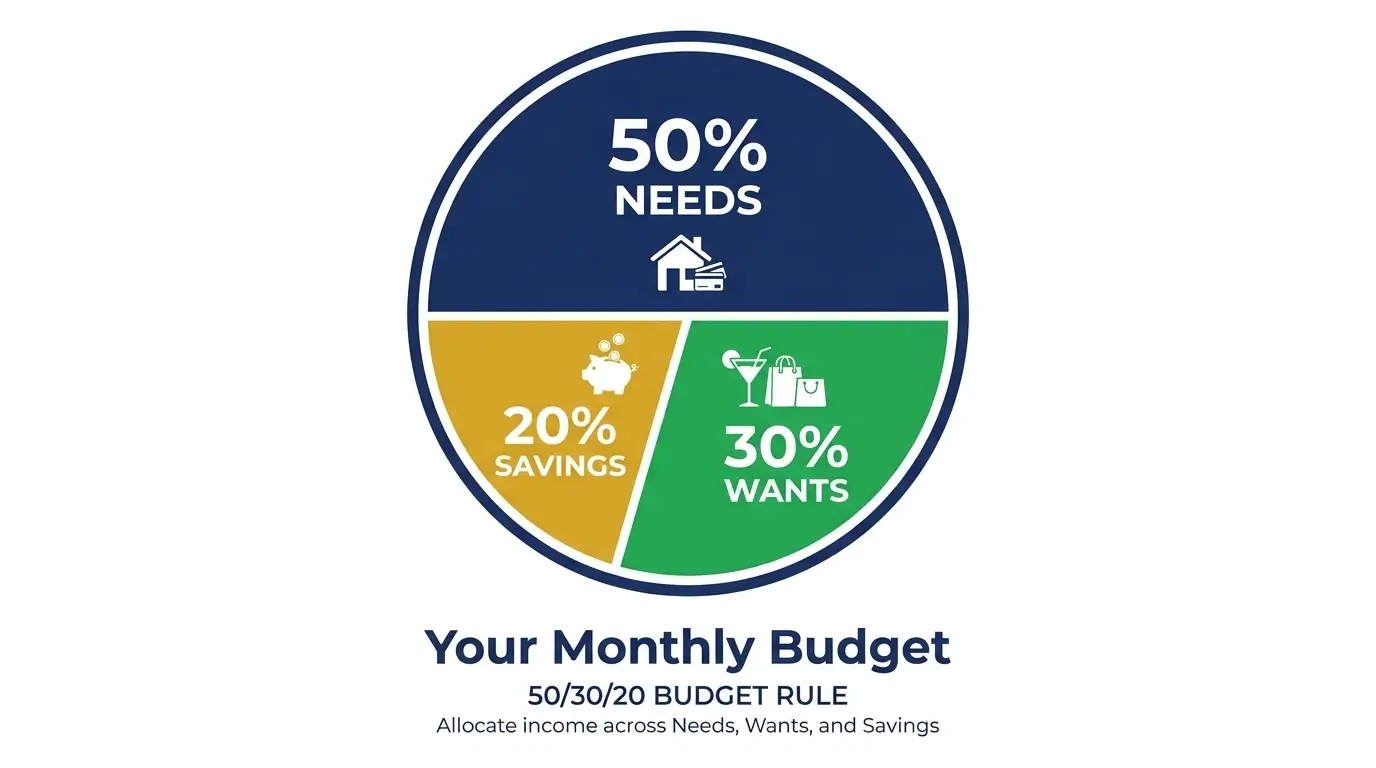
The 50/30/20 budget rule is a simple budgeting framework that allocates your after-tax income into three categories:
- 50% for Needs — Essential expenses you cannot live without
- 30% for Wants — Non-essential spending that improves your quality of life
- 20% for Savings and Debt Repayment — Building your financial future
The rule was popularized by US Senator Elizabeth Warren and her daughter Amelia Warren Tyagi in their 2005 book “All Your Worth: The Ultimate Lifetime Money Plan.” It has since become one of the most widely recommended budgeting frameworks by financial advisors, journalists, and personal finance educators.
The beauty of the 50/30/20 rule is its simplicity: instead of creating detailed spending categories for 20 different expense types, you only need to classify your spending into three buckets. This makes it sustainable for people who find traditional detailed budgets too complex to maintain.
Breaking Down Each Category
50% — Needs (Essential Expenses)
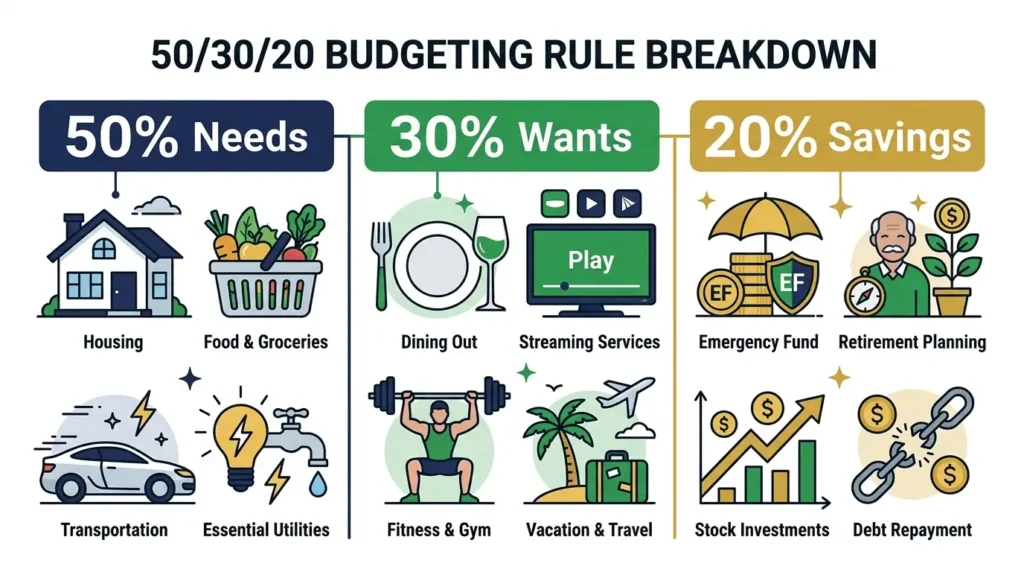
Needs are expenses that are necessary for basic living. These are non-negotiable — you cannot reasonably eliminate them without major life changes. The 50% category includes:
- Housing: Rent or mortgage payments, property taxes, home insurance
- Utilities: Electricity, water, gas, internet (basic plan)
- Groceries: Food and household supplies (not dining out)
- Transportation: Car payment, gas, public transit, car insurance
- Health insurance: Premiums and essential medical costs
- Minimum debt payments: The required minimums on credit cards and loans
- Childcare: If required for you to work
The test for a “need”: Ask yourself — “Would serious harm or major life disruption result if I didn’t pay this?” If yes, it’s a need. If no, it’s likely a want.
30% — Wants (Non-Essential Spending)
Wants are expenses that enhance your life but are not strictly necessary. They are the choices you make about how to spend your discretionary income. Examples include:
- Dining out and takeaway food
- Streaming subscriptions (Netflix, Spotify, Disney+)
- Gym memberships
- Hobbies and recreational activities
- Vacations and travel
- Shopping for clothing beyond basics
- Upgraded phone or internet plan beyond the minimum needed
- Entertainment — concerts, movies, sporting events
The wants category is not about eliminating enjoyment from your life — it’s about being intentional with your discretionary spending. The 30% allocation is generous enough to enjoy life while keeping finances healthy.
20% — Savings and Debt Repayment
This category is your financial future. The 20% covers:
- Emergency fund: Building 3 to 6 months of expenses in savings
- Retirement savings: Contributions to your 401(k) and Roth IRA
- Debt repayment above minimums: Extra payments to pay down credit cards or loans faster
- Savings goals: Down payment for a home, car, education, etc.
- Investment contributions: Brokerage account, index funds
Priority order for the 20%: First build a starter emergency fund ($1,000), then pay off high-interest debt, then build your full emergency fund (3–6 months), then invest for retirement. Once your emergency fund is complete, the full 20% should go toward retirement and investing.
50/30/20 Budget Examples at Different Income Levels
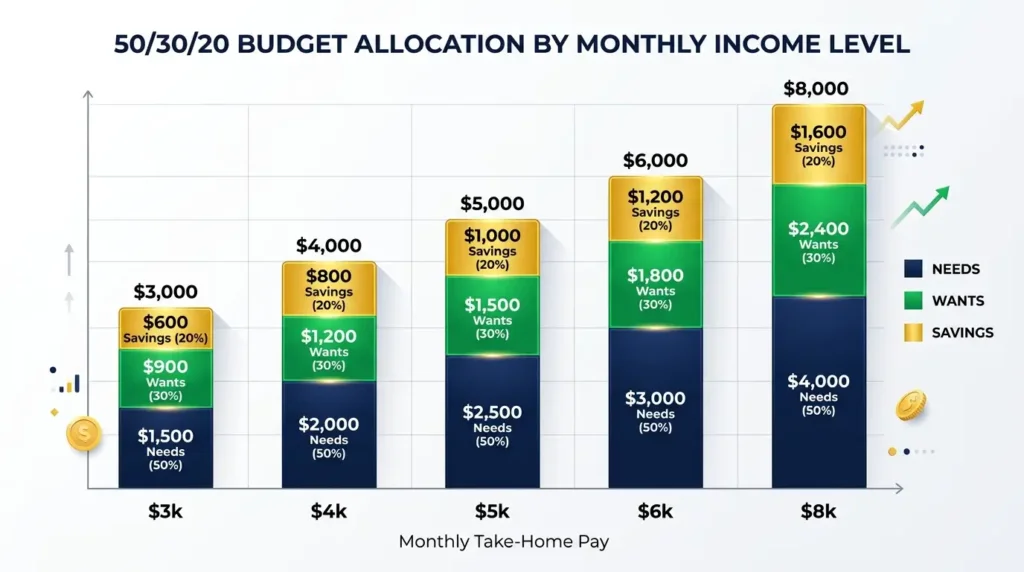
Here is how the 50/30/20 rule looks in practice across different income levels. All amounts are based on after-tax (take-home) income:
| After-Tax Income | 50% Needs | 30% Wants | 20% Savings |
|---|---|---|---|
| $3,000/month | $1,500 | $900 | $600 |
| $4,000/month | $2,000 | $1,200 | $800 |
| $5,000/month | $2,500 | $1,500 | $1,000 |
| $6,000/month | $3,000 | $1,800 | $1,200 |
| $8,000/month | $4,000 | $2,400 | $1,600 |
Note: These are after-tax figures. If you earn $60,000 per year in gross income, your after-tax take-home pay might be approximately $48,000 to $50,000 depending on your state, tax filing status, and deductions — roughly $4,000 to $4,200 per month.
How to Apply the 50/30/20 Rule: Step by Step
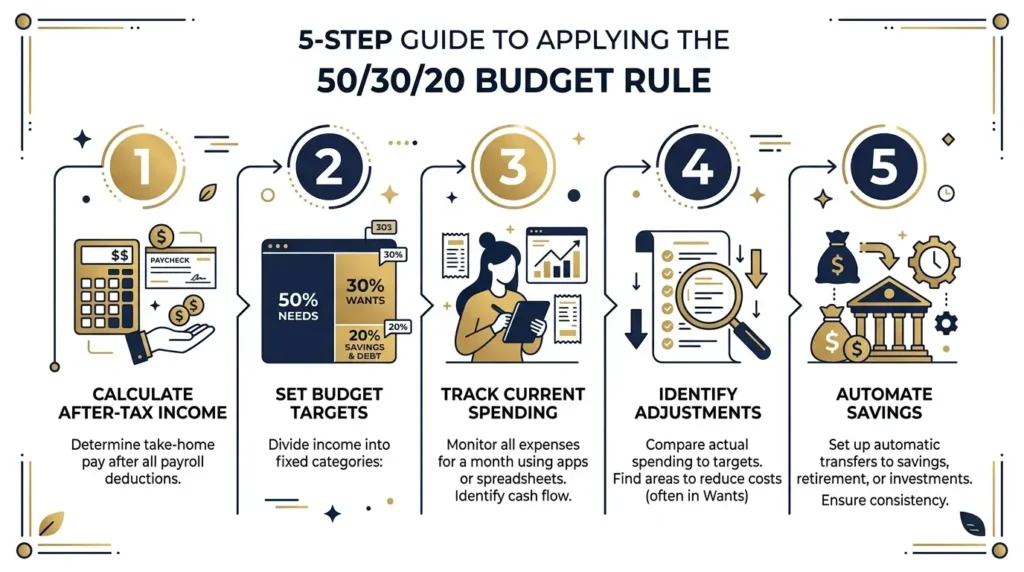
Step 1: Calculate Your After-Tax Income
Start with your actual take-home pay — the amount deposited into your bank account after taxes and deductions. If you have multiple income streams, add them all together. If your income varies (freelance, gig work), use a conservative average of the past 3 months.
Step 2: Calculate Your Budget Targets
Multiply your monthly take-home pay by each percentage:
- Needs: Monthly income × 0.50
- Wants: Monthly income × 0.30
- Savings: Monthly income × 0.20
Step 3: Track Your Current Spending for One Month
Before making changes, understand where your money currently goes. Review your last month’s bank statements and credit card statements. Categorize every expense as a need, want, or savings. This baseline reveals exactly where you’re over or under the targets — and what needs to change.
Step 4: Identify What Needs Adjusting
Compare your current spending to your budget targets. Most people find they’re overspending on wants and underfunding savings. The most common issue: housing costs exceeding 30% of income alone, pushing the entire “needs” category over the 50% target.
Step 5: Make Adjustments and Automate
Reduce wants spending to bring totals in line with targets. Then automate your savings — set up automatic transfers to your savings account and retirement contributions on payday. When savings come out automatically, you’re far less likely to overspend. Read our guide on how to build an emergency fund to prioritize the first piece of your 20%.
What If My Needs Exceed 50%?
This is the most common challenge — especially in high cost-of-living cities where housing alone can consume 40% or more of income. If your needs exceed 50%, you have a few options:
- Reduce housing costs: Get a roommate, refinance your mortgage, move to a less expensive area
- Reduce transportation costs: Downsize your car, use public transit, carpool
- Increase income: Side hustle, raise, additional part-time work
- Adjust the percentages: Use a 60/20/20 or 70/20/10 split temporarily while working to reduce fixed costs
The 50/30/20 rule is a guideline, not a rigid law. The most important ratio to protect is the 20% for savings — even if needs temporarily exceed 50%, try never to reduce your savings allocation below 10% to 15%.
50/30/20 Rule: Advantages and Limitations
| ✅ Advantages | ❌ Limitations |
|---|---|
| Extremely simple — only 3 categories | Not detailed enough for serious debt payoff |
| Flexible — works at any income level | Difficult in high cost-of-living cities |
| Prevents over-restriction (30% for wants) | 30% wants may be too generous for low incomes |
| Forces consistent savings habit (20%) | Doesn’t account for irregular expenses |
| Easy to track and maintain long-term | May not optimize for aggressive wealth building |
50/30/20 vs Other Budgeting Methods
50/30/20 vs Zero-Based Budgeting
Zero-based budgeting assigns every dollar to a specific category until you have $0 “unassigned.” It requires more time and detail but gives you maximum control over your spending. The 50/30/20 rule is better for beginners or people who want a low-maintenance system. Zero-based budgeting is better for people with specific financial goals or who need strict spending control. Read our complete guide on zero-based budgeting for a full comparison.
50/30/20 vs Envelope System
The envelope system allocates physical (or digital) cash to spending categories. It’s highly effective for curbing overspending but requires more daily attention than the 50/30/20 rule. The 50/30/20 rule is more practical for most modern consumers who primarily use cards and digital payments.
50/30/20 vs Pay Yourself First
“Pay yourself first” means automatically transferring your savings amount the moment you get paid, then spending the rest however you like. This approach prioritizes savings above all else. The 50/30/20 rule combines elements of pay yourself first (the 20% savings target) with structured spending categories (50% needs, 30% wants).
Frequently Asked Questions About the 50/30/20 Rule
Is the 50/30/20 rule realistic?
For most middle-income Americans, yes. It becomes challenging in high cost-of-living areas where housing alone can push needs above 50%. In those cases, adjust the percentages while keeping savings as close to 20% as possible — even 10% to 15% is far better than nothing.
Does the 50/30/20 rule work for low incomes?
It’s more challenging at lower income levels because basic needs often consume more than 50% of income. At lower incomes, a modified version — such as 60/20/20 or even 70/10/20 — may be more realistic while still preserving the savings habit.
Where do taxes go in the 50/30/20 rule?
The 50/30/20 rule applies to your after-tax income — your actual take-home pay after all taxes have been deducted. Taxes are already accounted for before you start the calculation.
Is a gym membership a need or a want?
A gym membership is typically a want — you could exercise for free outdoors or at home. However, if your job requires physical fitness or your doctor has prescribed exercise for a health condition, it could reasonably be classified as a need. The categorization depends on your specific circumstances.
What is the best app for the 50/30/20 budget?
Several apps support the 50/30/20 framework: YNAB (You Need a Budget), Mint, Personal Capital, and Simplifi by Quicken all allow you to set budget categories aligned with the 50/30/20 rule. Many banks and credit unions also have built-in budgeting tools in their mobile apps. Check our guide on the best budgeting apps for 2026 for a full comparison.
The Bottom Line
The 50/30/20 budget rule is one of the best starting points for anyone new to budgeting. Its simplicity makes it sustainable, its flexibility makes it adaptable to different incomes and life situations, and its built-in 20% savings mandate ensures you’re always building toward financial security.
Start today: calculate your after-tax monthly income, multiply by 50%, 30%, and 20%, and compare those targets to what you actually spent last month. The gaps you discover will tell you exactly what to change. Pair this with an automated savings transfer on payday and you’ll have one of the most effective personal finance systems available — in about 30 minutes of setup.
Ready to go deeper? Read our guide on zero-based budgeting for a more detailed approach, or check our list of the best budgeting apps for 2026 to find the right tool to track your 50/30/20 plan. And if you’re wondering where to put your 20% savings, our guide on how to build an emergency fund is the perfect first step.
Disclaimer: This article is for informational purposes only and does not constitute financial advice. Budget percentages may need to be adjusted based on individual income, location, and financial circumstances.