


Is a money market account FDIC insured? In many cases, yes—but only when the account is a qualifying deposit account held at an FDIC-insured bank.
The FDIC specifically lists money market deposit accounts (MMDAs) among the deposit products it insures. Coverage is automatic when an eligible deposit account is held at an FDIC-insured institution. FDIC
The standard insurance amount is $250,000 per depositor, per FDIC-insured bank, for each account ownership category. FDIC
However, there’s an important distinction: a money market deposit account isn’t the same thing as a money market mutual fund. Mutual funds are investment products and aren’t covered by FDIC deposit insurance. FDIC
If you’re new to these accounts, first read our guide explaining what a money market account is.
Are Money Market Accounts Covered by FDIC Insurance?
Yes, an eligible money market deposit account at an FDIC-insured bank is covered by FDIC deposit insurance.
According to the FDIC, covered deposit products include checking accounts, savings accounts, money market deposit accounts and certificates of deposit. FDIC
You don’t have to purchase FDIC insurance separately. Coverage is automatic when the qualifying deposit is held at an insured bank. FDIC
But two conditions matter:
The institution must be FDIC-insured, and the product must be an eligible deposit account.
Simply seeing the words “money market” in a product name doesn’t automatically mean it’s FDIC-insured.
How Much FDIC Insurance Does a Money Market Account Have?
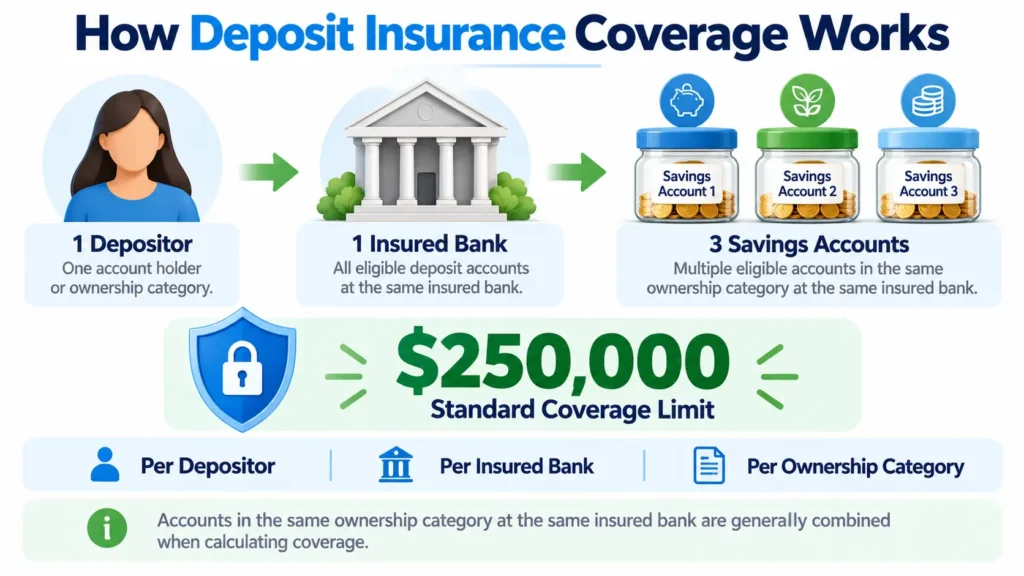
The standard FDIC insurance amount is:
$250,000 per depositor, per FDIC-insured bank, per ownership category. FDIC
For example, suppose you have a single-owner money market deposit account containing $100,000 at an FDIC-insured bank and no other deposits in the same ownership category at that bank.
That $100,000 would generally fall within the standard $250,000 insurance limit.
But the calculation becomes more important when you have multiple deposit accounts at the same bank.
Does Each Money Market Account Get $250,000 of FDIC Insurance?
Not necessarily.
This is one of the most important points to understand.
FDIC coverage isn’t simply $250,000 for every account you open.
Deposits held by the same depositor in the same ownership category at the same insured bank are generally added together when determining coverage. FDIC
For example, imagine you have at the same FDIC-insured bank:
| Account | Balance |
|---|---|
| Money Market Account | $150,000 |
| Savings Account | $75,000 |
| Checking Account | $50,000 |
| Total | $275,000 |
If all three are single-owner deposits belonging to the same person and fall within the same ownership category, they’re generally aggregated for FDIC insurance purposes.
The standard coverage for that ownership category would be $250,000, meaning $25,000 would exceed the standard insured amount in this simplified example. FDIC
Can You Have More Than $250,000 Insured?
Yes, depending on how deposits are legally owned and structured.
The FDIC uses different ownership categories, including single accounts, joint accounts, certain retirement accounts, trust accounts and certain business accounts.
Deposits held in qualifying different ownership categories can receive separate coverage. FDIC
For example, eligible single-owner deposits and an eligible ownership interest in joint deposits at the same bank can be insured separately under their respective ownership categories.
That doesn’t mean simply opening multiple accounts automatically increases coverage. The ownership category and FDIC requirements matter.
For larger balances or more complicated ownership arrangements, use the FDIC’s official Electronic Deposit Insurance Estimator (EDIE).
Money Market Account vs. Money Market Fund: The Critical Difference
These two products have similar names but aren’t the same.
| Feature | Money Market Deposit Account | Money Market Mutual Fund |
|---|---|---|
| Type | Bank deposit account | Investment product |
| Offered through | Banks/credit unions | Investment companies/brokerages |
| FDIC insurance at eligible bank | Yes | No |
| Value can fluctuate | Generally deposit balance | Yes |
| Investment risk | Not investment-market risk | Yes |
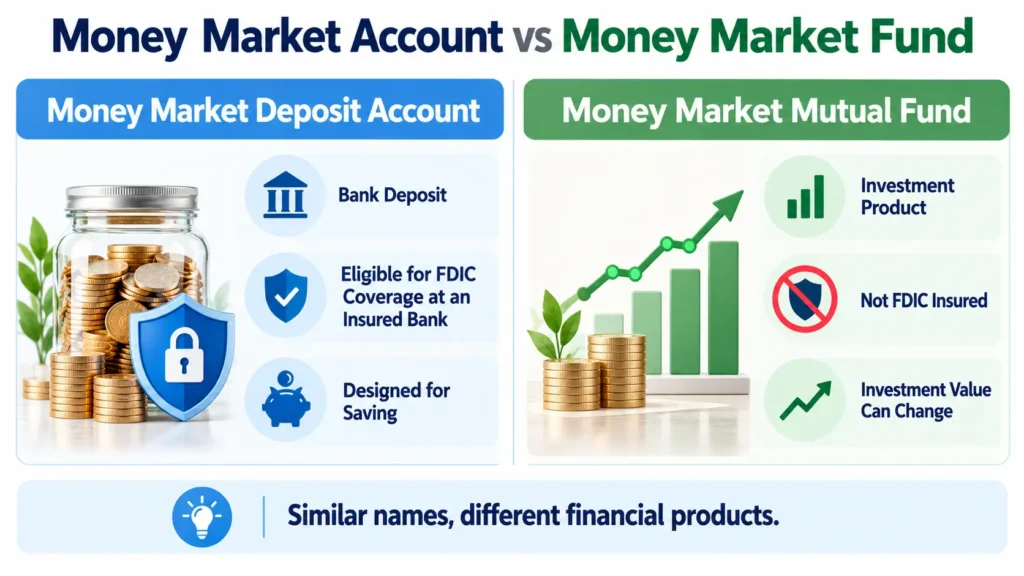
The FDIC explicitly includes money market deposit accounts among insured deposit products and explicitly excludes mutual funds from FDIC coverage. FDIC
So if you’re evaluating a product labeled “money market,” determine whether it’s a deposit account or mutual fund before assuming it has federal deposit insurance.
What Happens If an FDIC-Insured Bank Fails?
FDIC insurance exists to protect eligible deposits if an insured bank fails.
Coverage includes eligible principal and accrued interest through the date of the bank’s failure, subject to the applicable insurance limits. FDIC
Funds above the applicable insurance limit aren’t guaranteed by FDIC deposit insurance. Depositors with uninsured funds may recover some portion through the receivership process, but recovery isn’t guaranteed and can take time. FDIC
That’s why understanding your coverage before holding a large balance at one institution is important.
Are Money Market Accounts at Credit Unions Insured?
Federally insured credit unions use a different system.
Instead of the FDIC, qualifying share accounts at federally insured credit unions are protected by the National Credit Union Share Insurance Fund, administered by the NCUA.
The NCUA states that individual accounts at federally insured credit unions are insured up to $250,000, with additional rules for joint accounts, retirement accounts and trusts. NCUA
So, broadly:
Bank → FDIC
Federally insured credit union → NCUA
Both systems provide federal protection for qualifying deposits/share accounts, but their rules and terminology aren’t identical.
Are Online Money Market Accounts FDIC Insured?
They can be.
Whether a bank operates primarily online or through physical branches doesn’t determine FDIC coverage.
What matters is whether the institution is FDIC-insured and whether the product is an eligible deposit account.
Before opening an online money market account, verify the institution rather than relying only on marketing language.
The FDIC recommends using its BankFind tool to determine whether a bank is FDIC-insured. FDIC
You can use the official FDIC BankFind Suite to check an institution.
Does a Higher APY Affect FDIC Insurance?
No.
The APY offered by a money market account doesn’t determine whether eligible deposits receive FDIC insurance.
A high APY doesn’t automatically make an account uninsured, and a low APY doesn’t make it safer.
The relevant questions are whether the bank is FDIC-insured, whether the product is an eligible deposit, how much you have deposited and how your accounts are owned.
If you’re comparing yields, see our guide to current money market account rates.
Does the Minimum Balance Affect FDIC Insurance?
The account’s minimum balance requirement is separate from its FDIC coverage.
A bank may require a particular amount to:
open the account,
earn the advertised APY,
or avoid a monthly fee.
Those requirements don’t replace FDIC insurance rules.
Our guide to money market account minimum balance requirements explains these distinctions.
Are High-Balance Money Market Accounts Safe?
A large balance doesn’t automatically mean the entire amount is FDIC-insured.
If your deposits exceed the standard coverage applicable to your ownership category at one bank, part of the balance may be uninsured.
For example, having $300,000 in a single-owner money market account doesn’t mean all $300,000 automatically receives standard FDIC protection.
The FDIC’s standard amount is $250,000 per depositor, per insured bank, for each ownership category. FDIC
People with balances above that amount should determine their actual coverage based on their complete deposit structure rather than assuming all funds are insured.
Does Having Accounts at Different Banks Increase FDIC Coverage?
Potentially, yes.
FDIC-insured deposits held at separately chartered insured banks are insured separately.
The FDIC explains that deposits at Bank A are insured separately from eligible deposits at Bank B. However, different branches of the same insured bank aren’t treated as separate banks for this purpose. FDIC
This distinction can become important for people holding large cash balances.
How to Check Whether Your Money Market Account Is FDIC Insured
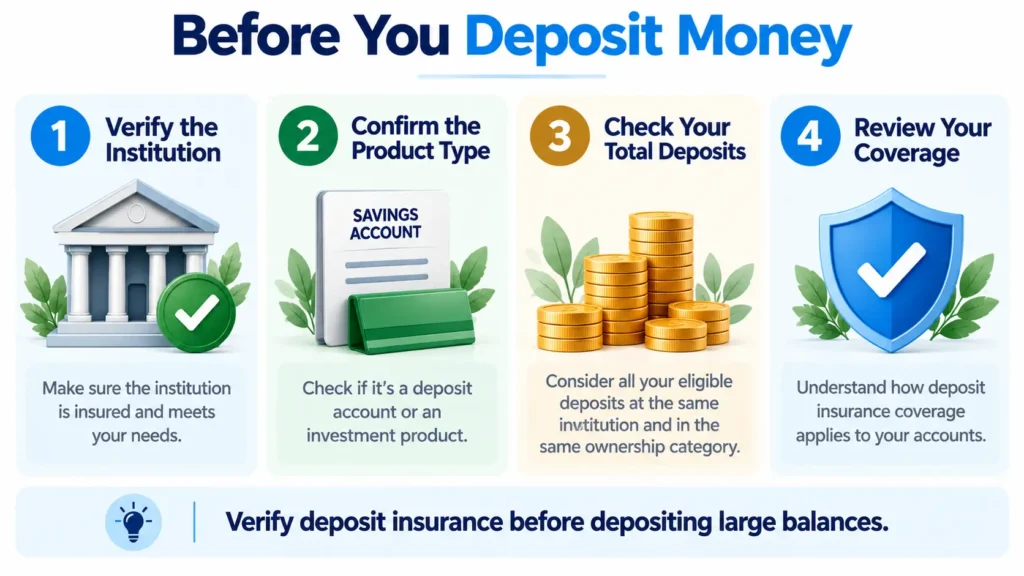
Before depositing money, verify:
1. The institution
Confirm that the bank itself is FDIC-insured.
2. The product
Make sure you’re opening a money market deposit account, not purchasing a money market mutual fund.
3. Your total deposits
Consider all eligible deposits you already hold in the same ownership category at that bank.
4. Your ownership category
Single, joint, retirement and trust deposits can be treated differently under FDIC rules.
5. Your total insurance coverage
For larger or more complicated balances, use the FDIC’s EDIE calculator rather than estimating coverage yourself.
For choosing an account after checking these factors, see our best money market accounts of 2026.
Money Market Account Safety Checklist
Before opening an account, ask:
Is the institution FDIC-insured or federally insured by the NCUA?
Is this actually a deposit account rather than an investment fund?
How much do I already have at this institution?
Are my deposits in the same ownership category?
Would any portion exceed my applicable insurance coverage?
These questions are more useful for evaluating deposit protection than simply looking for the words “FDIC insured” in an advertisement.
Frequently Asked Questions
Are money market accounts FDIC insured?
Money market deposit accounts at FDIC-insured banks are eligible for FDIC deposit insurance. The standard insurance amount is $250,000 per depositor, per insured bank, for each ownership category. FDIC
Are all money market accounts FDIC insured?
No. The institution must be FDIC-insured and the product must qualify as a deposit. Money market mutual funds, for example, aren’t FDIC-insured. FDIC
Is a money market account safe if the bank fails?
Eligible deposits at an FDIC-insured bank are protected if the bank fails, subject to applicable coverage limits and requirements. FDIC
Is a money market fund FDIC insured?
No. Money market mutual funds are mutual funds, and the FDIC doesn’t insure mutual funds. FDIC
Is each bank account insured for $250,000?
Not necessarily. Deposits owned by the same depositor in the same ownership category at the same bank are generally aggregated when calculating coverage. FDIC
Can I have more than $250,000 of FDIC insurance?
Yes. Depending on your ownership categories and account structure, you may qualify for more than $250,000 of coverage at one insured bank. FDIC
Are money market accounts at credit unions FDIC insured?
Credit unions generally aren’t insured by the FDIC. Qualifying accounts at federally insured credit unions are instead protected by the NCUA-administered Share Insurance Fund. NCUA
Does FDIC insurance cover interest earned?
FDIC coverage includes principal and accrued interest through the date an insured bank fails, subject to the applicable insurance limit.
Final Thoughts
A money market account can be FDIC insured when it’s an eligible money market deposit account held at an FDIC-insured bank.
The key number to remember is $250,000 per depositor, per insured bank, for each ownership category—not simply $250,000 for every account. FDIC
And always distinguish a money market deposit account from a money market mutual fund, because mutual funds aren’t covered by FDIC deposit insurance. FDIC
Once you’ve verified deposit protection, you can compare money market account rates and review our best money market accounts of 2026 to evaluate other account features.
Financial Disclaimer: This article is for educational and informational purposes only and doesn’t constitute personalized financial, investment, tax or legal advice. Deposit insurance depends on the institution, product, ownership structure and other applicable requirements. Verify your specific coverage with the FDIC, NCUA or financial institution.